
[논문 리뷰] Wireless Multi-Agent Generative AI: From Connected Intelligence to Collective Intelligence
이 논문은 무선 네트워크에서 온-디바이스 다중 에이전트 생성 AI를 위한 기초를 제시하고, planning, 게임 이론적 상호작용 및 시맨틱 커뮤니케이션을 분석하여 에지에서의 집단 지능을 가능하게 하며, 온-디바이스 LLM을 사용한 네트워크 에너지 절감 사례 연구를 보여준다.
The convergence of generative large language models (LLMs), edge networks, and multi-agent systems represents a groundbreaking synergy that holds immense promise for future wireless generations, harnessing the power of collective intelligence and paving the way for self-governed networks where intelligent decision-making happens right at the edge. This article puts the stepping-stone for incorporating multi-agent generative artificial intelligence (AI) in wireless networks, and sets the scene for realizing on-device LLMs, where multi-agent LLMs are collaboratively planning and solving tasks to achieve a number of network goals. We further investigate the profound limitations of cloud-based LLMs, and explore multi-agent LLMs from a game theoretic perspective, where agents collaboratively solve tasks in competitive environments. Moreover, we establish the underpinnings for the architecture design of wireless multi-agent generative AI systems at the network level and the agent level, and we identify the wireless technologies that are envisioned to play a key role in enabling on-device LLM. To demonstrate the promising potentials of wireless multi-agent generative AI networks, we highlight the benefits that can be achieved when implementing wireless generative agents in intent-based networking, and we provide a case study to showcase how on-device LLMs can contribute to solving network intents in a collaborative fashion. We finally shed lights on potential challenges and sketch a research roadmap towards realizing the vision of wireless collective intelligence.
연구 동기 및 목표
- 무선 네트워크에 생성적 에이전트를 통합하여 에지 기반의 집단 지능을 달성하고자 한다.
- 6G 무선 시스템에서 온-디바이스 LLM의 가능 기술과 아키텍처를 식별한다.
- 여러 LLM 에이전트 간의 계획, 추론, 게임 이론적 상호작용을 탐구한다.
- 에이전트 간 지식과 작업을 효율적으로 공유하기 위한 시맨틱 커뮤니케이션의 중요성을 강조한다.
- 멀티에이전트 LLM에 의해 안내되는 에너지 절감 의도를 보여주는 사례 연구를 제시하고 도전과 로드맵을 논의한다.
제안 방법
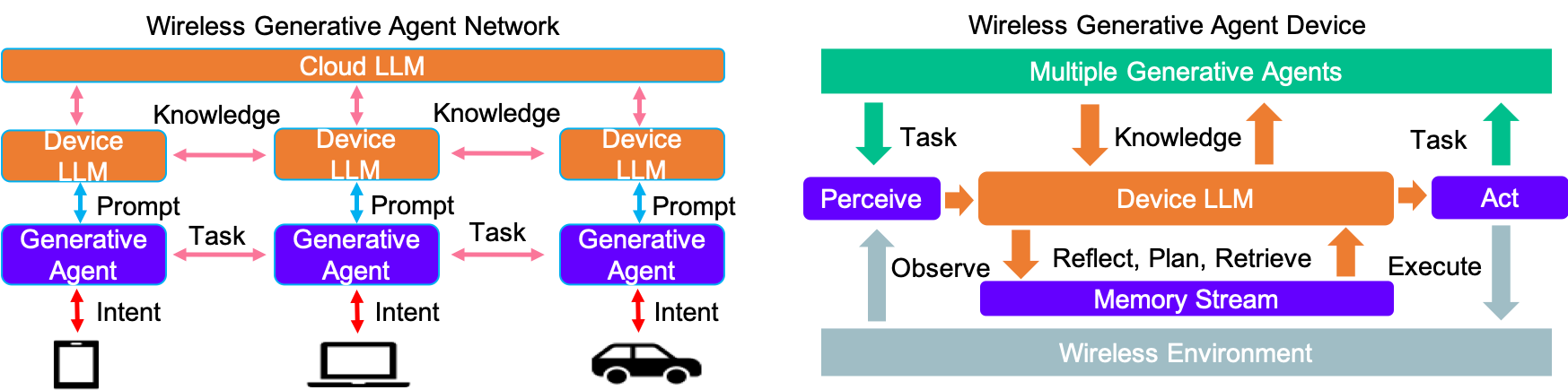
- 여러 온-디바이스 LLM이 상호 작용하여 의도를 에지 실행을 위한 일련의 작업으로 분해하는 아키텍처를 설명한다.
- 시스템-2 수준의 인지(연쇄적 사고, 자기 일관성, 사고의 나무)를 가능하게 하는 계획 및 추론 기법을 논의한다.
- 협력적 행동을 도출하고 에이전트 간 커뮤니케이션 비용을 줄이기 위한 다중 에이전트 LLM 게임 및 강화 학습을 도입한다.
- 원시 데이터가 아닌 작업 관련 지식을 전달하기 위한 시맨틱 정보 및 커뮤니케이션을 옹호한다.
- 네트워크 전반의 최적화를 위한 사용자 4인을 활용한 에너지 절감 게임을 해결하는 사례 연구를 제시한다.

실험 결과
연구 질문
- RQ1온-디바이스 LLM이 클라우드 기반 LLM에 의존하지 않고도 네트워크 수준의 목표를 달성하기 위해 협력적으로 계획, 추론, 행동할 수 있는가?
- RQ2무선 생성 에이전트 간의 어떤 아키텍처와 상호작용이 네트워크 에지에서 효율적인 집단 지능을 가능하게 하는가?
- RQ3계획, 추론 및 MARL이 무선 환경에서 협력적이면서도 경쟁적인 다중 에이전트 행동을 달성하는 데 어떤 역할을 하는가?
- RQ4시맨틱 커뮤니케이션이 다중 에이전트 무선 네트워크에서 LLM의 작업 관련 지식을 보존하면서 정보 교환을 어떻게 줄일 수 있는가?
- RQ5에지 네트워크의 Telecom 도메인 LLM에서의 주요 도전과제(예: 현혹, 자가 복제 개념, 리소스 관리 등)와 향후 방향은 무엇인가?
주요 결과
- 온-디바이스 다중 에이전트 LLM은 폐쇄 루프(계획, 실행, 최적화)에서 네트워크 목표를 달성하기 위해 협력적으로 계획하고 telecom 작업을 해결할 수 있다.
- 게임 이론과 MARL은 에이전트 간의 상호 작용을 모델링하고 개별 KPI를 고려하면서 협력 정책을 학습하는 프레임워크를 제공한다.
- 시맨틱 커뮤니케이션은 작업 특정 지식을 전달하여 데이터 교환을 줄이고 에이전트 간 협업을 개선할 수 있다.
- 사용자 4인을 활용한 에너지 절감 사례 연구는 온-디바이스 LLM이 속도 제약을 유지하면서 전력 절감 목표를 달성할 수 있음을 보여주지만, 에이전트 수가 늘어나면 다에이전트 조정이 더 어려워진다.
- 논문은 Telecom 도메인 특화 LLM을 위한 필요한 구성요소를 식별하고, 현혹, 자기 복제 개념, 온-디바이스 LLM의 리소스 관리와 같은 도전과제를 강조한다.
더 나은 연구,지금 바로 시작하세요
연구 설계부터 논문 작성까지, 연구 시간을 획기적으로 줄여보세요.
카드 등록 없음 · 무료 플랜 제공
이 리뷰는 AI가 만들고, 인간 에디터가 검토했습니다.