
[논문 리뷰] X-Ray Detection of the Galaxy's Missing Baryons in the Circum-Galactic Medium of L$^*$ Galaxies
이 연구는 L∗은하의 XMM-Newton 및 찰라 스펙트럼을 통합한 결과에서 O vii Kα 흡수의 첫 번째 고의미 검출(4.2–5.6σ)을 보고한다. 이는 log T ≈ 5.8–6.3 K(즉, T ≈ 10⁶ K)의 뜨거운, 비틀림된 은하간 매질(CGM)을 특정한 것으로, 검출된 X선 환은 일반적인 L∗은하에서 부족한 빈도를 70–120% 포함하고 있으며, 오랫동안 지속된 은하 부족 빈도 문제의 주요 성분을 해결한다.
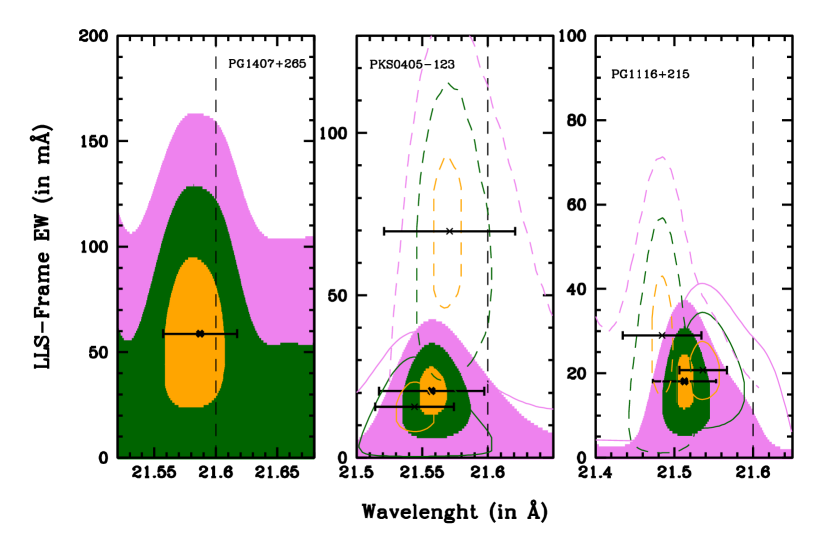
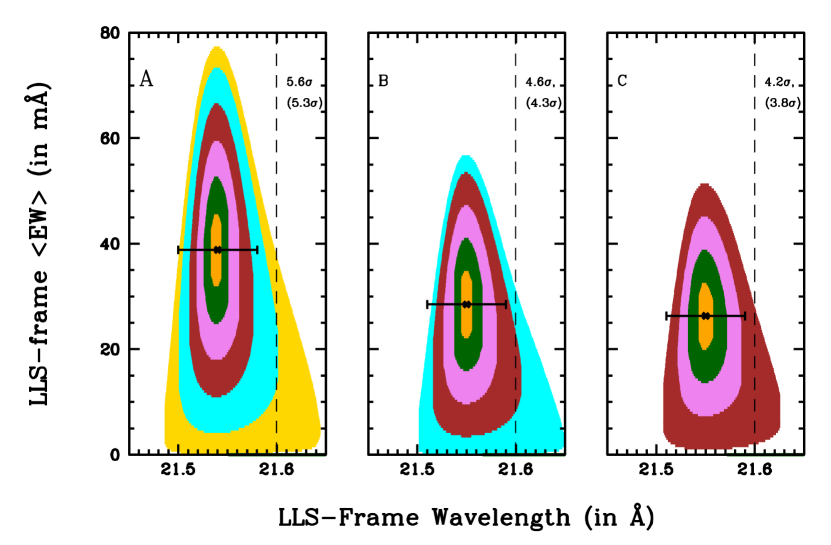
The amount of baryons hosted in the disks of galaxies is lower than expected based on the mass of their dark-matter halos and the fraction of baryon-to-total matter in the universe, giving rise to the so called galaxy missing-baryon problem. The presence of cool circum-galactic matter gravitationally bound to its galaxy's halo up to distances of at least ten times the size of the galaxy's disk, mitigates the problem but is far from being sufficient for its solution. It has instead been suggested, that the galaxy missing baryons may hide in a much hotter gaseous phase of the circum-galactic medium, possibly near the halo virial temperature and co-existing with the cool phase. Here we exploit the best available X-ray spectra of known cool circum-galactic absorbers of L$^*$ galaxies to report the first direct high-statistical-significance (best estimates ranging from $4.2-5.6σ$, depending on fitting methodology)} detection of associated OVII absorption in the stacked XMM and Chandra spectra of three quasars. We show that these absorbers trace hot medium in the X-ray halo of these systems, at logT(in k)$\simeq 5.8-6.3$ K (comprising the halo virial temperature T$_{vir} \simeq 10^6$ K). We estimate masses of the X-ray halo within 1 virial radius within the interval M$_{hot-CGM}\simeq (1-1.7) imes 10^{11} (Z/0.3 Z_{\odot})^{-1}$ M$_{\odot}$. For these systems, this corresponds to galaxy missing baryon fractions in the range $ξ_b = M_{hot-CGM}/M_{missing}\simeq (0.7-1.2) (Z/0.3 Z_{\odot})^{-1}$, thus potentially closing the galaxy baryon census in typical L$^*$ galaxies. Our measurements contribute significantly to the solution of the long-standing galaxy missing baryon problem and to the understanding of the continuous cycle of baryons in-and-out of galaxies throughout the life of the universe.
연구 동기 및 목표
- 은하 디스크에서 관측된 빈도가 천체역학 예측에 못 미치는, 은하 부족 빈도 문제를 해결하기 위해.
- 부족한 빈도가 은하 허브의 비틀림 온도 근처의 뜨거운, 비틀림된 상태의 은하간 매질(CGM)에 존재한다는 가설을 시험하기 위해.
- 쿼라서 흡수선을 이용한 고해상도 X선 스펙트럼 분석을 통해 뜨거운 CGM 단계를 검출하고 특성화하기 위해.
- L∗은하에서 뜨거운 CGM의 질량과 빈도 비율을 추정하고, 총 부족 빈도 예산에 기여하는지를 평가하기 위해.
제안 방법
- 냉각된 CGM 흡수체가 알려진 L∗은하 뒤의 3개의 쿼라서 XMM-Newton(RGS) 및 찰라(LEDG) 관측의 통합 X선 스펙트럼을 사용하였다.
- 18.96 Å 및 15.01 Å의 고정 프레임 파장에서 O vii Kα 및 Kβ 흡수선의 검출을 위해 고해상도 스펙트럼 분석을 수행하였다.
- 적합 방법론의 변동을 고려하여, O vii 흡수의 검출을 확인하기 위해 통계적의미 검정(4.2–5.6σ)을 사용하였다.
- 충돌성 이온화 평형(CIE)과 광이온화 평형(PIE)을 사용하여 이온 상태를 모델링하고 관측된 이온 농도를 해석하였다.
- 관측된 O vii 열역학적 밀도와 온도 제약 조건을 이용하여, 하나의 비틀림 반경 내에서 뜨거운 CGM 질량을 추정하였다.
- 금속성(Z)을 보정하여, 뜨거운 CGM의 빈도 비율을 총 부족 빈도에 비해 계산하였다.
실험 결과
연구 질문
- RQ1L∗은하에서 뜨거운, 비틀림된 상태의 은하간 매질(CGM)에 대한 직접적인 X선 증거가 존재하는가?
- RQ2뜨거운 CGM 단계의 온도와 질량는 무엇이며, 이는 은하 허브의 비틀림 온도와 일치하는가?
- RQ3뜨거운 CGM는 일반적인 L∗은하의 부족 빈도의 어느 정도를 차지하는가?
- RQ4관측된 O vii 흡수선은 CIE 및 PIE 모델의 예측과 어떻게 비교되는가?
주요 결과
- 이 연구는 3개의 L∗은하에 대한 통합 X선 스펙트럼에서 O vii Kα 흡수의 첫 번째 고의미 검출(4.2–5.6σ)을 보고한다.
- 검출된 기체의 온도는 log T ≈ 5.8–6.3 K로, L∗은하의 허브 비틀림 온도(Tvir ≈ 10⁶ K)와 일치한다.
- 비틀림 반경 내에서 뜨거운 CGM의 질량는 Mhot-CGM ≈ (1–1.7) × 10¹¹ M⊙ (Z/0.3Z⊙)⁻¹로 추정된다.
- 뜨거운 CGM는 L∗은하에서 부족한 빈도의 70–120%를 차지하며, ξb ≈ (0.7–1.2)(Z/0.3Z⊙)⁻¹로 나타난다.
- 기체의 이온화 상태는 충돌성 이온화 평형(CIE)에 의해 가장 잘 설명되며, 관측된 온도에서 O vii는 주요 산소 이온이다.
- 결과는 뜨거운 CGM 단계가 일반적인 L∗은하에서 빈도 수치를 완성하며, 은하 진화의 오랫동안 지속된 문제를 해결함을 시사한다.
더 나은 연구,지금 바로 시작하세요
논문 읽기부터 검토까지, 연구 시간을 획기적으로 줄여보세요.
카드 등록 없음 · 무료 플랜 제공
이 리뷰는 AI가 만들고, 인간 에디터가 검토했습니다.