
[논문 리뷰] 1100 days in the life of the supernova 2018ibb -- The best pair-instability supernova candidate, to date
SN 2018ibb는 현재까지 가장 잘 알려진 페어-불안정 초신성 후보로 식별되었으며, 확산 시간이 길고 니켈 질량이 PISN 예측과 일치하며, 중앙 엔진이 작동한다는 증거가 없다.
Abridged - Stars with ZAMS masses between 140 and $260 M_\odot$ are thought to explode as pair-instability supernovae (PISNe). During their thermonuclear runaway, PISNe can produce up to several tens of solar masses of radioactive nickel, resulting in luminous transients similar to some superluminous supernovae (SLSNe). Yet, no unambiguous PISN has been discovered so far. SN2018ibb is a H-poor SLSN at $z=0.166$ that evolves extremely slowly compared to the hundreds of known SLSNe. Between mid 2018 and early 2022, we monitored its photometric and spectroscopic evolution from the UV to the NIR with 2-10m class telescopes. SN2018ibb radiated $>3 imes10^{51} m erg$ during its evolution, and its bolometric light curve reached $>2 imes10^{44} m erg\,s^{-1}$ at peak. The long-lasting rise of $>93$ rest-frame days implies a long diffusion time, which requires a very high total ejected mass. The PISN mechanism naturally provides both the energy source ($^{56}$Ni) and the long diffusion time. Theoretical models of PISNe make clear predictions for their photometric and spectroscopic properties. SN2018ibb complies with most tests on the light curves, nebular spectra and host galaxy, potentially all tests with the interpretation we propose. Both the light curve and the spectra require 25-44 $M_\odot$ of freshly nucleosynthesised $^{56}$Ni, pointing to the explosion of a metal-poor star with a He-core mass of 120-130 $M_\odot$ at the time of death. This interpretation is also supported by the tentative detection of [Co II]$λ$1.025$μ$m, which has never been observed in any other PISN candidate or SLSN before. Powering by a central engine, such as a magnetar or a black hole, can be excluded with high confidence. This makes SN2018ibb by far the best candidate for being a PISN, to date.
연구 동기 및 목표
- 수소가 적은 SLSN 중에서 모호하지 않은 PISN 식별을 위한 탐색을 촉진한다.
- SN 2018ibb에 대한 장기 광측정 및 분광 데이터 셋을 대조하여 PISN 예측을 검증한다.
- SN 2018ibb의 전이원성 특성과 니켈 수율을 추정하여 PISN 특성 여부를 평가한다.
제안 방법
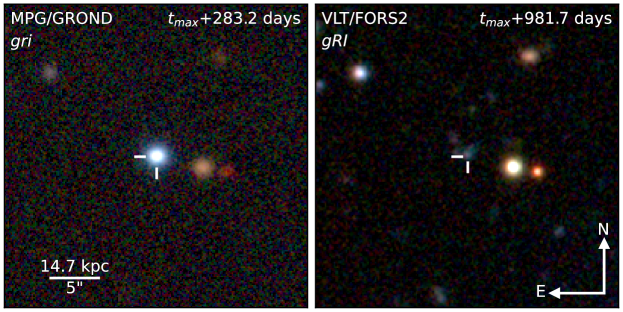
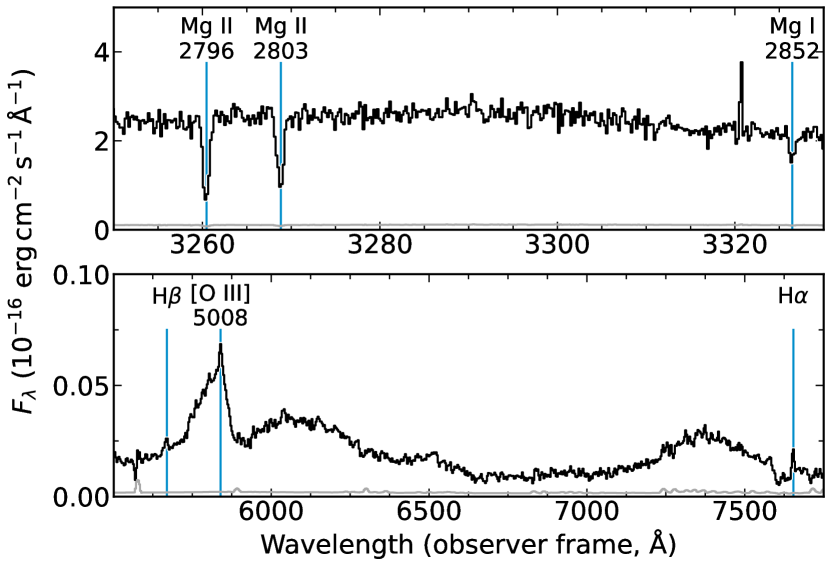
- 대략 1100일의 원시 프레임 동안 UV에서 NIR까지 다중 파장 광측정 및 분광 모니터링을 수행한다.
- 여러 시설의 데이터를 동질화하기 위해 s-보정과 기기 간 보정을 적용한다.
- 호스트 은하의 차감 및 스펙트럼의 절대 플럭스 보정을 수행하고 광측정을 통합한다.
- 관측된 광변곡선과 성운 스펙트럼을 PISN 모델 예측과 비교한다.
- 대체 전력원(중심 엔진) 신호 및 주변 성간 물질(CSM)과의 상호작용 증거를 찾는다.
실험 결과
연구 질문
- RQ1SN 2018ibb가 매우 질량이 크고 금속이 적은 전구체에서 예측된 페어-불안정 초신성 메커니즘에 의해 주로 구동되는가?
- RQ2관측에 요구되는 니켈-56 질량과 방출물/헬륨-핵 질량은 얼마이며, 이것이 PISN 기대와 일치하는가?
- RQ3광측정 및 분광 데이터가 순수한 PISN 해석에 도전하는 중심 엔진 에너지 소스의 신호나 방출물의 주변 성간 물질과의 상호작용 징후를 보이는가?
- RQ4SN 2018ibb의 PISN 시나리오를 어떻게 뒷받침하거나 제약하는가? (금속성, 질량이 호스트 은하 환경이?)
주요 결과
- SN 2018ibb은 3×10^51 erg를 초과하는 복사를 보였고 볼로메트릭 피크는 2×10^44 erg s^-1를 초과했다.
- 긴 휴식 프레임상 상승(>93일)은 매우 큰 총 방출 질량과 긴 확산 시간을 시사한다.
- 모델링에 따르면 빛 곡선과 스펙트럼을 설명하려면 25–44 M⊙의 새로 합성된 56Ni가 필요하다.
- 데이터는 금속이 적은 전구체를 지시하며, 사망 시 헬륨 코어 질량이 120–130 M⊙이다.
- [Co II] 1.025 μm의 잠정 탐지는 PISN 해석을 보강하며, 다른 PISN 후보나 SLSNe에서 관찰되지 않는 특징이다.
- 관측은 분출적 질량손실 에피소드와 그에 따른 방출물-발견물 상호작용이 광에 기여했다는 증거를 제시하며, 일부 PISN 모델과의 차이를 설명할 수 있다.
- 중심 엔진(마그네타 또는 블랙홀)에 의한 구동은 높은 신뢰도로 배제되어 PISN 가능성을 더욱 강화한다.
더 나은 연구,지금 바로 시작하세요
연구 설계부터 논문 작성까지, 연구 시간을 획기적으로 줄여보세요.
카드 등록 없음 · 무료 플랜 제공
이 리뷰는 AI가 만들고, 인간 에디터가 검토했습니다.