
[Paper Review] $^{16}$O spectral function from coupled-cluster theory: applications to lepton-nucleus scattering
This paper presents a first-principles calculation of the $^{16}$O spectral function using coupled-cluster theory combined with the Chebyshev polynomial expansion of the kernel (ChEK) method, enabling uncertainty quantification. The resulting spectral function accurately predicts electron- and neutrino-nucleus scattering cross sections in the quasi-elastic regime up to 1.2 GeV, with good agreement to experimental data and successful implementation in the NuWro Monte Carlo generator for T2K neutrino data comparison.
We calculate the $^{16}$O spectral function by combining coupled-cluster theory with a Gaussian integral transform and by expanding the integral kernel in terms of Chebyshev polynomials to allow for a quantification of the theoretical uncertainties. We perform an analysis of the spectral function and employ it to predict lepton-nucleus scattering. Our results well describe the $^{16}$O electron scattering data in the quasi-elastic peak for momentum transfers $|\mathbf{q}|\gtrapprox500$ MeV and electron energies up to 1.2 GeV, extending therefore the so-called first principles approach to lepton-nucleus cross sections well into the relativistic regime. To prove the applicability of this method to neutrino-nucleus cross sections, we implement our $^{16}$O spectral functions in the NuWro Monte Carlo event generator and provide a comparison with recently published T2K neutrino data.
Motivation & Objective
- To develop a first-principles approach to the spectral function of $^{16}$O that enables reliable predictions of lepton-nucleus scattering cross sections.
- To quantify theoretical uncertainties in the spectral function reconstruction using the ChEK method.
- To extend ab initio calculations into the relativistic regime of lepton-nucleus scattering, beyond the reach of traditional soft nuclear Hamiltonians.
- To validate the method against electron scattering data and neutrino data from the T2K experiment.
- To provide a spectral function suitable for inclusion in Monte Carlo event generators like NuWro for future neutrino oscillation experiments.
Proposed method
- The spectral function is computed using coupled-cluster theory with a chiral nuclear Hamiltonian including two- and three-nucleon forces at next-to-next-to-leading order.
- The spectral function reconstruction is performed via the ChEK method, which expands the integral kernel in Chebyshev polynomials to enable uncertainty quantification.
- The Gaussian integral transform is used to connect the spectral function to the Green's function, allowing for stable numerical evaluation.
- The method propagates uncertainties from the spectral function reconstruction to the final cross-section predictions.
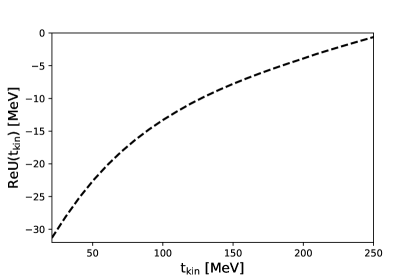
- The resulting spectral function is implemented in the NuWro Monte Carlo event generator to simulate neutrino-nucleus scattering, including final-state interactions via an optical potential.
- The approach assumes the impulse approximation, where only one nucleon interacts with the probe, and the rest of the nucleus acts as a spectator.
Experimental results
Research questions
- RQ1Can the ChEK method combined with coupled-cluster theory produce a spectral function for $^{16}$O with quantified theoretical uncertainties?
- RQ2How well does the ab initio spectral function predict electron scattering data at momentum transfers $|\mathbf{q}| \gtrapprox 500$ MeV and electron energies up to 1.2 GeV?
- RQ3To what extent does the spectral function reproduce T2K neutrino data for $\nu_\mu + {}^{16}\mathrm{O} \to \mu^- + X$ in the quasi-elastic $0\pi$ channel?
- RQ4How significant are final-state interactions and two-body currents in the forward-scattering regime where the impulse approximation breaks down?
- RQ5Can the spectral function be reliably used in Monte Carlo event generators for future neutrino oscillation experiments?
Key findings
- The spectral function calculation shows good agreement with electron scattering data for $|\mathbf{q}| \gtrapprox 500$ MeV and electron energies up to 1.2 GeV, validating the method in the relativistic regime.
- For low momentum transfers ($|\mathbf{q}| \lesssim 500$ MeV) and forward angles, the impulse approximation underperforms, and final-state interactions significantly improve agreement with data when included via the optical potential.
- The inclusion of two-body currents (MEC) contributes substantially to the cross section in the low-$|\mathbf{q}|$ and forward-angle regime, highlighting their importance in this kinematic region.
- The spectral function implementation in NuWro reproduces the T2K $\nu_\mu + {}^{16}\mathrm{O} \to \mu^- + X$ $0\pi$ data with reasonable accuracy, particularly when final-state interactions are included.
- Theoretical uncertainty in the spectral function reconstruction propagates to the cross-section predictions, with the upper and lower bounds of the spectral function yielding distinct but consistent results in the T2K comparison.
- The study identifies a lack of low-energy electron scattering data on $^{16}$O as a key limitation, urging future measurements at MAMI to guide future theoretical models.
Read this paper
Open the full text in the Nubint reader and ask about any passage as you read.
Read this paper on NubintThis review was generated by AI from the original paper. Please check the paper before citing it.