
[Paper Review] 6G Positioning and Sensing Through the Lens of Sustainability, Inclusiveness, and Trustworthiness
This paper proposes integrating sustainability, inclusiveness, and trustworthiness (SIT) as core design principles for 6G positioning and sensing, redefining key performance indicators (KPIs) through quantifiable key value indicators (KVIs). It presents a holistic framework that aligns ISAC (Integrated Sensing and Communication) technologies with UN Sustainable Development Goals, emphasizing synergies and trade-offs between SIT and conventional KPIs, while identifying AI, RIS, and terahertz bands as enablers with dual impacts on value and performance.
6G promises a paradigm shift by integrating positioning and sensing, enhancing not only the communication performance but also enabling location- and context-aware services. Historically, positioning and sensing were focused on cost and performance tradeoffs, implying an escalated demand for resources, such as radio, physical, and computational resources, for improved performance. However, 6G expands this perspective, embracing a set of broader values, namely sustainability, inclusiveness, and trustworthiness. From a joint industrial/academic perspective, this paper aims to shed light on these important value indicators and their relationship with the conventional key performance indicators in the context of positioning and sensing.
Motivation & Objective
- To reframe 6G positioning and sensing beyond traditional KPIs by embedding sustainability, inclusiveness, and trustworthiness (SIT) as first-order design principles.
- To identify and quantify key value indicators (KVIs) that align 6G ISAC with the UN Sustainable Development Goals (SDGs).
- To analyze the synergies and trade-offs between SIT KVIs and conventional KPIs in the context of integrated sensing and communication (ISAC).
- To propose a methodology for transforming SIT KVIs into measurable, actionable KPIs for system design and evaluation.
Proposed method
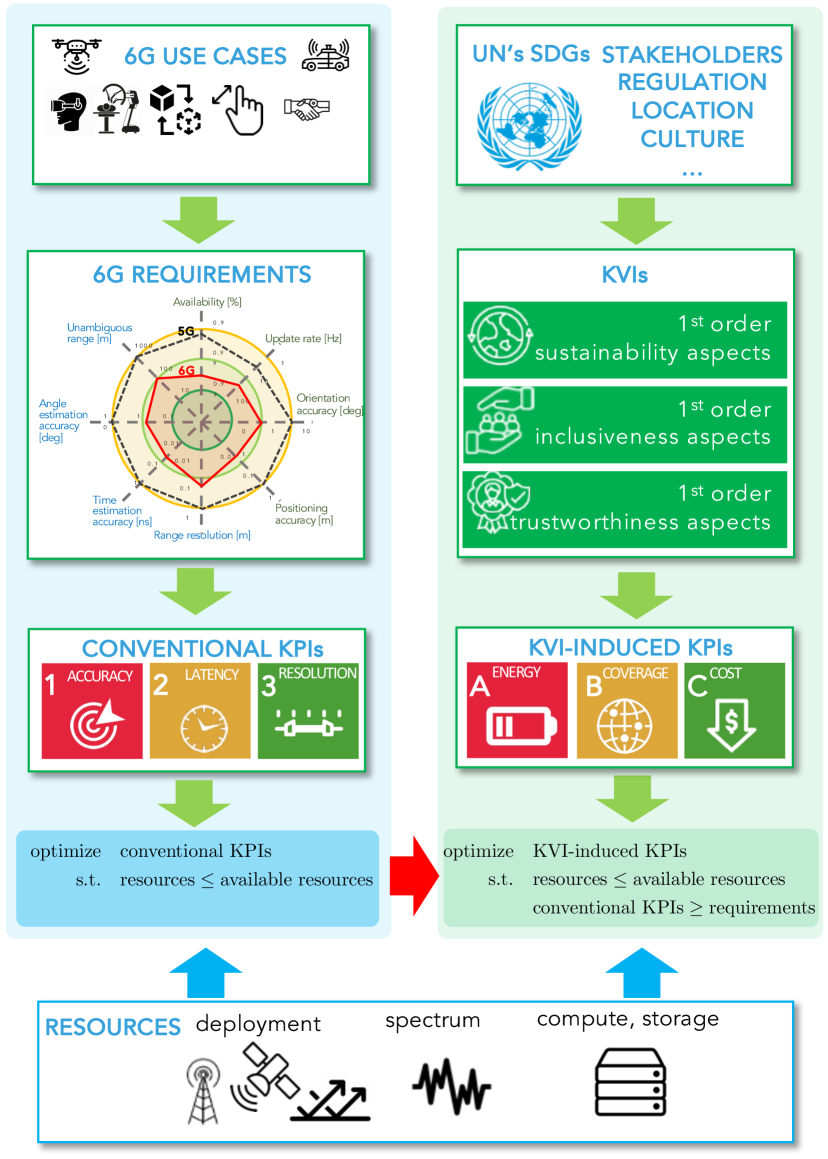
- The paper introduces a dual-layer framework: first, mapping SIT principles to KVIs, then transforming these KVIs into quantifiable KPIs for system optimization.
- It analyzes 6G enablers—such as reconfigurable intelligent surfaces (RIS), non-terrestrial networks (NTN), AI, and sub-THz signals—through the lens of their impact on SIT.
- The authors use a joint industrial-academic perspective to evaluate how technologies like D-MIMO, OTFS, and joint radar-communication (JRC) affect SIT metrics.
- A case study on AI-driven attacks and defenses illustrates how trustworthiness is compromised by model opacity and how formal verification can enhance transparency.
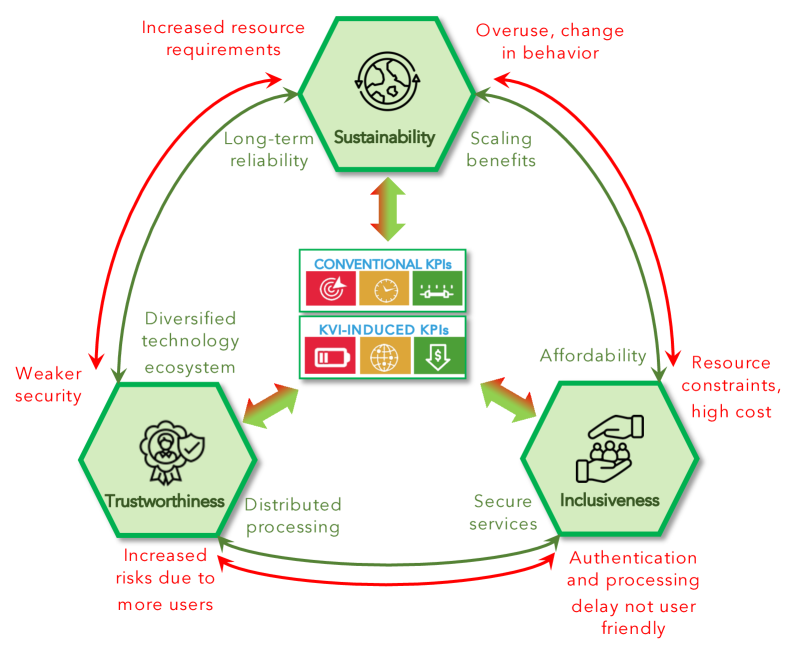
- The paper maps technological enablers to SIT impacts using a visual framework (Fig. 6), highlighting both benefits and hidden costs.
- It proposes a holistic design methodology where SIT KVIs are optimized alongside conventional KPIs, ensuring value-driven system evolution.
Experimental results
Research questions
- RQ1How can sustainability, inclusiveness, and trustworthiness (SIT) be systematically integrated into the design of 6G positioning and sensing systems?
- RQ2What are the measurable key value indicators (KVIs) that can represent SIT in 6G ISAC, and how can they be mapped to conventional KPIs?
- RQ3What are the synergies and trade-offs between SIT KVIs and traditional KPIs such as accuracy, latency, and coverage in ISAC?
- RQ4How do emerging 6G enablers—like RIS, AI, and sub-THz—impact the three SIT dimensions, and what are their hidden costs?
- RQ5In what ways can 6G ISAC contribute to achieving the UN Sustainable Development Goals (SDGs) through value-driven design?
Key findings
- The integration of SIT principles into 6G ISAC design enables alignment with the UN’s 17 Sustainable Development Goals, particularly through infrastructure and service-level contributions.
- Sustainability is enhanced by reducing capital and operational expenditures (CAPEX/OPEX) through efficient spectrum use and energy-aware waveforms.
- Inclusiveness is advanced by enabling connectivity for the unconnected via non-terrestrial networks (NTN) and low-complexity devices, supporting global access.
- Trustworthiness is strengthened by leveraging 6G’s built-in encryption and secure hardware, while AI-based attacks and model opacity require formal verification and transparency mechanisms.
- RIS and AI offer significant gains in positioning accuracy and coverage but introduce new risks in privacy and security, necessitating robust threat modeling.
- The paper demonstrates that SIT KVIs are not merely additive but can drive innovation, such as in secure localization and AI-hardened waveforms, leading to novel, trustworthy applications.
Read this paper
Open the full text in the Nubint reader and ask about any passage as you read.
Read this paper on NubintThis review was generated by AI from the original paper. Please check the paper before citing it.