
[논문 리뷰] A broadband thermal emission spectrum of the ultra-hot Jupiter WASP-18b
이 연구는 JWST/NIRISS를 사용하여 초고온 주성계 WASP-18b의 처음으로 폭넓은 열복사 스펙트럼을 제시하며, 6σ 이상의 유의미한 세 가지 수증기 방출 특징을 해결하고, H⁻, TiO, VO에서 기인할 가능성이 있는 광학적 투과도를 3.8σ 유의수준에서 검출한다. 데이터는 열역학적 역전, 분자 해리, 태양 금속성분 (M/H = 1.03⁺¹.¹¹₋₀.₅₁), 그리고 C/O 비율 <1을 보여주며, 낮은 쪽의 밝기 온도 맵은 하루 동안의 피크가 하루의 중심점에서 대칭적으로 감소하고, 종말선 쪽으로 급격히 감소하는 양상을 보인다.
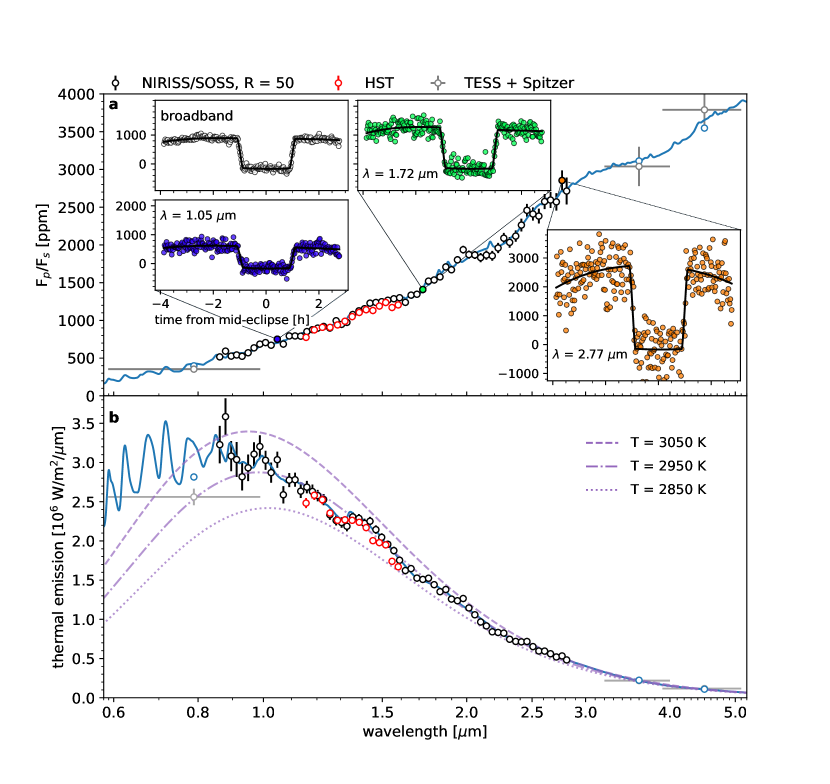
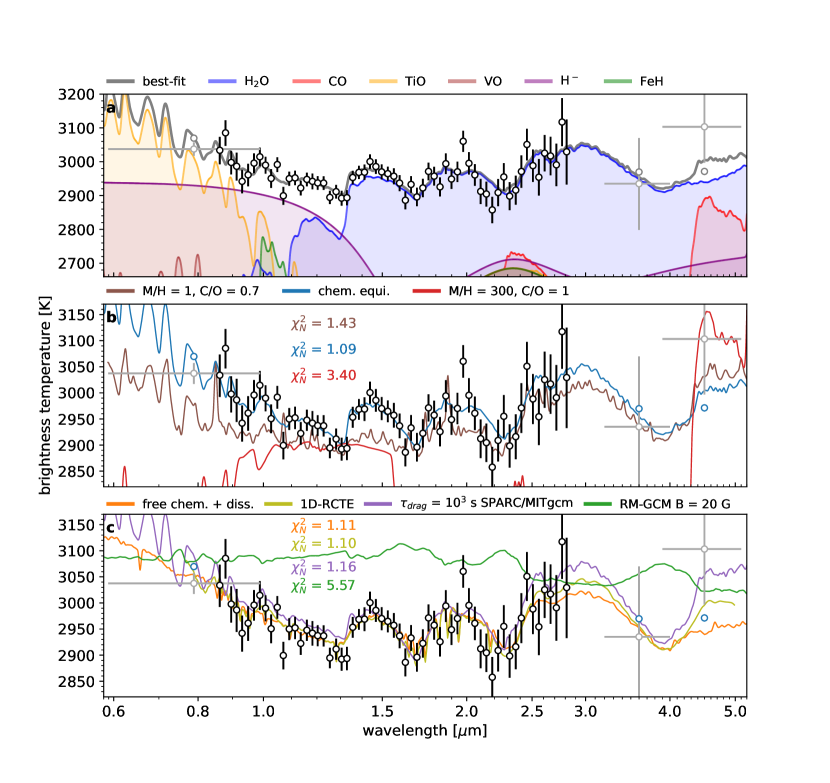
Close-in giant exoplanets with temperatures greater than 2,000 K (''ultra-hot Jupiters'') have been the subject of extensive efforts to determine their atmospheric properties using thermal emission measurements from the Hubble and Spitzer Space Telescopes. However, previous studies have yielded inconsistent results because the small sizes of the spectral features and the limited information content of the data resulted in high sensitivity to the varying assumptions made in the treatment of instrument systematics and the atmospheric retrieval analysis. Here we present a dayside thermal emission spectrum of the ultra-hot Jupiter WASP-18b obtained with the NIRISS instrument on JWST. The data span 0.85 to 2.85 $μ$m in wavelength at an average resolving power of 400 and exhibit minimal systematics. The spectrum shows three water emission features (at $>$6$σ$ confidence) and evidence for optical opacity, possibly due to H$^-$, TiO, and VO (combined significance of 3.8$σ$). Models that fit the data require a thermal inversion, molecular dissociation as predicted by chemical equilibrium, a solar heavy element abundance (''metallicity'', M/H = 1.03$_{-0.51}^{+1.11}$ $ imes$ solar), and a carbon-to-oxygen (C/O) ratio less than unity. The data also yield a dayside brightness temperature map, which shows a peak in temperature near the sub-stellar point that decreases steeply and symmetrically with longitude toward the terminators.
연구 동기 및 목표
- 고정밀 JWST 관측을 통해 초고온 주성계 WASP-18b의 낮은 쪽 열복사 스펙트럼을 특성화하는 것.
- 이전 허블 및 스피처 연구에서의 체계적 오차와 낮은 신호 대 잡음 비율로 인해 어려움을 겪었음에도 불구하고, 대기 조성, 열역학적 구조, 에너지 분포를 해결하는 것.
- 체계적 오차가 최소한인 폭넓은 스펙트럼을 통해 금속성분, C/O 비율, 열역학적 구조를 추출하여 대기 모델을 검증하는 것.
- 대기 순환 패턴을 추론하기 위해 고정밀 낮은 쪽 밝기 온도 맵을 제작하는 것.
제안 방법
- 0.85–2.85 μm 범위에서 R ≈ 400의 해상도로 JWST/NIRISS/SOSS의 SUBSTRIP96 모드를 사용하여 WASP-18b의 일식을 관측하여 과포화를 최소화하고 통합 효율을 67%로 극대화한다.
- 고정 너비 또는 최적 추출을 사용하여 체계적 오차를 최소화하기 위해 네 가지 독립적인 데이터 처리 파ip라인 (NAMELESS, nirHiss, supreme-SPOON, transitspectroscopy) 을 적용한다.
- 스펙트럼 트레이스의 밝기와 관련된 형태 변화를 모델링하고 제거하여 고급 1/f 노이즈 완화를 구현한다.
- ExoTEP를 사용하여 스펙트로포지트릭 및 화이트 라이트 일식곡선을 피팅하며, TESS의 전체 궤도 단계곡선 데이터로 시스템 파rameters (예: 중간 일식 시간, 궤도 기울기) 를 제약 조건으로 설정한다.
- SCARLET, ScCHIMERA, HyDRA, POSEIDON를 사용하여 대기 추출을 수행하여 금속성분, C/O 비율, 분자 농도에 대한 사후 분포를 유도한다.
- 구면 조화함수와 푸리에 급수를 사용하여 일식 맵 모델을 구성하여 공간적 밝기 분포를 추론하며, 경도 및 위도적 구조에 대한 제약 조건을 설정한다.
실험 결과
연구 질문
- RQ10.85–2.85 μm 범위에서 WASP-18b의 폭넓은 열복사 스펙트럼은 무엇이며, 어떤 대기 성분이 높은 유의수준에서 검출되었는가?
- RQ2WASP-18b의 대기는 열역학적 역전을 보이며, 금속성분과 C/O 비율은 어떻게 추정되는가?
- RQ3낮은 쪽의 밝기 분포는 어떻게 분포되어 있으며, 대기 순환 모델과 비교해보면 어떠한가?
- RQ41/f 노이즈 및 스펙트럼 트레이스 이동 등의 체계적 오차는 스펙트럼 추출에 어떤 영향을 미치며, 어떤 방법이 그 영향을 최소화하는가?
주요 결과
- 6σ 이상의 유의수준을 초월하는 세 가지 수증기 방출 특징이 검출되어 강력한 대기 중 수증기 농도를 확인한다.
- H⁻, TiO, VO에서 기인할 가능성이 있는 광학적 투과도가 3.8σ 유의수준에서 공동 검출되었지만, 개별적으로는 해결되지 않았다.
- 대기 추출 결과는 열역학적 역전을 지지하며, 금속성분은 태양과 유사한 수준 (M/H = 1.03⁺¹.¹¹₋₀.₅₁ × 태양) 이며, C/O 비율은 1 미만임을 나타낸다.
- 낮은 쪽 밝기 온도 맵은 하루 중심점 근처에 피크가 있으며, 종말선 쪽으로 경도에 따라 대칭적이고 급격히 감소하는 경향을 보인다.
- 모델 비교 결과, 강한 대기 저항력 (예: τ = 10³ s) 이 있는 GCM은 저항력이 없는 경우보다 관측된 단계곡선과 더 잘 일치한다.
- 일식 맵의 위도적 구조는 여전히 제약 조건이 없지만, 기저 함수 선택 (구면 조화함수 대비 푸리에 급수) 에 관계없이 경도적 밝기 분포는 안정적으로 추출되었다.
더 나은 연구,지금 바로 시작하세요
논문 읽기부터 검토까지, 연구 시간을 획기적으로 줄여보세요.
카드 등록 없음 · 무료 플랜 제공
이 리뷰는 AI가 만들고, 인간 에디터가 검토했습니다.