
[Paper Review] A chiral aperiodic monotile
This paper introduces the Spectre, a strictly chiral aperiodic monotile derived from a 14-sided equilateral polygon in the hat tile continuum. By modifying edge geometry to break reflection symmetry, the authors prove that Spectres admit only non-periodic tilings using only translations and rotations, achieving aperiodicity without reflections—resolving the 'vampire einstein' problem for monohedral tilings.
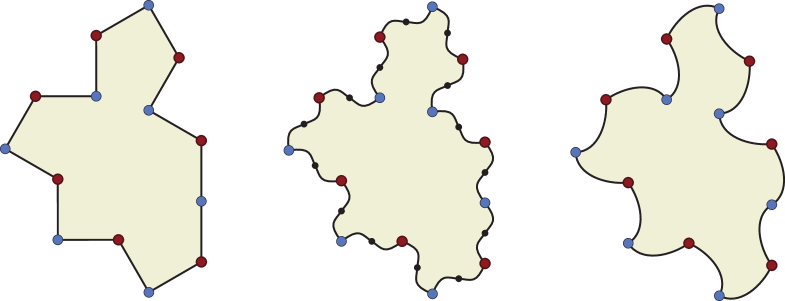
The recently discovered "hat" aperiodic monotile mixes unreflected and reflected tiles in every tiling it admits, leaving open the question of whether a single shape can tile aperiodically using translations and rotations alone. We show that a close relative of the hat -- the equilateral member of the continuum to which it belongs -- is a weakly chiral aperiodic monotile: it admits only non-periodic tilings if we forbid reflections by fiat. Furthermore, by modifying this polygon's edges we obtain a family of shapes called Spectres that are strictly chiral aperiodic monotiles: they admit only chiral non-periodic tilings based on a hierarchical substitution system.
Motivation & Objective
- To resolve the open question of whether a single tile can achieve aperiodic tiling without using reflections.
- To define and construct a strictly chiral aperiodic monotile that admits only non-periodic tilings even when reflections are permitted.
- To extend the hat tile's continuum by modifying edge geometry to enforce chirality and enforce hierarchical substitution rules.
- To develop a combinatorial substitution system based on key points and cluster construction that enables scalable tiling generation.
- To prove that the Spectre tile is aperiodic and chiral under orientation-preserving isometries alone, with no reliance on reflected copies.
Proposed method
- Derive a weakly chiral aperiodic monotile from the equilateral member of the hat tile continuum (Tile(1,1)), which admits only non-periodic tilings when reflections are forbidden.
- Modify the edges of Tile(1,1) to create a new family of shapes called 'Spectres' that break reflection symmetry and enforce chirality.
- Define a hierarchical substitution system using two base clusters—T7H and T8H—derived from hat and turtle tilings, which are then transformed into corresponding Spectre clusters.
- Introduce 'Mystics' as compounds of one odd and one even Spectre, enabling recursive cluster construction through combinatorial substitution rules.
- Establish a key-point-based algorithm: mark four vertices of each Spectre as key points, use them to compute translations and orientations for neighboring tiles in clusters.
- Iterate the cluster construction process through multiple generations, using key points to guide placement and ensure consistency across scales, with convergence to limit shapes at a scaling factor of $4 + \sqrt{15}$.
Experimental results
Research questions
- RQ1Can a single tile tile the plane aperiodically using only translations and rotations, without requiring reflected copies?
- RQ2Does there exist a strictly chiral aperiodic monotile that admits only chiral, non-periodic tilings even when reflections are allowed?
- RQ3Can a hierarchical substitution system be constructed for a chiral monotile that ensures non-periodicity and scalability?
- RQ4What geometric modifications to the hat tile's continuum enforce chirality and prevent reflection-based tilings?
- RQ5How can a combinatorial substitution system with key points enable the construction of arbitrarily large non-periodic tilings without rigid geometric constraints?
Key findings
- The Spectre is a strictly chiral aperiodic monotile: it admits only non-periodic tilings using translations and rotations, and no tiling uses reflected copies.
- The equilateral Tile(1,1) is a weakly chiral aperiodic monotile: it admits only non-periodic tilings when reflections are forbidden by fiat.
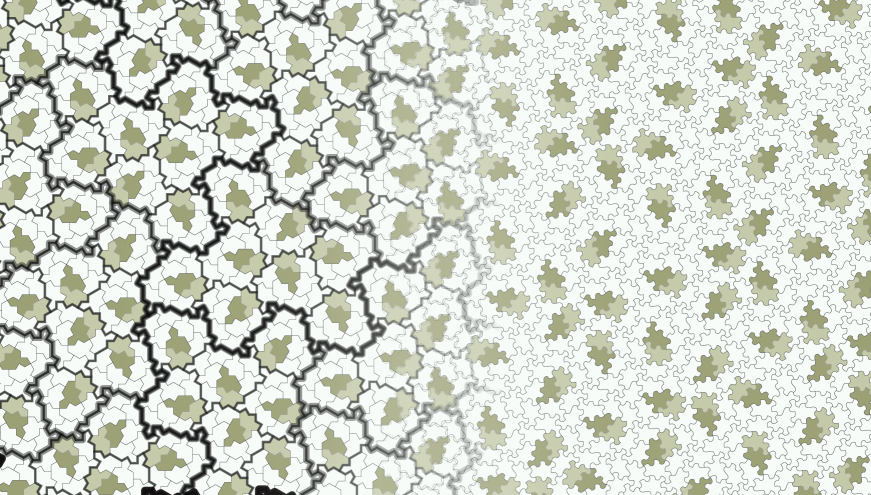
- A hierarchical substitution system based on T7H and T8H clusters (derived from hat and turtle tilings) enables the construction of Spectre tilings through recursive cluster assembly.
- The substitution process converges to limit shapes with an area scaling factor of $4 + \sqrt{15}$ per generation, and the ratio of even to odd Spectres stabilizes at $4 + \sqrt{15}$.
- A key-point-based algorithm enables precise, scalable tiling construction: each Spectre and Mystic cluster is defined by four key points that guide placement and orientation in higher-order clusters.
- The construction is combinatorial and non-rigid: clusters are assembled via matching key points and relative orientations, not fixed geometric transformations, allowing infinite tiling growth with consistent structure.
Read this paper
Open the full text in the Nubint reader and ask about any passage as you read.
Read this paper on NubintThis review was generated by AI from the original paper. Please check the paper before citing it.