
[Paper Review] A Cost-Sensitive Deep Belief Network for Imbalanced Classification
This paper proposes an evolutionary cost-sensitive deep belief network (ECS-DBN) that uses adaptive differential evolution to automatically optimize misclassification costs for imbalanced data, significantly improving minority class performance without altering data distributions. The method outperforms state-of-the-art approaches on benchmark and real-world fault diagnosis datasets, achieving higher G-mean and better computational efficiency than resampling-based methods.
Imbalanced data with a skewed class distribution are common in many real-world applications. Deep Belief Network (DBN) is a machine learning technique that is effective in classification tasks. However, conventional DBN does not work well for imbalanced data classification because it assumes equal costs for each class. To deal with this problem, cost-sensitive approaches assign different misclassification costs for different classes without disrupting the true data sample distributions. However, due to lack of prior knowledge, the misclassification costs are usually unknown and hard to choose in practice. Moreover, it has not been well studied as to how cost-sensitive learning could improve DBN performance on imbalanced data problems. This paper proposes an evolutionary cost-sensitive deep belief network (ECS-DBN) for imbalanced classification. ECS-DBN uses adaptive differential evolution to optimize the misclassification costs based on training data, that presents an effective approach to incorporating the evaluation measure (i.e. G-mean) into the objective function. We first optimize the misclassification costs, then apply them to deep belief network. Adaptive differential evolution optimization is implemented as the optimization algorithm that automatically updates its corresponding parameters without the need of prior domain knowledge. The experiments have shown that the proposed approach consistently outperforms the state-of-the-art on both benchmark datasets and real-world dataset for fault diagnosis in tool condition monitoring.
Motivation & Objective
- To address the challenge of imbalanced data classification where traditional deep belief networks (DBNs) fail due to equal misclassification cost assumptions.
- To develop a method that automatically determines optimal misclassification costs without prior domain knowledge, especially when costs are unknown in real-world applications.
- To improve DBN performance on minority classes in imbalanced datasets by integrating cost-sensitive learning via evolutionary optimization.
- To reduce computational overhead compared to resampling-based methods like SMOTE and ADASYN while maintaining or improving classification accuracy.
- To enable effective and efficient learning on large-scale imbalanced datasets, particularly in real-world applications such as tool condition monitoring.
Proposed method
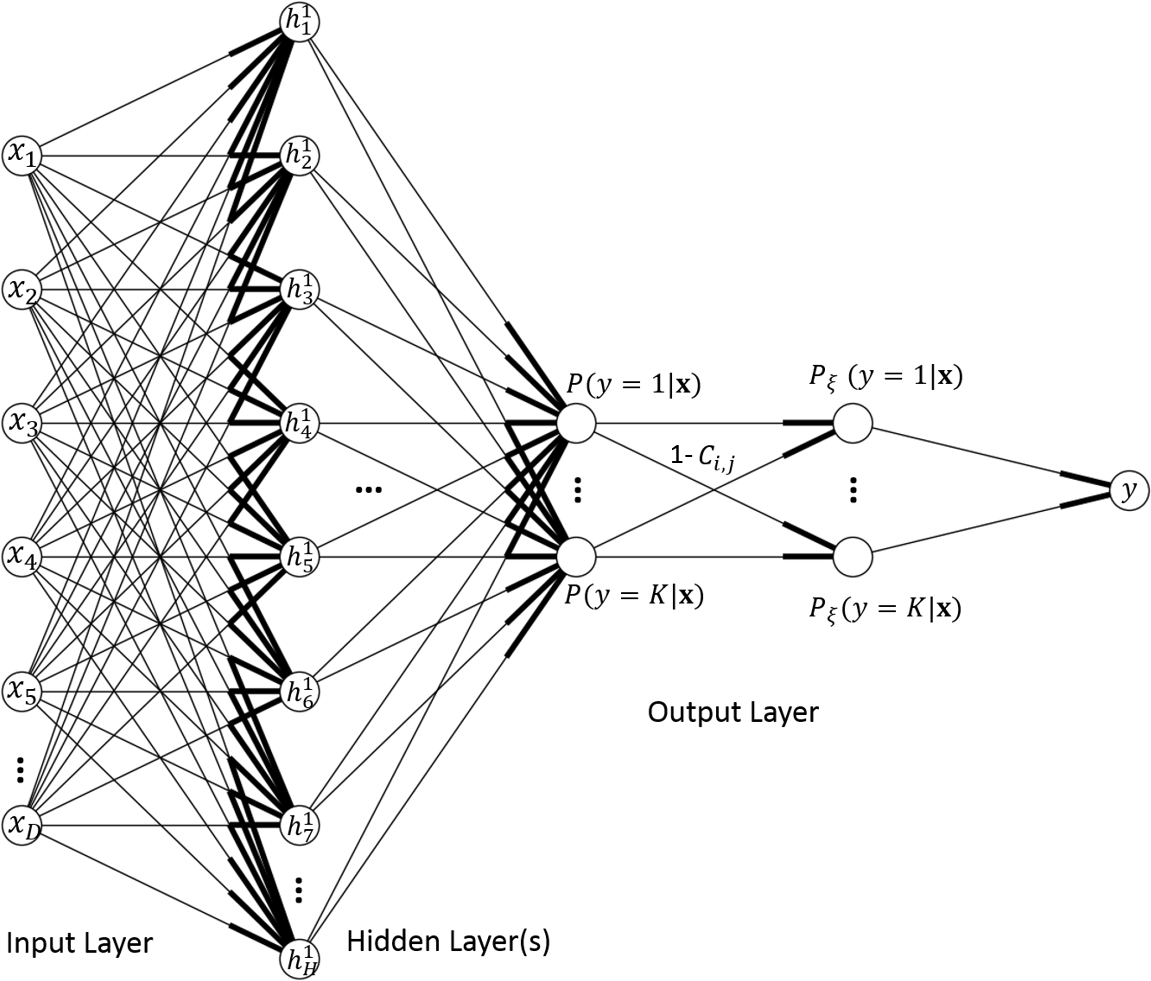
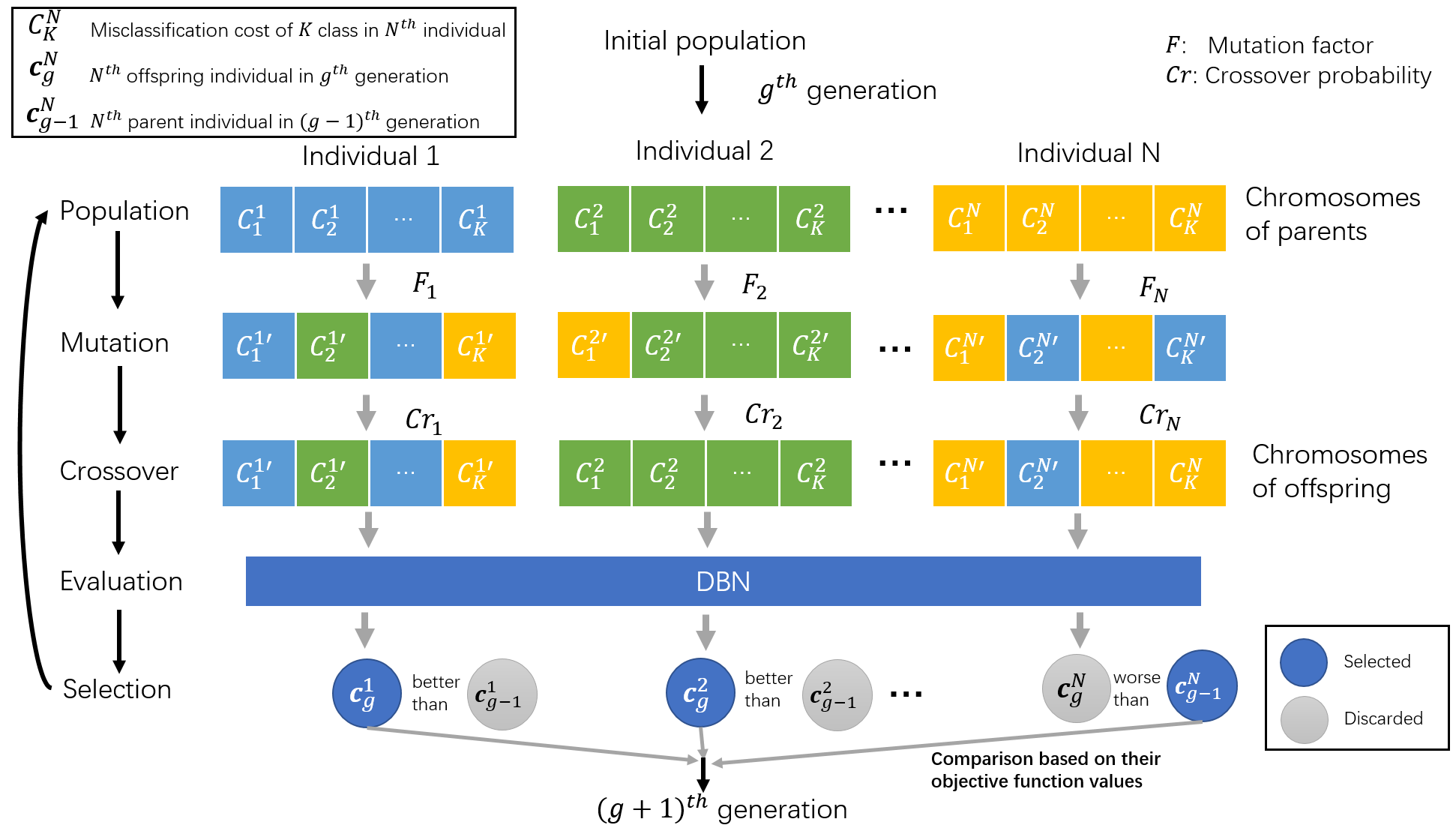
- The proposed ECS-DBN integrates cost-sensitive learning into the deep belief network by optimizing misclassification costs using adaptive differential evolution (jDE).
- The jDE algorithm dynamically adjusts its parameters during optimization, enabling automatic search for optimal cost values without requiring prior knowledge.
- The objective function for optimization is based on the G-mean metric, which balances sensitivity and specificity, ensuring improved performance on minority classes.
- Misclassification costs are optimized on training data before being applied to the DBN, preserving the original data distribution and avoiding data-level manipulation.
- The method is designed to be scalable and extensible to multi-class and dynamic data scenarios, with low computational overhead compared to resampling techniques.
- The framework is evaluated using 58 benchmark datasets and a real-world gun drilling fault diagnosis dataset, with 5-fold cross-validation across 10 trials.
Experimental results
Research questions
- RQ1Can an evolutionary cost-sensitive approach improve the performance of deep belief networks on imbalanced classification tasks?
- RQ2How does the adaptive differential evolution algorithm optimize misclassification costs when they are unknown in real-world applications?
- RQ3Does the proposed ECS-DBN outperform traditional resampling-based methods (e.g., SMOTE, ADASYN) in terms of both accuracy and computational efficiency on large-scale datasets?
- RQ4To what extent does the cost-sensitive learning strategy enhance minority class detection without degrading majority class performance?
- RQ5Can the ECS-DBN framework be effectively applied to real-world industrial applications such as tool condition monitoring?
Key findings
- The proposed ECS-DBN significantly outperforms standard DBN, SMOTE-DBN, ADASYN-DBN, and other resampling-based methods on 58 benchmark datasets in terms of G-mean and precision.
- On the real-world gun drilling fault diagnosis dataset, ECS-DBN achieved the highest average computational efficiency, with a total time of 9977.39 ± 148.55 seconds, outperforming SMOTE-SVM-DBN (20942.94 ± 6609.65 seconds).
- The adaptive differential evolution algorithm efficiently optimized misclassification costs with negligible computational overhead, contributing only 1280.28 seconds to the total training time.
- ECS-DBN improved minority class accuracy by finding optimal cost values, as validated in Figure 9, where the minority class accuracy was significantly higher than with grid search or standard DBN.
- The method achieved better G-mean and precision than grid search over misclassification costs, as shown in Figure 8, with the solid yellow circle (ECS-DBN) consistently outperforming other configurations.
- The framework demonstrated robustness and scalability, with potential for extension to other deep learning models like CNNs and online learning settings with concept drift.
Read this paper
Open the full text in the Nubint reader and ask about any passage as you read.
Read this paper on NubintThis review was generated by AI from the original paper. Please check the paper before citing it.