
[Paper Review] A distinct magnetic property of the inner penumbral boundary. II. Formation of a penumbra at the expense of a pore
This study demonstrates that a penumbra forms at the expense of a pore's magnetic flux when the pore's vertical magnetic field (≤1.4 kG) remains below the canonical stable umbra-penumbra boundary value of 1.8 kG. As penumbral bright grains invade the pore, the magnetic flux is reconfigured from vertical to horizontal, leading to complete pore disappearance and the formation of an orphan penumbra.
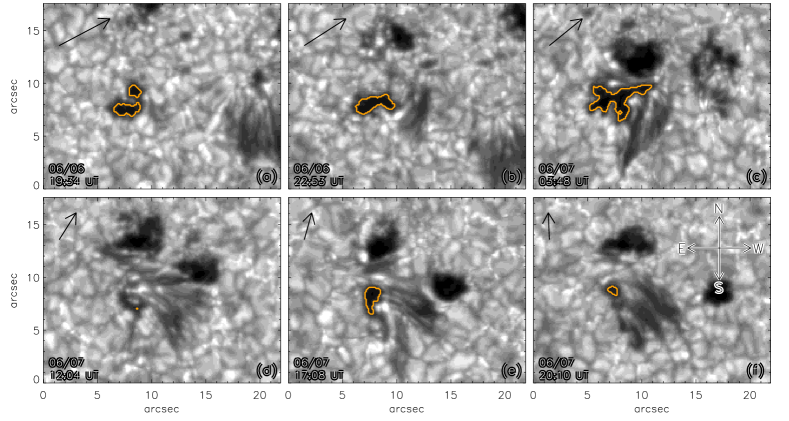
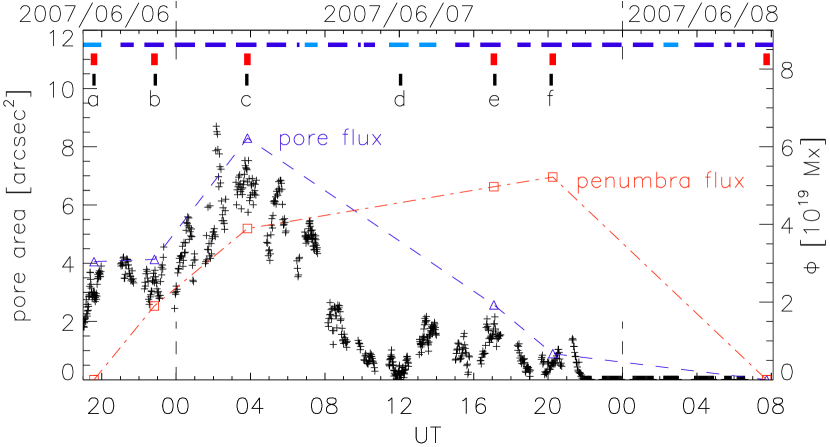
We recently presented evidence that stable umbra-penumbra boundaries are characterised by a distinct canonical value of the vertical component of the magnetic field, $B^{ m stable}_{ m ver}$. In order to trigger the formation of a penumbra, large inclinations in the magnetic field are necessary. In sunspots, the penumbra develops and establishes by colonising both umbral areas and granulation, that is, penumbral magneto-convection takes over in umbral regions with $B_{ m ver} < B^{ m stable}_{ m ver}$, as well as in granular convective areas. Eventually, a stable umbra-penumbra boundary settles at $B^{ m stable}_{ m ver}$. Here, we aim to study the development of a penumbra initiated at the boundary of a pore, where the penumbra colonises the entire pore ultimately. We have used Hinode/SOT G-band images to study the evolution of the penumbra. Hinode/SOT spectropolarimetric data were used to infer the magnetic field properties in the studied region. The penumbra forms at the boundary of a pore located close to the polarity inversion line of NOAA\,10960. As the penumbral bright grains protrude into the pore, the magnetic flux in the forming penumbra increases at the expense of the pore magnetic flux. Consequently, the pore disappears completely giving rise to an orphan penumbra. At all times, the vertical component of the magnetic field in the pore is smaller than $B^{ m stable}_{ m ver} \approx 1.8$~kG. Our findings are in an agreement with the need of $B^{ m stable}_{ m ver}$ for establishing a stable umbra-penumbra boundary: while $B_{ m ver}$ in the pore is smaller than $B^{ m stable}_{ m ver}$, the protrusion of penumbral grains into the pore area is not blocked, a stable pore-penumbra boundary does not establish, and the pore is fully overtaken by the penumbral magneto-convective mode. This scenario could also be one of the mechanisms giving rise to orphan penumbrae.
Motivation & Objective
- To investigate the formation of a penumbra at the boundary of a pore, particularly how magnetic flux is transferred from the pore to the penumbra.
- To determine whether the canonical vertical magnetic field value of 1.8 kG (B_ver^stable) acts as a threshold for stabilizing penumbra-pore boundaries.
- To explore the mechanism by which a pore can be fully colonized by penumbral magneto-convection, leading to the formation of an orphan penumbra.
- To analyze the role of magnetic field inclination and flux evolution in triggering and sustaining penumbral development in low-flux environments.
Proposed method
- Utilized high-resolution Hinode/SOT G-band images (0.11″ spatial resolution) to track the temporal evolution of pore and penumbra structures in active region NOAA 10960.
- Applied Hinode/SOT spectropolarimetric data in Fe I lines at 630.15 and 630.25 nm to infer the magnetic field vector, including vertical component (B_ver), inclination, and flux distribution.
- Used the SIR inversion code to retrieve physical parameters from Stokes profiles, enabling precise mapping of magnetic field properties in the pore and penumbra regions.
- Tracked the evolution of magnetic flux in the pore and penumbra over time, observing flux transfer from the pore to the penumbra via penumbral grain intrusion.
- Compared the vertical magnetic field strength in the pore (max 1.4 kG) with the canonical B_ver^stable value of 1.8 kG to assess boundary stability.
- Analyzed magnetic field line connectivity using inclination maps to determine whether the penumbra remained magnetically isolated from opposite-polarity pores.
Experimental results
Research questions
- RQ1Does the canonical vertical magnetic field value of 1.8 kG (B_ver^stable) act as a threshold for stabilizing a penumbra-pore boundary?
- RQ2What happens to a pore when its vertical magnetic field remains below B_ver^stable during penumbral invasion?
- RQ3Can a penumbra form and fully colonize a pore by transferring magnetic flux, leading to the creation of an orphan penumbra?
- RQ4How does the magnetic field configuration evolve during the transformation of a pore into a penumbra, particularly in terms of field inclination and flux redistribution?
Key findings
- The pore’s maximum vertical magnetic field strength was 1.4 kG, significantly below the canonical B_ver^stable value of 1.8 kG, preventing the formation of a stable pore-penumbra boundary.
- Penumbral bright grains continuously protruded into the pore, driving the transformation of pore magnetic flux into penumbral flux, with the penumbra’s flux reaching 84% of the pore’s peak flux.
- The pore was completely overtaken by the penumbra, resulting in the formation of an orphan penumbra with predominantly horizontal magnetic fields.
- Magnetic field lines in the penumbra were not connected to opposite-polarity pores, confirming the penumbra’s isolation and self-sustained nature.
- The process of pore disappearance occurred without evidence of flux cancellation or emerging flux, indicating that flux transfer via magneto-convection was the dominant mechanism.
- The observed evolution supports the hypothesis that a B_ver^stable threshold governs the stability of penumbra boundaries, and its absence allows full colonization of low-B_ver regions by penumbral convection.
Read this paper
Open the full text in the Nubint reader and ask about any passage as you read.
Read this paper on NubintThis review was generated by AI from the original paper. Please check the paper before citing it.