
[Paper Review] A dynamical model for IRAS 00500+6713: the remnant of a type Iax supernova SN 1181 hosting a double degenerate merger product WD J005311
This paper proposes that IRAS 00500+6713 is the remnant of a Type Iax supernova SN 1181, driven by a double degenerate white dwarf merger, with WD J005311 as the surviving merger product. Using X-ray data from XMM-Newton and Chandra, the authors model the dynamical evolution of the ejecta and wind, showing that the inner X-ray nebula arises from a wind termination shock and the outer nebula from SN ejecta interacting with the interstellar medium. The model fits the observations with an explosion energy of $ (0.77\text{--}1.1)\times10^{48} $ erg and ejecta mass of $ 0.18\text{--}0.53~{}M_\odot $, consistent with Type Iax SNe and a wind launched $ \gtrsim 810 $ yr after the explosion, likely tied to core contraction and surface carbon burning.
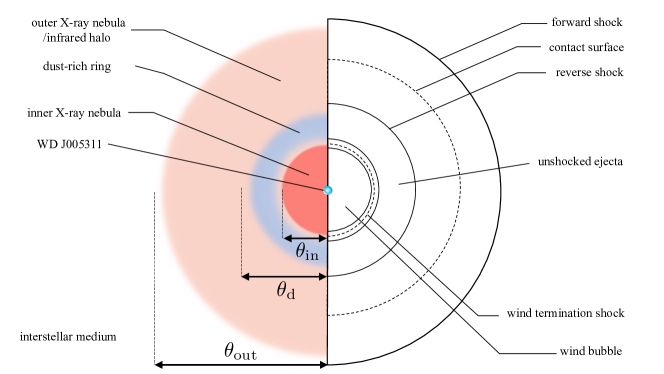
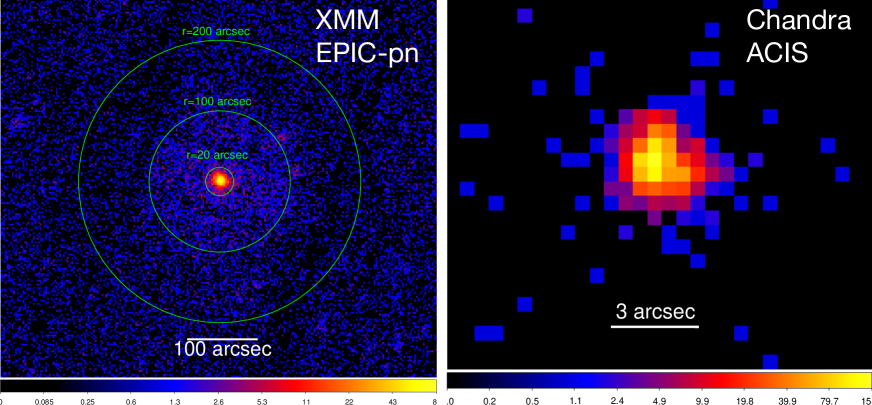
IRAS 00500+6713 is a hypothesized remnant of a type Iax supernova SN 1181. Multi-wavelength observations have revealed its complicated morphology; a dusty infrared ring is sandwiched by the inner and outer X-ray nebulae. We analyze the archival X-ray data taken by XMM-Newton and Chandra to constrain the {angular radius}, mass, and metal abundance of the X-ray nebulae, and construct a theoretical model describing the dynamical evolution of IRAS 00500+6713, including the effects of the interaction between the SN ejecta and the intense wind enriched with carbon burning ashes from the central white dwarf (WD) J005311. We show that the inner X-ray nebula corresponds to the wind termination shock while the outer X-ray nebula to the shocked interface between the SN ejecta and the interstellar matter. The observed X-ray properties can be explained by our model with an {ejecta kinetic} energy of $E_\mathrm{ej} = (0.77 \mbox{--} 1.1) imes 10^{48}$~erg, an ejecta mass of $M_\mathrm{ej} = 0.18\mbox{--}0.53~M_\odot$, if the currently observed wind from WD J005311 started to blow $t_\mathrm{w} \gtrsim 810$ yr after the explosion, i.e., approximately after A.D. 1990. The inferred SN properties are compatible with those of Type Iax SNe and the timing of the wind launch may correspond to the Kelvin-Helmholtz contraction of the oxygen-neon core of WD J005311 that triggered a surface carbon burning. Our analysis supports that IRAS 00500+6713 is the remnant of SN Iax 1181 produced by a double degenerate merger of oxygen-neon and carbon-oxygen WDs, and WD J005311 is the surviving merger product.
Motivation & Objective
- To determine the dynamical origin of the multi-wavelength morphology of IRAS 00500+6713, which features a dusty infrared ring sandwiched between inner and outer X-ray nebulae.
- To test the hypothesis that IRAS 00500+6713 is the remnant of a Type Iax supernova SN 1181 resulting from a double degenerate white dwarf merger.
- To constrain the explosion energy, ejecta mass, and wind launch time of the supernova using archival X-ray observations and theoretical modeling.
- To explain the origin of the intense, carbon-burning-ash-enriched wind from the central white dwarf WD J005311 and its role in shaping the nebular structure.
Proposed method
- Analysis of archival X-ray data from XMM-Newton and Chandra to measure angular size, mass, and metal abundance of the inner and outer X-ray nebulae.
- Construction of a theoretical dynamical model incorporating shock heating, radiative cooling, and wind interaction in a spherically symmetric, time-dependent framework.
- Use of the radiative shock condition $ \mathrm{EM}_{\rm ej}\Lambda(T_{\rm e}) \approx 2\pi r_{\rm sh}^{2}\rho_{\rm ej}v_{\rm sh}^{3} $ to estimate emission temperature and luminosity of the shocked ejecta.
- Incorporation of electron temperature evolution via heating and cooling timescales $ t_{\mathrm{eq}}(T_{\mathrm{e,down}}) $ and $ t_{\mathrm{cool}}(T_{\mathrm{e,down}}) $, with cooling function $ \Lambda(T_{\mathrm{e}}) $ from Kirchschlager et al. (2019) for oxygen-dominated plasma.
- Assumption that the inner X-ray nebula corresponds to the wind termination shock and the outer nebula to the SN ejecta–ISM shock interface, with the dust ring representing unshocked ejecta.
- Parameter space exploration of $ \dot{M}_{\rm w} $, $ t_{\rm w} $, and $ M_{\rm{ej}} $ to match observed X-ray properties and infer explosion and wind parameters.
Experimental results
Research questions
- RQ1What is the origin of the inner and outer X-ray nebulae in IRAS 00500+6713, and how do they relate to the SN explosion and central wind?
- RQ2Can the observed X-ray morphology and emission properties be explained by a dynamical model of a Type Iax supernova remnant with a post-merger white dwarf wind?
- RQ3What are the constraints on the SN explosion energy and ejecta mass consistent with the X-ray observations and wind dynamics?
- RQ4When did the intense wind from WD J005311 begin, and how does its timing relate to the post-merger evolution of the remnant?
- RQ5Is the chemical composition and kinematics of the wind from WD J005311 consistent with a double degenerate merger product undergoing surface carbon burning?
Key findings
- The inner X-ray nebula is identified as the wind termination shock of a high-velocity wind from WD J005311, with a mass loss rate of $ \sim 10^{-6}~{}M_\odot\,\mathrm{yr}^{-1} $ and velocity of $ 15,000\,\mathrm{km\,s^{-1}} $.
- The outer X-ray nebula arises from the shock interface between the SN ejecta and the interstellar medium, with a shock speed of $ \sim 1,000\,\mathrm{km\,s^{-1}} $.
- The model fits the X-ray data with an explosion energy of $ E_{\mathrm{ej}} = (0.77\text{--}1.1)\times10^{48} $ erg and ejecta mass of $ M_{\mathrm{ej}} = 0.18\text{--}0.53~{}M_\odot $, consistent with Type Iax supernovae.
- The wind from WD J005311 is inferred to have started blowing $ t_{\mathrm{w}} \gtrsim 810 $ yr after the explosion, corresponding to approximately A.D. 1990, likely triggered by Kelvin-Helmholtz contraction and surface carbon burning in the oxygen-neon core.
- The emission temperature of the inner shocked ejecta is estimated at $ \lesssim 3\text{--}4\,\mathrm{eV} $, indicating UV emission that is absorbed by the surrounding dust ring and re-emitted in the infrared, explaining the observed dusty ring morphology.
- The radiative cooling timescale is shorter than the dynamical timescale, confirming that the shock downstream is radiative, with energy loss dominated by thermal radiation rather than adiabatic expansion.
Read this paper
Open the full text in the Nubint reader and ask about any passage as you read.
Read this paper on NubintThis review was generated by AI from the original paper. Please check the paper before citing it.