
[Paper Review] A Fusion Approach for Multi-Frame Optical Flow Estimation
This paper proposes a novel fusion framework for multi-frame optical flow estimation that warps optical flow predictions from previous frames to the current frame and combines them with the current-frame estimate using a learnable fusion network. The method achieves state-of-the-art performance on MPI Sintel and KITTI 2015 benchmarks by effectively leveraging long-term temporal context, outperforming two-frame baselines and GRU-based multi-frame methods.
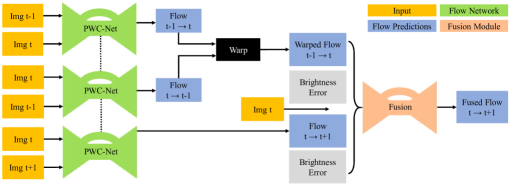
To date, top-performing optical flow estimation methods only take pairs of consecutive frames into account. While elegant and appealing, the idea of using more than two frames has not yet produced state-of-the-art results. We present a simple, yet effective fusion approach for multi-frame optical flow that benefits from longer-term temporal cues. Our method first warps the optical flow from previous frames to the current, thereby yielding multiple plausible estimates. It then fuses the complementary information carried by these estimates into a new optical flow field. At the time of writing, our method ranks first among published results in the MPI Sintel and KITTI 2015 benchmarks. Our models will be available on https://github.com/NVlabs/PWC-Net.
Motivation & Objective
- To address the limitation of current optical flow methods that rely only on two consecutive frames, despite longer temporal sequences offering richer motion context.
- To improve flow estimation in challenging regions such as occlusions and out-of-boundary pixels where two-frame methods often fail.
- To develop a flexible, end-to-end trainable framework that can integrate any two-frame optical flow model as input.
- To demonstrate that fusing multiple warped flow estimates leads to better performance than selecting a single best estimate or using recurrent networks.
Proposed method
- Warp optical flow predictions from previous frames to the current frame using inverse warping to align them spatially.
- Feed the warped past flows and the current-frame flow estimate into a dedicated fusion network that learns to combine complementary information.
- Use a deep neural network for fusion that operates over large receptive fields, enabling context-aware aggregation of flow candidates.
- Train the fusion network end-to-end with the underlying two-frame model, enabling joint optimization of flow estimation and fusion.
- Leverage the differentiability of modern two-frame models (e.g., PWC-Net) to allow backpropagation through the entire pipeline.
- Fine-tune the fusion network on public benchmarks (KITTI 2015, Sintel) after pretraining on synthetic datasets (virtual KITTI, Monkaa).

Experimental results
Research questions
- RQ1Can incorporating optical flow estimates from multiple past frames improve performance on challenging optical flow benchmarks compared to two-frame methods?
- RQ2Does a learnable fusion mechanism outperform simple selection or averaging of multiple flow candidates?
- RQ3Can a fusion network effectively utilize long-term temporal context even when motion changes abruptly or in occluded regions?
- RQ4Is the proposed fusion framework compatible with and effective when combined with state-of-the-art two-frame optical flow models?
- RQ5Does the fusion approach generalize across different datasets and motion patterns, including motion boundaries and occlusions?
Key findings
- PWC-Fusion achieves the highest rank among all published methods on the MPI Sintel benchmark, outperforming all two-frame baselines.
- On the KITTI 2015 benchmark, PWC-Fusion surpasses all two-frame optical flow methods, including the then-state-of-the-art PWC-Net.
- The fusion network reduces average end-to-end error (EPE) by 3.93 in red regions (where fused flow differs from both inputs), indicating improved accuracy beyond the best input.
- In occluded and out-of-boundary regions, the fused flow achieves significantly lower EPE than the current-frame flow, demonstrating the value of past flow information.
- The fusion network produces better results than both the current flow and warped past flows in 37.65% of pixels in ambiguous regions, proving its ability to synthesize superior estimates.
- Visual results show consistent improvements at motion boundaries, with the fusion method producing more accurate and coherent flow fields than PWC-Net alone.
Read this paper
Open the full text in the Nubint reader and ask about any passage as you read.
Read this paper on NubintThis review was generated by AI from the original paper. Please check the paper before citing it.