
[Paper Review] A hidden population of white dwarfs with atmospheric carbon traces in the Gaia bifurcation
The paper proposes that the B branch of the Gaia white dwarf bifurcation is caused by 'stealth DQ' white dwarfs—He-rich stars with trace atmospheric carbon undetectable in optical spectra but causing blueward continuum shifts. These stars, formed via convection-driven carbon dredge-up, reproduce the bifurcation and yield a mass peak at ~0.6 M⊙, consistent with standard evolution and DA white dwarf distributions.
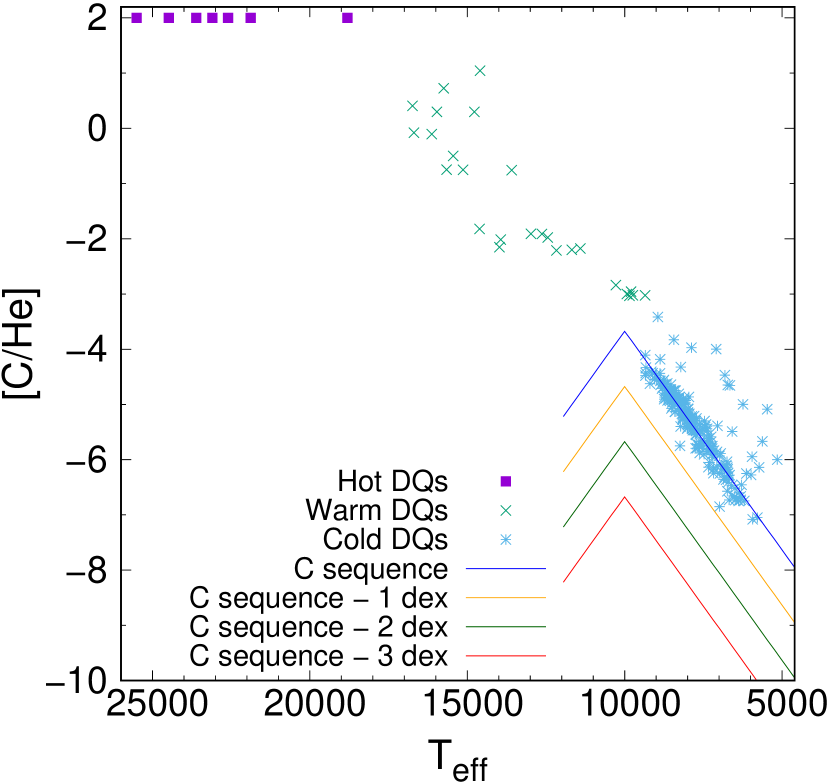
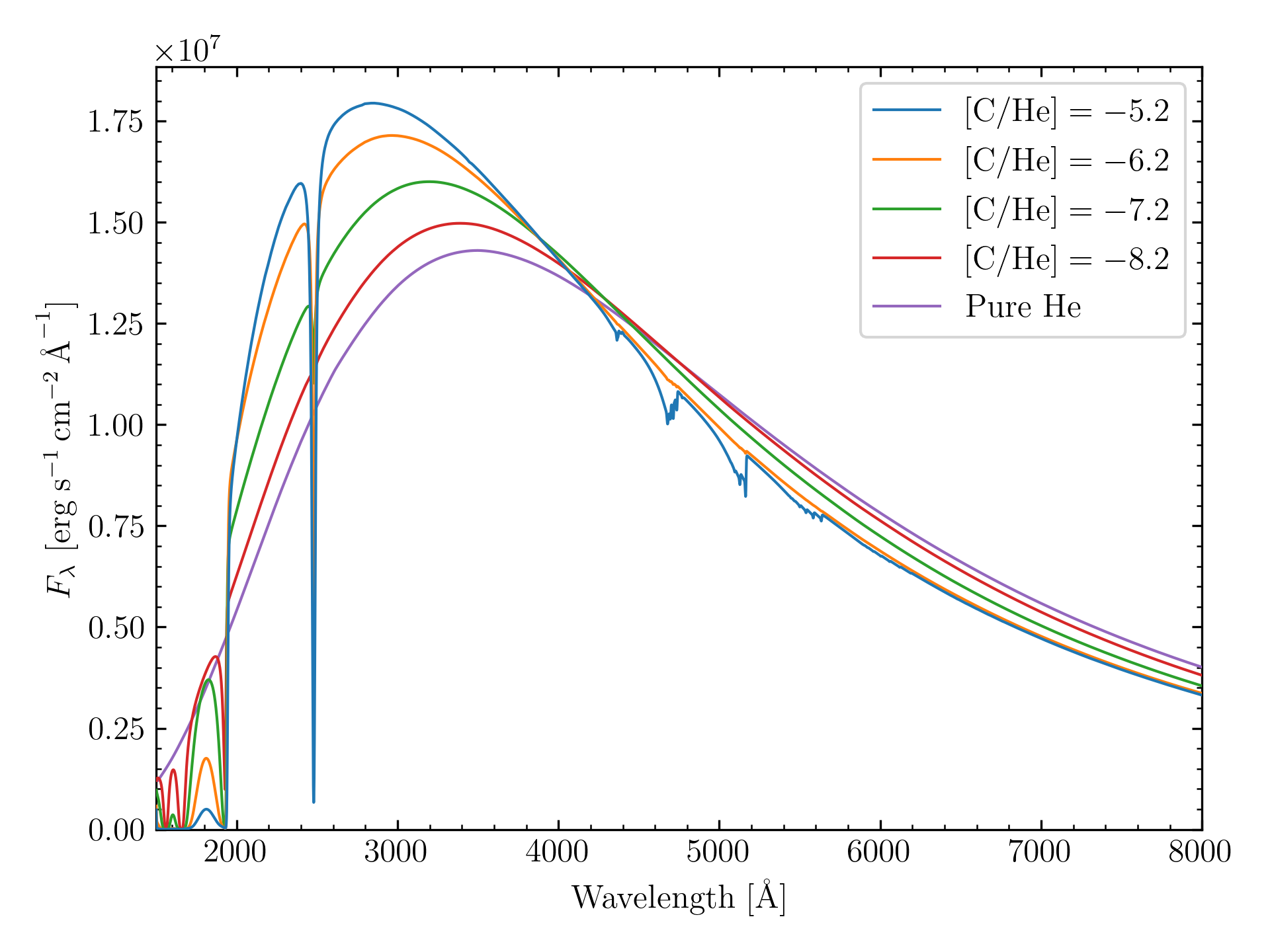
The ESA Gaia space mission has revealed a bifurcation of the white dwarf (WD) sequence on the color magnitude diagram in two branches: A and B. While the A branch consists mostly of WDs with H-rich atmospheres, the B branch is not completely understood. Although invoked to be populated mainly by He-rich WDs, the B branch overlaps a $\sim 0.8M_\odot$ evolutionary track with a pure He envelope, fact that would imply an unexpected peak in the WD mass distribution. In cold He-rich WDs, it is expected that the outer convective zone penetrates into deep C-rich layers, thus leading to a slight C contamination in their surfaces at $\sim 10,000$K. Here we aim at studying the Gaia bifurcation as the natural consequence of C dredge-up by convection in cold He-dominated WDs. Relying on accurate atmosphere models, we provide a new set of evolutionary models for He-rich WDs employing different prescriptions for the C enrichment. On the basis of these models, we made a population synthesis study of the Gaia 100pc WD sample to constrain the models that best fit the bifurcation. Our study shows that He-rich WD models with a slight C contamination below the optical detection limit can accurately reproduce the Gaia bifurcation. We refer to these stars as stealth DQ WDs because they do not exhibit detectable C signatures in their optical spectra, but the presence of C in their atmosphere produces a continuum absorption favouring the emission in bluer wavelengths, thereby creating the B branch of the bifurcation. Also, we show that the mass distribution for He-rich WDs obtained when a stealth C contamination is considered is consistent with the mass distribution for H-rich WDs and with the standard evolutionary channels for their formation. We conclude that stealth DQ WDs can account for the lower branch in the Gaia bifurcation. The C signatures of these stars could be detectable in Ultra-Violet spectra.
Motivation & Objective
- Explain the origin of the B branch in the Gaia white dwarf color-magnitude diagram bifurcation, which remains unexplained by pure He-rich models.
- Address the inconsistency in the white dwarf mass distribution, where pure He-rich models predict a peak at ~0.8 M⊙, conflicting with observed DA white dwarf masses.
- Investigate whether trace carbon in He-rich white dwarf atmospheres can produce the observed photometric offset without detectable optical spectral features.
- Reconcile the observed mass distribution of non-DA white dwarfs with standard evolutionary channels, particularly late thermal pulses.
- Provide a testable prediction: detectable carbon features in UV spectra of B branch white dwarfs.
Proposed method
- Developed new evolutionary models for He-rich white dwarfs with varying prescriptions for carbon enrichment from deep C-rich layers via convective dredge-up.
- Used accurate atmosphere models to compute synthetic photometry and spectral energy distributions for He-rich white dwarfs with trace carbon.
- Performed population synthesis on the Gaia 100 pc white dwarf sample, varying initial-final mass relations (IFMR), DA to non-DA ratios, and atmospheric compositions.
- Compared synthetic color-magnitude diagrams with observed Gaia DR3 data, using χ² minimization to assess model fit.
- Interpolated Gaia G and G<sub>BP</sub>−G<sub>RP</sub> magnitudes in evolutionary models to infer individual white dwarf masses.
- Evaluated multiple carbon enrichment prescriptions, including C sequence and C sequence −1 dex, and randomized distributions across the population.
Experimental results
Research questions
- RQ1Can trace carbon in He-rich white dwarf atmospheres explain the photometric offset of the B branch without detectable optical C lines?
- RQ2Does the inclusion of 'stealth DQ' white dwarfs with invisible carbon reproduce the observed white dwarf mass distribution in the 100 pc sample?
- RQ3Is the observed peak at ~0.6 M⊙ in the non-DA mass distribution consistent with standard evolutionary channels when carbon contamination is included?
- RQ4Which carbon enrichment prescription best fits the Gaia bifurcation in the color-magnitude diagram?
- RQ5Can UV spectroscopy detect carbon features in B branch white dwarfs, providing observational confirmation of the stealth DQ hypothesis?
Key findings
- He-rich white dwarf models with trace carbon contamination below optical detection limits accurately reproduce the Gaia bifurcation's B branch.
- The 'stealth DQ' model—where carbon causes continuum absorption favoring bluer emission—produces a mass distribution peaking at ~0.6 M⊙, matching DA white dwarfs and standard evolution.
- Pure He-atmosphere models for non-DA white dwarfs fail to reproduce the data, yielding a spurious peak at ~0.8 M⊙ inconsistent with observations.
- The best-fitting model uses a C sequence parametrization for carbon enrichment, though the C sequence −1 dex model also yields good agreement.
- A randomized carbon enrichment model across the population performs nearly as well, suggesting a heterogeneous but trace-level C contamination is plausible.
- The study predicts that UV spectra of B branch white dwarfs should show strong carbon features, offering a direct observational test for the stealth DQ hypothesis.
Read this paper
Open the full text in the Nubint reader and ask about any passage as you read.
Read this paper on NubintThis review was generated by AI from the original paper. Please check the paper before citing it.