
[논문 리뷰] A Hierarchy of Normalizing Flows for Modelling the Galaxy-Halo Relationship
이 논문은 CAMELS 유체역학 시뮬레이션을 사용하여 우주론적 및 천체물리적 파rameter에 조건부로 은하와 은하단 속성의 연합 분포를 학습하는 계층적 정규화 흐름 모델을 소개한다. 정확한 밀도 추정과 효율적인 샘플링을 가능하게 함으로써, 모델은 자율적인 은하-은하단 관계를 생성하고 부수적 변수에 대한 근사화를 통해 파rameter 의존성을 정량화한다.
Using a large sample of galaxies taken from the Cosmology and Astrophysics with MachinE Learning Simulations (CAMELS) project, a suite of hydrodynamic simulations varying both cosmological and astrophysical parameters, we train a normalizing flow (NF) to map the probability of various galaxy and halo properties conditioned on astrophysical and cosmological parameters. By leveraging the learnt conditional relationships we can explore a wide range of interesting questions, whilst enabling simple marginalisation over nuisance parameters. We demonstrate how the model can be used as a generative model for arbitrary values of our conditional parameters; we generate halo masses and matched galaxy properties, and produce realisations of the halo mass function as well as a number of galaxy scaling relations and distribution functions. The model represents a unique and flexible approach to modelling the galaxy-halo relationship.
연구 동기 및 목표
- 잠재 변수에서 기인하는 내재 산란을 포괄하는 비결정론적이고 생성적인 은하-은하단 연결 모델을 개발하기 위해.
- 우주론적 및 천체물리적 파rameter에 조건부로 은하 및 은하단 속성의 연합 다변량 분포를 모델링하기 위해.
- 은하 형성 시뮬레이션에서 부수적 파rameter에 대한 효율적 샘플링과 근사화를 가능하게 하기 위해.
- 모델이 다양한 파rameter 세트에서 핵심 스케일링 관계와 분포 함수를 재현할 수 있는지를 입증하기 위해.
- N-체 시뮬레이션에서 기반 기반 추론과 빠른 은하 속성 생성을 위한 유연한 프레임워크를 제공하기 위해.
제안 방법
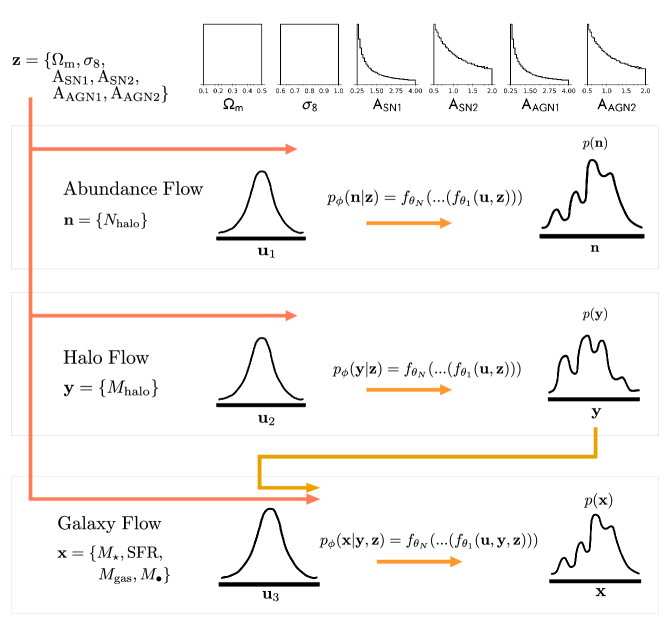
- 모델은 은하 및 은하단 속성 x와 우주론적 및 천체물리적 파ram터 z를 조건으로 하는 조건부 확률 분포 p(x|z)를 학습하기 위해 계층적 정규화 흐름(NFs)을 사용한다.
- 각 흐름 레이어는 신경 스퍼링 플로우 기반의 커파링 레이어를 사용하는 역행성 신경망을 활용하여 기저 정규분포에서 정확한 우도 추정과 이항 변환을 가능하게 한다.
- 모델은 6차원 조건부 파ram터(Ωm, σ8, ASN1, ASN2, AAGN1, AAGN2)와 타겟 변수(Mh, M⋆, Mgas, M•, SFR)를 사용하여 CAMELS Simba 시뮬레이션 세트에서 훈련된다.
- 계층은 세 가지 흐름으로 구성된다: 하위은하단 수를 위한 집합 빈도 흐름, 은하단 질량 분포를 위한 은하단 흐름, 그리고 연합 은하 속성 분포를 위한 은하 흐름.
- 과적합을 방지하기 위해 훈련 중에 조기 정지와 검증 기반 체크포인트 기법을 사용한다.
- 조건부 생성은 특정 z 파ram터를 사용하여 기저 분포에서 샘플링하고 학습된 역변환을 적용하여 달성된다.
실험 결과
연구 질문
- RQ1다양한 우주론적 및 천체물리적 파arameter에 걸쳐 계층적 정규화 흐름 모델이 은하단 질량 함수와 은하 스케일링 관계를 얼마나 잘 재현할 수 있는가?
- RQ2고정된 은하단 질량에서 은하 속성의 내재 산란을 고려하여, 랜덤성 있는 피드백 과정을 어떻게 포괄하는가?
- RQ3우주론적 파arameter(예: Ωm)와 천체물리적 피드백 강도(예: ASN1)의 변화가 예측된 은하-은하단 관계에 어떤 영향을 미치는가?
- RQ4모델이 관측된 관계와 일치하는 자율적이고 다차원적인 은하 속성 분포를 생성할 수 있는가?
- RQ5추론 또는 생성적 샘플링 중에 모델이 부수적 파arameter를 얼마나 효과적으로 근사화하는가?
주요 결과
- 모델은 50개 실현의 산란 내에서 은하단 질량 함수를 성공적으로 재현하였으며, 다양한 파arameter 세트에서 정규화와 형태가 정확하게 유지된다.
- 집합 빈도 흐름과 은하단 흐름에서 생성된 은하단에서 유래한 은하 성간 질량 함수(GSMF)는 진짜 시뮬레이션 분포와 일치하여 정확하게 복원된다.
- 우주론적 이론에 따르면 예상되는 바와 같이, Ωm와 은하단 및 은하 질량 함수의 정규화 사이에 강한 정의 상관관계를 포착한다.
- 은하 형성 시퀀스, 성간 질량 대 가스 질량 관계, 블랙홀 질량 관계, 성간 질량 대 은하단 질량 관계 등 모든 관계가 파arameter 변화에 걸쳐 일관되게 재현된다.
- 모델은 파arameter 변화에 대해 강건성을 보이며, 예측된 관계에서 ASN1, ASN2 및 Ωm에 대한 명확하고 물리적으로 타당한 의존성을 보여준다.
- 계층적 구조는 은하 및 은하단 속성의 일관된 연합 샘플링을 가능하게 하여 개별 관계를 별도로 모델링할 필요 없이 다차원 상관관계를 유지한다.

더 나은 연구,지금 바로 시작하세요
논문 읽기부터 검토까지, 연구 시간을 획기적으로 줄여보세요.
카드 등록 없음 · 무료 플랜 제공
이 리뷰는 AI가 만들고, 인간 에디터가 검토했습니다.