
[논문 리뷰] A Hitchhiker's Guide to Geometric GNNs for 3D Atomic Systems
Geometric Graph Neural Networks (GNNs) for 3D 원자 시스템에 대한 포괄적이고 독립적인 조사로, 아키텍처, 입력 파이프라인, 대칭성 및 응용 분야를 자세히 다룬다. 네 가지 분류 체계(invariant, Cartesian-equivariant, spherical-equivariant, unconstrained)를 제시하고 데이터셋, 과업, 향후 방향에 대해 논의한다.
Recent advances in computational modelling of atomic systems, spanning molecules, proteins, and materials, represent them as geometric graphs with atoms embedded as nodes in 3D Euclidean space. In these graphs, the geometric attributes transform according to the inherent physical symmetries of 3D atomic systems, including rotations and translations in Euclidean space, as well as node permutations. In recent years, Geometric Graph Neural Networks have emerged as the preferred machine learning architecture powering applications ranging from protein structure prediction to molecular simulations and material generation. Their specificity lies in the inductive biases they leverage - such as physical symmetries and chemical properties - to learn informative representations of these geometric graphs. In this opinionated paper, we provide a comprehensive and self-contained overview of the field of Geometric GNNs for 3D atomic systems. We cover fundamental background material and introduce a pedagogical taxonomy of Geometric GNN architectures: (1) invariant networks, (2) equivariant networks in Cartesian basis, (3) equivariant networks in spherical basis, and (4) unconstrained networks. Additionally, we outline key datasets and application areas and suggest future research directions. The objective of this work is to present a structured perspective on the field, making it accessible to newcomers and aiding practitioners in gaining an intuition for its mathematical abstractions.
연구 동기 및 목표
- Geometric GNNs for 3D 원자 시스템에 대한 구조화되고 교육적인 개요를 제공한다.
- Geometric 그래프 학습에서 물리적 대칭성과 귀납 편향의 역할을 설명한다.
- Geometric GNN 아키텍처의 분류 체계를 제안하고 설계 선택을 응용에 연결한다.
- 해당 분야의 데이터셋, 과업 및 향후 연구 방향을 요약한다.
제안 방법
- 3D 좌표와 벡터/텐서 특징을 갖는 기하학적 그래프를 소개한다.
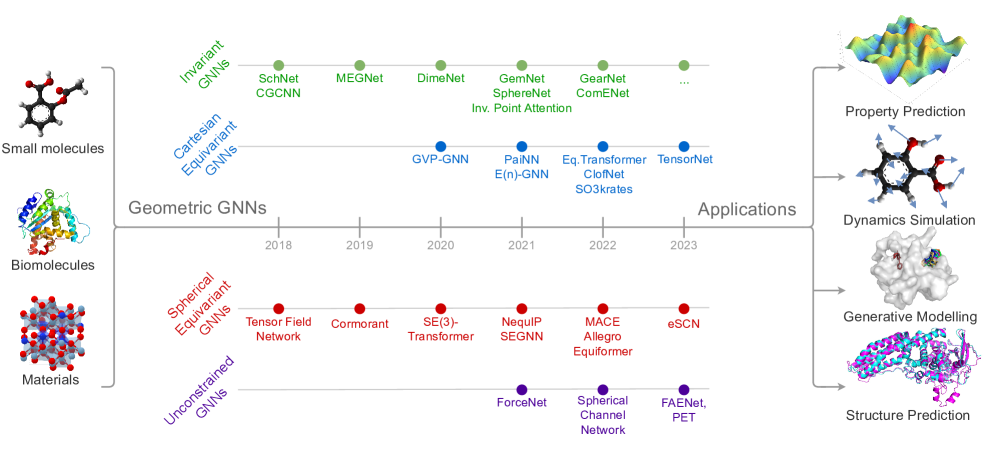
- Geometric GNN을 불변, Cartesian-equivariant, spherical-equivariant 및 unconstrained 가족으로 분류한다.
- Geometric GNN 내의 입력 준비, 임베딩, 상호작용(메시지 전달), 출력 블록을 설명한다.
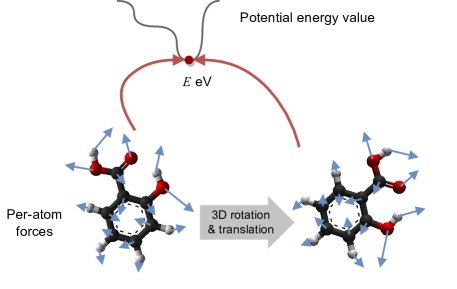
- 유클리드 대칭성(치환, 회전, 평행 이동)이 불변/등가성 설계에 어떻게 영향을 미치는지 설명한다.
- 그래프 구성 전략(컷오프, 완전 그래프, 장거리, 주기적 경계 조건) 및 전처리 방법을 논의한다.
실험 결과
연구 질문
- RQ1Geometric GNN에서 3D 원자 시스템의 물리적 대칭성을 가장 잘 강제하는 아키텍처 선택은 무엇인가?
- RQ2불변, Cartesian-equivariant, spherical-equivariant, 및 unconstrained GNN은 표현력과 적용 적합성에서 어떻게 다른가?
- RQ3원자 상호작용 모델링에 효과적인 그래프 구성 전략(컷오프, 장거리, 주기적)은 무엇인가?
- RQ4화학 및 재료 과학에서 Geometric GNN의 평가와 진전을 주도하는 데이터셋과 과업은 무엇인가?
주요 결과
- Geometric GNN은 물리적 대칭성을 명시적으로 인코딩하여 프레임 불변(close) 또는 등가성 예측을 의미 있게 생성한다.
- 4가지 분류 체계(invariant, Cartesian-equivariant, spherical-equivariant, unconstrained)가 핵심 아키텍처를 조직하고 설계 선택을 안내한다.
- 그래프 구성, 임베딩, 상호작용 블록 및 출력으로 구성된 입력 파이프라인이 3D 원자 시스템 모델링의 효과를 뒷받침한다.
- 작은 국소성, 정확도 및 계산 효율성의 균형을 맞추는 다양한 그래프 구성 전략(컷오프, 스무스 컷오프, 장거리, 주기적 경계)
- 이 논문은 특성 예측, 원자 간 포텐셜, 생성적 설계 및 구조 예측에 걸친 응용을 조사한다.
더 나은 연구,지금 바로 시작하세요
연구 설계부터 논문 작성까지, 연구 시간을 획기적으로 줄여보세요.
카드 등록 없음 · 무료 플랜 제공
이 리뷰는 AI가 만들고, 인간 에디터가 검토했습니다.