
[Paper Review] A Mathematical Description of the IDSA for Supernova Neutrino transport, its discretization and a comparison with a finite volume scheme for Boltzmann's Equation
This paper provides a rigorous mathematical formulation of the Isotropic Diffusion Source Approximation (IDSA) for neutrino transport in core-collapse supernovae, comparing it to a reduced Boltzmann equation solved via time-splitting and finite volume schemes. It demonstrates that the IDSA introduces a significant modeling error—approximately 20% in relative $L^2$ norm—mainly localized in the transition regime between trapped and free-streaming neutrino regimes, despite low discretization errors.
In this paper we give an introduction to the Boltzmann equation for neutrino transport used in core collapse supernova models as well as a detailed mathematical description of the \emph{Isotropic Diffusion Source Approximation} (IDSA). Furthermore, we present a numerical treatment of a reduced Boltzmann model problem based on time splitting and finite volumes and revise the discretization of the IDSA for this problem. Discretization error studies carried out on the reduced Boltzmann model problem and on the IDSA show that the errors are of order one in both cases. By a numerical example, a detailed comparison of the reduced model and the IDSA is carried out and interpreted. For this example the IDSA modeling error with respect to the reduced Boltzmann model is numerically determined and localized.
Motivation & Objective
- To provide a mathematically rigorous derivation and description of the Isotropic Diffusion Source Approximation (IDSA) for neutrino transport in core-collapse supernovae.
- To develop a numerical scheme based on time splitting and finite volumes for a reduced Boltzmann model with frozen background matter.
- To re-express and adapt the IDSA discretization to the reduced model for consistent comparison.
- To quantify and localize the modeling error of IDSA relative to the reduced Boltzmann model using numerical experiments.
- To assess the validity and limitations of IDSA in capturing key physical regimes of neutrino transport, especially in the transition between trapped and free-streaming behavior.
Proposed method
- Derives the $Ø(v/c)$ Boltzmann equation for neutrino transport in spherical symmetry, including energy, radius, and angular dependence.
- Introduces the IDSA as a decomposition of the distribution function into trapped and free-streaming components, coupled via a diffusion-based source term.
- Applies time-splitting to decouple reaction and transport operators, solving the reaction part analytically and the transport part with a conservative finite volume scheme.
- Adapts the IDSA discretization from prior work to the reduced model, ensuring consistency in spatial and angular grids.
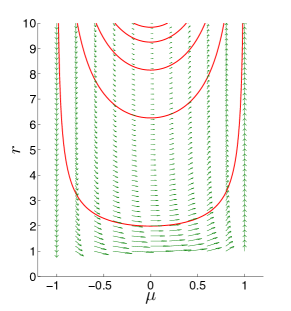
- Uses a high-resolution grid ($N_r=257$, $N_\mu=129$, $\Delta t=1.5625\cdot10^{-3}$) to ensure discretization error is below 1%.
- Computes modeling error as the $L^2$ relative difference between IDSA and Boltzmann solutions, and maps absolute differences spatially to localize error.
Experimental results
Research questions
- RQ1How does the IDSA model compare quantitatively to the reduced Boltzmann equation in terms of solution accuracy?
- RQ2Where in space is the modeling error of the IDSA most pronounced, particularly in relation to physical regimes?
- RQ3What is the magnitude of the IDSA modeling error relative to the reduced Boltzmann model, and how does it depend on the transition regime?
- RQ4How do discretization errors in both models affect the reliability of the comparison?
- RQ5Why does the IDSA exhibit faster convergence to equilibrium in the reaction-dominated regime compared to the Boltzmann model?
Key findings
- The IDSA modeling error relative to the reduced Boltzmann model is approximately 20% in the $L^2$ norm, with a margin of error of ±2%.
- The modeling error is predominantly localized in the intermediate transition regime between reaction-dominated and free-streaming regions, specifically in the spatial interval $(3,6)$.
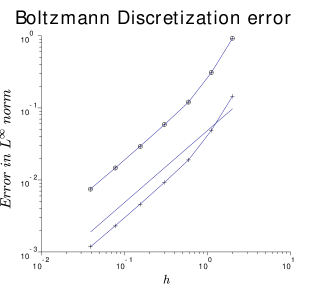
- Discretization errors for both the reduced Boltzmann model and the IDSA are of order one, but the authors control them below 1% through high-resolution grids.
- The IDSA underestimates the Boltzmann solution in both the reaction and transport regimes, with the largest underestimation occurring in the transition zone.
- The IDSA shows faster convergence to equilibrium in the reaction-dominated region due to strong coupling between trapped and streaming components via the stationary state approximation.
- The IDSA's streaming component does not vanish in the reaction-dominated regime as expected, leading to a reduction in the trapped component and contributing to modeling error.
Read this paper
Open the full text in the Nubint reader and ask about any passage as you read.
Read this paper on NubintThis review was generated by AI from the original paper. Please check the paper before citing it.