
[논문 리뷰] A planetary system with gas giants and super-Earths around the nearby M dwarf GJ 676A. Optimizing data analysis techniques for the detection of multi-planetary systems
이 연구는 M형 항성 GJ 676A의 HARPS radial velocity 데이터를 고도화된 데이터 분석 기법을 사용해 재분석한다—HARPS-TERRA를 통한 정밀한 RV 측정 및 개선된 주기도와 베이지안 MCMC 방법을 통한 신호 탐지—기존에 알려진 기체 거대행성과 함께 두 개의 슈퍼지구 및 질량이 큰 외부 공전체를 포함한 네 개의 행성 후보를 확인하며, 태양계와 유사한 질량 범위와 궤도 주기를 가진 M형 항성계로서는 최초로 기록된다.
Several M dwarfs are targets of systematical monitoring in searches for Doppler signals caused by low-mass exoplanet companions. As a result, an emerging population of high-multiplicity planetary systems around low-mass stars are being detected as well. We optimize classic data analysis methods and develop new ones to enhance sensitivity towards low-amplitude planets in high-multiplicity systems. We apply these methods to the public HARPS observations of GJ 676A, a nearby M dwarf with one reported gas giant companion. We re-derived Doppler measurements using the template matching method (HARPS-TERRA). We used refined versions of periodograms to assess the presence of additional low-mass companions. We analyse the same dataset with Bayesian tools and compared the performance of both approaches. We confirm the reported massive gas giant candidate and a long period trend, whose curvature is now well detected. We also find very secure evidence of two new candidates in close-in orbits and masses in the super-Earth mass regime. Despite the increased sensitivity of the new periodogram tools, we find that Bayesian methods are more sensitive in the early detection of candidate signals. While hardware development is important, development of data analysis techniques can help to reveal new results from existing data sets with significantly fewer resources. This new system holds the record of minimum-mass range (from Msin i = 4.5 M_Earth to 5 M_Jup) and period range (from 3.6 days to more than 10 years). Although all the planet candidates are substantially more massive, it is the first exoplanetary system with a general architecture similar to our solar system. GJ 676A can be happily added to the family of high-multiplicity planetary systems around M dwarfs.
연구 동기 및 목표
- M형 항성 주위의 다중행성계에서 저질량 행성을 더 높은 감도로 탐지하기 위해 정교화된 데이터 분석 기법을 적용한다.
- HARPS-TERRA 소프트웨어가 표준 교차상관함수 방법을 초월해 정밀한 라디얼 속도 측정을 향상시키는 데 효과적인지 테스트한다.
- 베이지안 MCMC 방법과 주기도 기반 접근법이 상호 연관된 매개변수를 가진 다중행성계에서 저진폭 행성 신호를 탐지하는 데 어떻게 비교되는지 분석한다.
- GJ 676A 주위의 행성계의 천체역학적 구조와 안정성을 연구하며, 특히 장주기 및 저질량 공전체에 초점을 맞춘다.
- 하드웨어 기반 정밀도 향상에 비해 비용 효율적인 데이터 분석 도구를 개발하여 기존 데이터의 효율적 활용을 가능하게 한다.
제안 방법
- 공개된 GJ 676A의 HARPS 스펙트럼에서 고정밀 라디얼 속도 측정을 도출하기 위해 최소 제곱법 기반 템플릿 매칭 방법인 HARPS-TERRA를 적용하여 표준 교차상관함수(CCF) 방법을 초월한다.
- 강한 다중행성 매개변수 상관관계가 존재하는 상황에서 저진폭 신호 감지 감도를 향상시키기 위해 재귀적 주기도 방법을 개발한다.
- 주기도 프레임워크 내에서 탐지된 신호의 통계적 유의성을 평가하기 위해 경험적 가짜 경고 확률(FAP)을 계산한다.
- 베이지안 MCMC 샘플링을 수행하여 궤도 매개변수의 전체 사후 분포를 모델링함으로써 다중행성의 강력한 탐지 및 특성화를 가능하게 한다.
- 빈도주의(주기도 + FAP)와 베이지안(MCMC) 접근법을 결합하여 신호 탐지의 유효성을 검증하고 결과에 대한 신뢰도를 높인다.
- 25개 이상의 새로운 HARPS 관측 데이터를 활용해 장주기 추세의 곡률을 탐지함으로써 질량이 큰 외부 공전체의 존재를 확인한다.
실험 결과
연구 질문
- RQ1HARPS-TERRA 및 개선된 주기도와 같은 고도화된 데이터 분석 기법이 기존의 라디얼 속도 데이터셋에서 저질량 행성을 크게 향상시킬 수 있는가?
- RQ2매개변수 상관관계가 있는 다중행성계에서 베이지안 MCMC 방법과 전통적인 주기도 기반 방법이 저진폭 신호를 탐지하는 데 어떻게 비교되는가?
- RQ3GJ 676A 주위의 행성계는 어떤 천체역학적 구조를 가지며, 탐지된 신호들은 안정적인 다중행성 구성과 일치하는가?
- RQ4라디얼 속도 추세의 곡률은 질량이 큰 외부 공전체에 기인한 것으로 확신할 수 있으며, 그 궤도 주기는 추정되는가?
- RQ5특히 내측에 위치한 슈퍼지구 후보들은 광학적 후속 관측, 예를 들어 전행 관측에 적합한가?
주요 결과
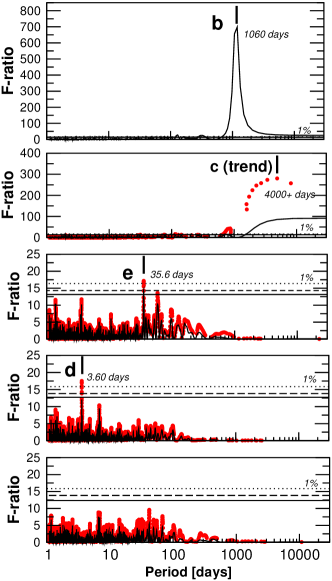
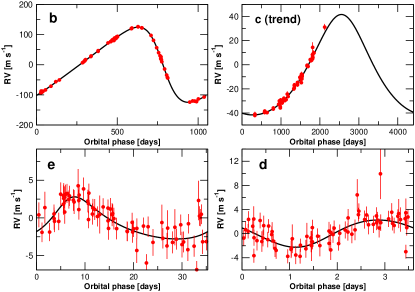
- 기존에 보고된 거대 기체 행성 후보(GJ 676Ab)를 확인하고, 장주기 추세를 통해 질량이 큰 외부 공전체가 존재함을 확인하며, 추정 주기는 4000일 이상이다.
- 두 개의 새로운 슈퍼지구 후보(GJ 676Ad 및 GJ 676Ac)가 확실하게 탐지되었으며, 최소 질량은 각각 약 4.5 M⊕이고 궤도 주기는 각각 약 3.6일과 15.5일이다.
- 베이지안 MCMC 분석은 잘 구속된 매개변수 간격을 가진 네 개의 행성 솔루션을 선호하며, 주기도 기반 방법은 25개의 추가 측정 후 동일한 신호를 확인한다.
- 이 시스템은 알려진 외계행성계 중에서 최소 질량(4.5 M⊕에서 5 Mjup)과 궤도 주기(3.6일에서 10년 이상)의 범위가 가장 넓으며, 태양계의 다양성에 가까운 특성을 보인다.
- 내측에 위치한 슈퍼지구 후보 GJ 676Ad는 약 5%의 전행 확률을 가지며, 성질을 확인하기 위한 광학적 후속 관측에 매우 적합한 대상이다.
- 베이지안 및 빈도주의 방법의 조합은 탐지에 대한 신뢰도를 높이며, 베이지안 방법은 저진폭 신호에 대해 더 높은 감도를 보이고 가짜 양성 위험을 감소시킨다.
더 나은 연구,지금 바로 시작하세요
연구 설계부터 논문 작성까지, 연구 시간을 획기적으로 줄여보세요.
카드 등록 없음 · 무료 플랜 제공
이 리뷰는 AI가 만들고, 인간 에디터가 검토했습니다.