
[Paper Review] A Prompt Array Keeps the Bias Away: Debiasing Vision-Language Models with Adversarial Learning
This paper proposes a prompt-based adversarial debiasing method for vision-language models using learnable 'debiasing' tokens appended to text queries, jointly optimized with a contrastive loss to reduce gender and racial bias in image-text representations. The approach achieves significant bias reduction across multiple metrics—MaxSkew and NDKL—without degrading representation quality, using only attribute-labeled face datasets as supervision.
Vision-language models can encode societal biases and stereotypes, but there are challenges to measuring and mitigating these multimodal harms due to lacking measurement robustness and feature degradation. To address these challenges, we investigate bias measures and apply ranking metrics for image-text representations. We then investigate debiasing methods and show that prepending learned embeddings to text queries that are jointly trained with adversarial debiasing and a contrastive loss reduces various bias measures with minimal degradation to the image-text representation.
Motivation & Objective
- To develop a robust, efficient method for measuring and mitigating representational bias in vision-language models.
- To evaluate existing bias measurement techniques and identify those most suitable for multimodal representations.
- To address the challenge of debiasing without retraining or access to original pretraining data.
- To minimize degradation of image-text representation quality during debiasing.
- To provide a lightweight, deployable debiasing protocol applicable to existing pretrained models.
Proposed method
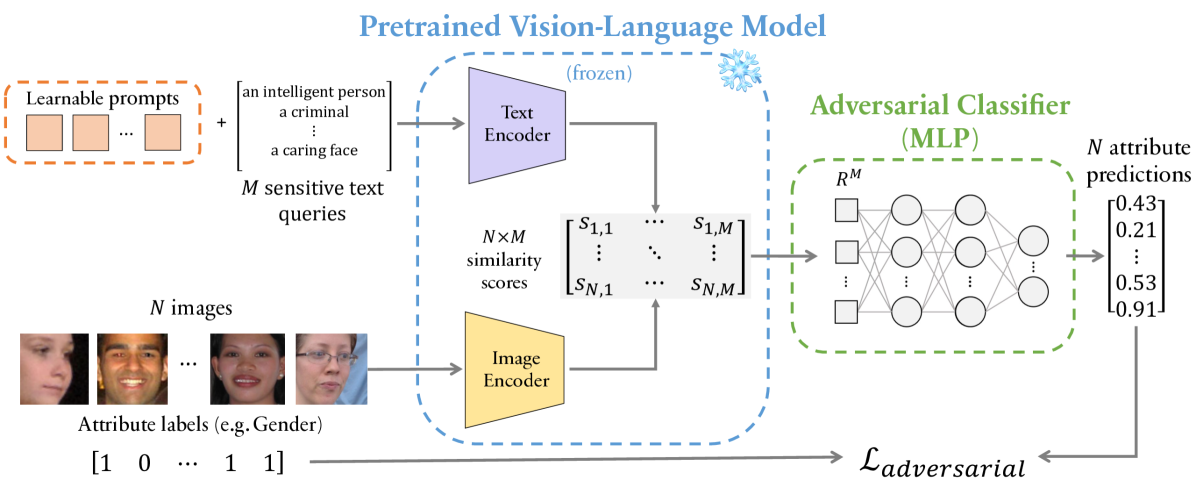
- Introduces an adversarial classifier that predicts image attribute labels (e.g., gender, race) from image-text similarity scores.
- Employs learnable 'debiasing' prompt tokens appended to sensitive text queries to maximize the adversary's error, thereby reducing biased correlations.
- Jointly optimizes the debiasing objective with a contrastive loss on generic image-text pairs to preserve representation quality.
- Uses only image attribute labels as supervision, avoiding costly retraining or access to original training data.
- Applies the method to face datasets (FairFace and UTKFace) with protected attribute annotations.
- Trains the prompt tokens end-to-end while keeping the vision and language encoders frozen.
Experimental results
Research questions
- RQ1Which bias measurement metrics are most effective for vision-language models, particularly in detecting representational harms?
- RQ2How does the proposed prompt-based adversarial debiasing method compare to existing debiasing techniques in terms of bias reduction and representation preservation?
- RQ3Can a lightweight, prompt-based method effectively reduce bias in vision-language models without fine-tuning the main encoders?
- RQ4To what extent does joint optimization with a contrastive loss prevent degradation of image-text representation during debiasing?
- RQ5How do intersectional attributes (e.g., race and gender) affect bias and mitigation performance?
Key findings
- MaxSkew and NDKL were identified as effective bias metrics for vision-language models, while WEAT was found inappropriate for this multimodal setting.
- The proposed method significantly reduced MaxSkew and NDKL across both FairFace and UTKFace datasets for gender and race attributes.
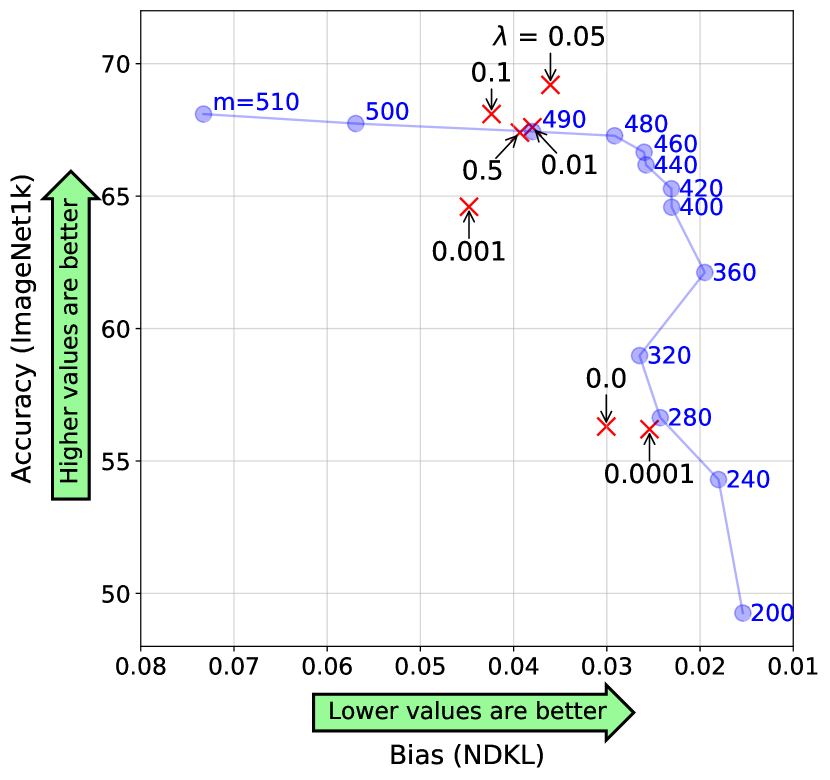
- Bias reduction was achieved with minimal degradation to image-text representation quality, thanks to joint training with the contrastive loss.
- Models pre-trained on larger datasets or with self-supervised learning (SSL) showed lower baseline bias, confirming prior findings in related domains.
- The method is effective even when attributes are combined (e.g., race and gender), suggesting potential for intersectional bias mitigation.
- The approach is computationally efficient and applicable to existing models without retraining, making it suitable for real-world deployment.
Read this paper
Open the full text in the Nubint reader and ask about any passage as you read.
Read this paper on NubintThis review was generated by AI from the original paper. Please check the paper before citing it.