
[Paper Review] A Quantum Algorithm for Model-Independent Searches for New Physics
This paper proposes a quantum-inspired test statistic, ${\mathcal{H}}_{\text{min}}$, for model-independent searches for new physics in binned collider data by mapping data residuals to an Ising spin lattice with spatially correlated interactions. The method reduces the look-elsewhere effect by exploiting correlations typical of physics signals but absent in statistical noise, outperforming traditional tests like $\chi^2$ in ROC curve analysis with up to 51.3% overlap reduction in 2D grids.
We propose a novel quantum technique to search for unmodeled anomalies in multidimensional binned collider data. We propose associating an Ising lattice spin site with each bin, with the Ising Hamiltonian suitably constructed from the observed data and a corresponding theoretical expectation. In order to capture spatially correlated anomalies in the data, we introduce spin-spin interactions between neighboring sites, as well as self-interactions. The ground state energy of the resulting Ising Hamiltonian can be used as a new test statistic, which can be computed either classically or via adiabatic quantum optimization. We demonstrate that our test statistic outperforms some of the most commonly used goodness-of-fit tests. The new approach greatly reduces the look-elsewhere effect by exploiting the typical differences between statistical noise and genuine new physics signals.
Motivation & Objective
- To develop a model-independent goodness-of-fit test that detects unmodeled anomalies in multi-dimensional binned collider data without assuming a specific new physics signal.
- To reduce the look-elsewhere effect by distinguishing spatially correlated signals from uncorrelated statistical fluctuations.
- To introduce a novel test statistic, ${\mathcal{H}}_{\text{min}}$, derived from the ground state energy of an Ising Hamiltonian constructed from data residuals.
- To enable both anomaly detection and interpretation via spin configuration analysis in the ground state.
- To explore the feasibility of using adiabatic quantum optimization for large-scale applications in high-energy physics.
Proposed method
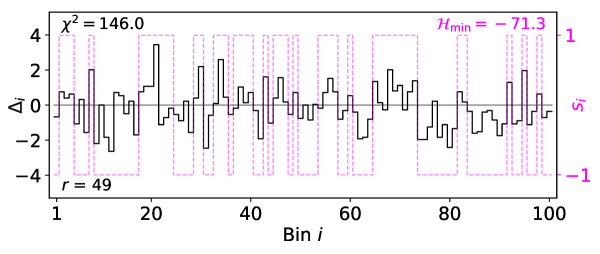
- Associate each data bin with a spin site $s_i = \pm 1$ in an Ising lattice, with spin configurations representing deviations from expected background.
- Define an Ising Hamiltonian ${\mathcal{H}}$ using normalized residuals $\Delta_i = (o_i - e_i)/\sqrt{e_i}$, incorporating nearest-neighbor spin-spin interactions and self-interactions.
- Construct the Hamiltonian as ${\mathcal{H}} = -\sum_i \frac{|\Delta_i|\Delta_i}{2} \cdot \frac{s_i}{2} - \frac{\lambda}{2} \sum_{i,j} w_{ij} \frac{(\Delta_i + \Delta_j)^2}{4} \cdot \frac{1 + s_i s_j}{2}$, where $\lambda$ controls interaction strength.
- Use the ground state energy ${\mathcal{H}}_{\text{min}}$ as a test statistic: lower values indicate worse fit to the background hypothesis.
- Compute ${\mathcal{H}}_{\text{min}}$ via classical methods like simulated annealing for small $N$, or adiabatic quantum optimization for large $N$.
- Interpret anomalies by analyzing spin configurations in the ground state, identifying large domains of aligned spins indicating correlated deviations.
Experimental results
Research questions
- RQ1Can a model-independent test statistic be constructed that captures spatial correlations in data residuals to improve anomaly detection in collider physics?
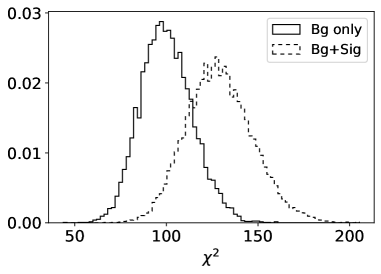
- RQ2How does the proposed ${\mathcal{H}}_{\text{min}}$ test statistic compare to traditional goodness-of-fit tests like $\chi^2$ in terms of statistical power and look-elsewhere effect reduction?
- RQ3To what extent can the ground state of an Ising Hamiltonian built from data residuals reveal interpretable structures indicative of new physics signals?
- RQ4Can adiabatic quantum optimization provide a scalable solution for computing ${\mathcal{H}}_{\text{min}}$ in high-dimensional, multi-bin data sets?
- RQ5How does the inclusion of systematic uncertainties, modeled via nuisance parameters $\vec{\theta}$, affect the robustness of the test statistic?
Key findings
- In a 1D example with 16 bins, the overlap between the null and signal distributions was 51.3% for the $\chi^2$ test, but reduced to 41.4% for ${\mathcal{H}}_{\text{min}}$, indicating improved separation.
- In a 2D $10\times10$ grid, the overlap area was 40.7% for $\chi^2$ and only 20.1% for ${\mathcal{H}}_{\text{min}}$, demonstrating a significant performance gain.
- The ROC curves in Fig. 8 show that ${\mathcal{H}}_{\text{min}}$ consistently outperforms the $\chi^2$ test and the 'regions' test in two-dimensional examples.
- The spin configurations in the ground state of ${\mathcal{H}}$ clearly show large domains of aligned spins for signal-like deviations, enabling interpretable anomaly localization.
- For large $N$, exact computation of ${\mathcal{H}}_{\text{min}}$ becomes infeasible, but adiabatic quantum optimization offers a promising scalable alternative.
- Classical methods like simulated annealing perform comparably to current adiabatic quantum optimizers, making them viable for near-term applications.
Read this paper
Open the full text in the Nubint reader and ask about any passage as you read.
Read this paper on NubintThis review was generated by AI from the original paper. Please check the paper before citing it.