
[Paper Review] A Review of Cybersecurity Incidents in the Food and Agriculture Sector
The paper catalogs 30 disclosed cybersecurity incidents in the food and agriculture sector from 2011–2023, analyzes attack patterns and impacts, surveys security frameworks, and proposes a Farmer-Centered AI (FCAI) framework with AI assurance.
The increasing utilization of emerging technologies in the Food & Agriculture (FA) sector has heightened the need for security to minimize cyber risks. Considering this aspect, this manuscript reviews disclosed and documented cybersecurity incidents in the FA sector. For this purpose, thirty cybersecurity incidents were identified, which took place between July 2011 and April 2023. The details of these incidents are reported from multiple sources such as: the private industry and flash notifications generated by the Federal Bureau of Investigation (FBI), internal reports from the affected organizations, and available media sources. Considering the available information, a brief description of the security threat, ransom amount, and impact on the organization are discussed for each incident. This review reports an increased frequency of cybersecurity threats to the FA sector. To minimize these cyber risks, popular cybersecurity frameworks and recent agriculture-specific cybersecurity solutions are also discussed. Further, the need for AI assurance in the FA sector is explained, and the Farmer-Centered AI (FCAI) framework is proposed. The main aim of the FCAI framework is to support farmers in decision-making for agricultural production, by incorporating AI assurance. Lastly, the effects of the reported cyber incidents on other critical infrastructures, food security, and the economy are noted, along with specifying the open issues for future development.
Motivation & Objective
- Motivate and justify the need to secure the Food & Agriculture (FA) sector as a critical infrastructure amid Industry 4.0 technologies.
- Compile and classify disclosed cybersecurity incidents in FA from 2011–2023 to assess threat patterns and impacts.
- Summarize commonly used cybersecurity frameworks and agriculture-specific security solutions.
- Propose an AI assurance-based framework (FCAI) to support farmer decision-making in agricultural AI systems.
- Discuss broader effects on critical infrastructure, food security, and the economy, and identify open challenges for future work.
Proposed method
- Systematic compilation of 30 incidents disclosed and documented in the FA sector between 2011 and 2023 (grouped by organization).
- Sourcing from FBI flash notifications, CSIS lists, internal organization reports, and media sources.
- Briefly describe each incident’s threat, ransom amount, and organizational impact.
- Synthesize findings to identify common threat vectors (e.g., ransomware) and incident consequences.
- Review popular cybersecurity frameworks and agriculture-specific security solutions relevant to FA.
- Introduce and describe the Farmer-Centered AI (FCAI) framework with AI assurance considerations.
Experimental results
Research questions
- RQ1What are the predominant cyber threats and attack patterns affecting the FA sector from 2011 to 2023?
- RQ2What are the typical impacts (data loss, financial loss, service disruption) of these incidents across FA organizations?
- RQ3Which cybersecurity frameworks and agriculture-specific security solutions are most applicable to mitigating FA sector risks?
- RQ4How can AI assurance be integrated into agricultural AI systems through the FCAI framework to enhance decision-making and resilience?
Key findings
- Cybersecurity threats in the FA sector are increasingly frequent, with ransomwares and data breaches being prominent.
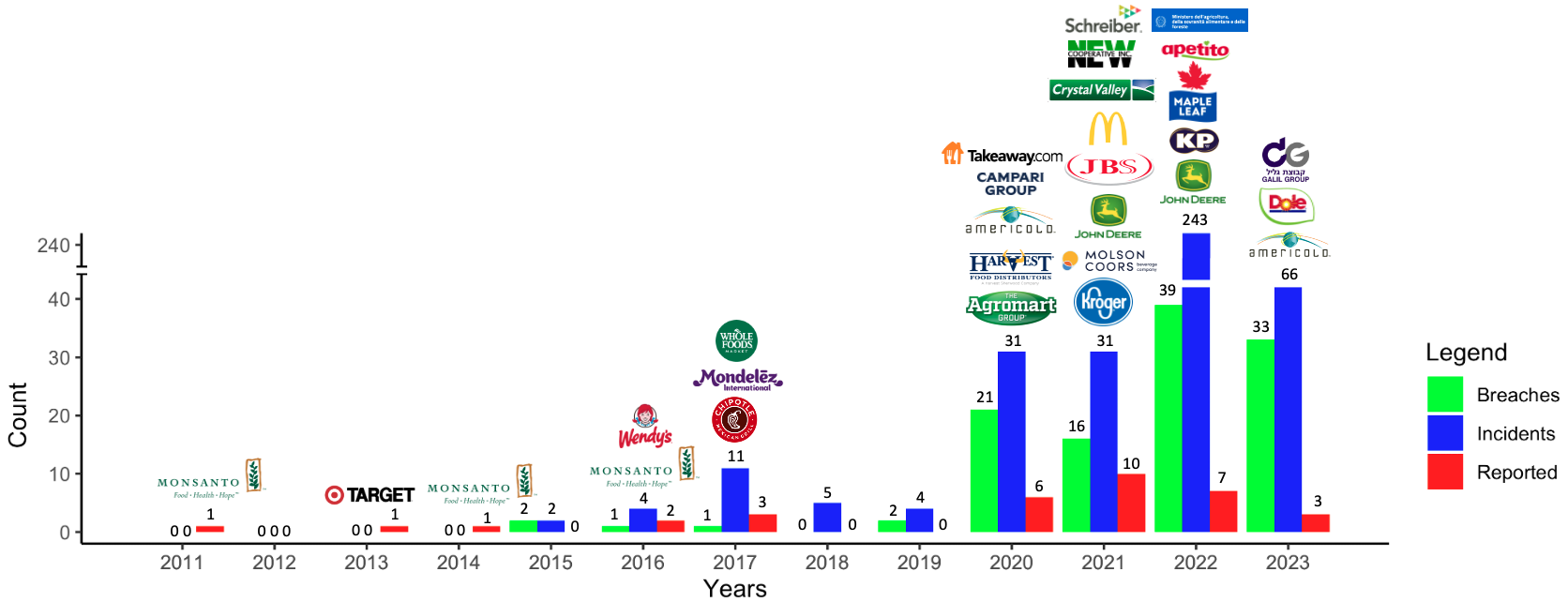
- The study catalogs 30 incidents across multiple countries and subsectors (food producers, retailers, distributors, and service providers) from 2011–2023.
- Notable financial impacts include Target’s data breach with approximately $202 million in costs, Mondelez’s roughly $180 million disruption, and other multi‑million losses.
- Ransomware and data exfiltration consistently disrupted operations, supply chains, and critical processing (e.g., plant operations, logistics, and inventory management).
- FA incidents show cross-sector effects on critical infrastructure, food security, and economic stability beyond the immediate victims.
- The paper advocates cybersecurity frameworks and agriculture-specific solutions, and proposes the FCAI framework to embed AI assurance in agricultural AI lifecycles.

Read this paper
Open the full text in the Nubint reader and ask about any passage as you read.
Read this paper on NubintThis review was generated by AI from the original paper. Please check the paper before citing it.