
[Paper Review] A rich hydrocarbon chemistry and high C to O ratio in the inner disk around a very low-mass star
Using JWST/MIRI, this study detects a rich hydrocarbon chemistry with a high C/O ratio in the inner 0.1 au of a very low-mass star's protoplanetary disk. The absence of strong silicate and water features, combined with high C₂H₂/CO₂ and C₂H₂/H₂O column density ratios, indicates oxygen is sequestered in icy solids beyond the water iceline, significantly influencing the volatile composition of forming exoplanets.
Carbon is an essential element for life but how much can be delivered to young planets is still an open question. The chemical characterization of planet-forming disks is a crucial step in our understanding of the diversity and habitability of exoplanets. Very low-mass stars ($<0.2~M_{\odot}$) are interesting targets because they host a rich population of terrestrial planets. Here we present the JWST detection of abundant hydrocarbons in the disk of a very low-mass star obtained as part of the MIRI mid-INfrared Disk Survey (MINDS). In addition to very strong and broad emission from C$_2$H$_2$ and its $^{13}$C$^{12}$CH$_2$ isotopologue, C$_4$H$_2$, benzene, and possibly CH$_4$ are identified, but water, PAH and silicate features are weak or absent. The lack of small silicate grains implies that we can look deep down into this disk. These detections testify to an active warm hydrocarbon chemistry with a high C/O ratio in the inner 0.1 au of this disk, perhaps due to destruction of carbonaceous grains. The exceptionally high C$_2$H$_2$/CO$_2$ and C$_2$H$_2$/H$_2$O column density ratios suggest that oxygen is locked up in icy pebbles and planetesimals outside the water iceline. This, in turn, will have significant consequences for the composition of forming exoplanets.
Motivation & Objective
- Investigate the chemical composition of the inner disk around a very low-mass star to understand volatile delivery to forming terrestrial planets.
- Characterize the abundance of hydrocarbons and oxygen-bearing species in a disk with a low stellar mass, which hosts a high population of terrestrial exoplanets.
- Determine the C/O elemental ratio in the gas phase and assess its implications for planet formation and habitability.
- Explain the observed absence of strong silicate and water features in the mid-infrared spectrum of the disk.
- Assess the role of icy pebbles and planetesimals in sequestering oxygen, based on column density ratios of key molecular species.
Proposed method
- Utilized JWST/MIRI mid-infrared spectroscopy to observe the protoplanetary disk around a very low-mass star as part of the MINDS survey.
- Performed continuum subtraction and extracted high-sensitivity, high-resolution spectra to isolate molecular emission features.
- Identified molecular species using laboratory and theoretical line lists from HITRAN and other databases, including C₂H₂, C₄H₂, benzene, CH₄, CO₂, and H₂O.
- Applied a slab model to derive column densities and excitation temperatures, with emission components split into optically thick (Component I) and thin (Component II) regions.
- Compared observed column density ratios (e.g., C₂H₂/CO₂, C₂H₂/H₂O) with predictions from disk models assuming solar C/O ratios.
- Used synthetic spectra generated with the publicly available slabspec code to validate model fits and interpret the observed emission features.
Experimental results
Research questions
- RQ1What is the chemical composition of the warm inner disk (within 0.1 au) of a very low-mass star, particularly regarding hydrocarbons and oxygen-bearing molecules?
- RQ2What is the gas-phase C/O elemental ratio in the inner disk, and how does it compare to solar values?
- RQ3Why are silicate and water features weak or absent in the mid-infrared spectrum, despite the presence of a disk?
- RQ4How is oxygen distributed in the disk, and what role do icy pebbles and planetesimals play in sequestering oxygen beyond the water iceline?
- RQ5What are the implications of a high C/O ratio and oxygen depletion in the gas phase for the volatile inventory of forming exoplanets?
Key findings
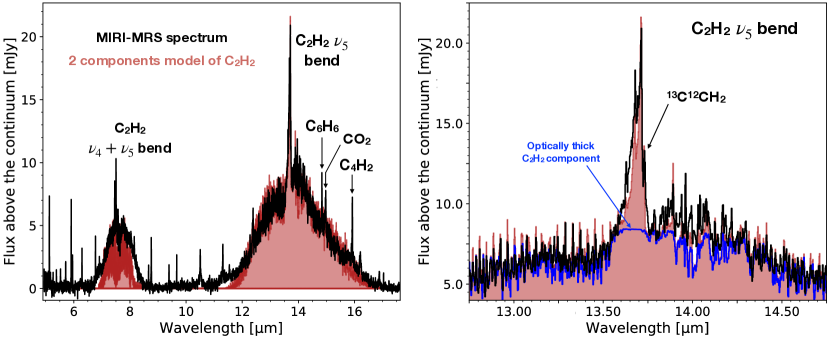
- JWST/MIRI detected strong and broad emission features from C₂H₂ and its ¹³C¹²CH₂ isotopologue, indicating a high abundance of acetylene in the inner disk.
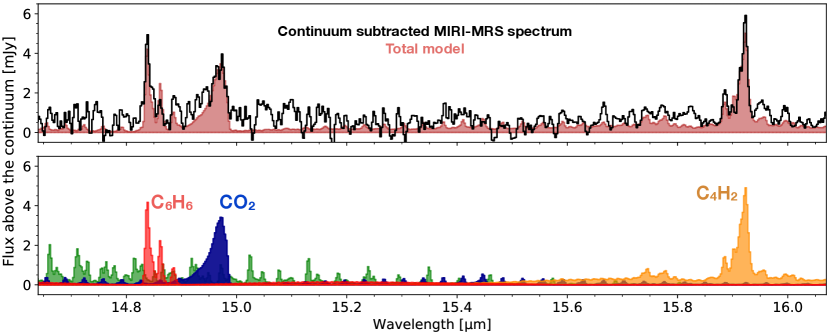
- Additional detections include C₄H₂, benzene, and possibly CH₄, confirming a rich hydrocarbon chemistry in the warm inner disk region.
- The CO₂ emission is dominated by the optically thick Component I, while small hydrocarbons are associated with the optically thinner Component II.
- The H₂O/C₂H₂ column density ratio is ≤1×10⁻², and the CO₂/C₂H₂ ratio is 8×10⁻³, both significantly lower than predicted by solar C/O models.
- The C₂H₂/CO₂ and C₂H₂/H₂O column density ratios are exceptionally high, implying that oxygen is largely locked in icy solids beyond the water iceline.
- The lack of strong silicate features suggests minimal small dust grains, allowing deep penetration into the disk and enabling detection of warm gas-phase molecules.
Read this paper
Open the full text in the Nubint reader and ask about any passage as you read.
Read this paper on NubintThis review was generated by AI from the original paper. Please check the paper before citing it.