
[Paper Review] A Survey of Imbalanced Learning on Graphs: Problems, Techniques, and Future Directions
This survey provides a comprehensive review of imbalanced learning on graphs (ILoGs), introducing two unified taxonomies—problem taxonomy (class and structure imbalance at node, edge, and graph levels) and technique taxonomy (data-, model-, and loss-based methods). It identifies key challenges, reviews existing solutions, and outlines future research directions in benchmarking, synthetic data generation, and foundation models for graph learning under data imbalance.
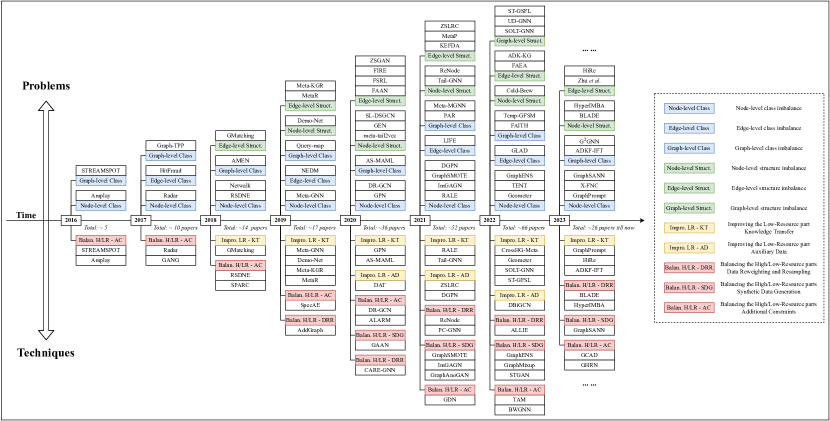
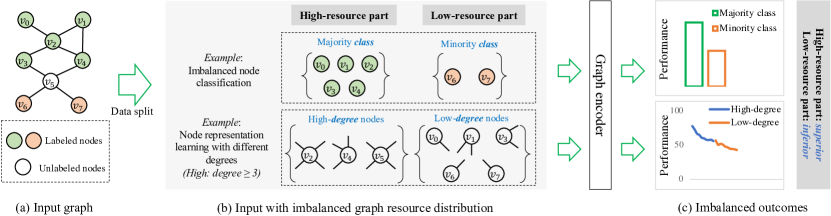
Graphs represent interconnected structures prevalent in a myriad of real-world scenarios. Effective graph analytics, such as graph learning methods, enables users to gain profound insights from graph data, underpinning various tasks including node classification and link prediction. However, these methods often suffer from data imbalance, a common issue in graph data where certain segments possess abundant data while others are scarce, thereby leading to biased learning outcomes. This necessitates the emerging field of imbalanced learning on graphs, which aims to correct these data distribution skews for more accurate and representative learning outcomes. In this survey, we embark on a comprehensive review of the literature on imbalanced learning on graphs. We begin by providing a definitive understanding of the concept and related terminologies, establishing a strong foundational understanding for readers. Following this, we propose two comprehensive taxonomies: (1) the problem taxonomy, which describes the forms of imbalance we consider, the associated tasks, and potential solutions; (2) the technique taxonomy, which details key strategies for addressing these imbalances, and aids readers in their method selection process. Finally, we suggest prospective future directions for both problems and techniques within the sphere of imbalanced learning on graphs, fostering further innovation in this critical area.
Motivation & Objective
- To address the growing challenge of data imbalance in graph-based machine learning, where high-resource and low-resource groups exhibit skewed performance.
- To unify the fragmented literature on imbalanced learning on graphs (ILoGs) by introducing a systematic taxonomy of problems and techniques.
- To identify underexplored research areas such as edge-level and graph-level imbalance, and structure-based imbalances beyond node degree.
- To guide researchers in selecting appropriate techniques by classifying methods according to imbalance type and solution strategy.
- To propose future directions including unified benchmarks, synthetic data with diffusion models, and integration of foundation models for text-informed graph learning.
Proposed method
- Proposes a problem taxonomy that categorizes imbalanced learning on graphs into two main types: class imbalance (at node, edge, and graph levels) and structure imbalance (e.g., degree, generalized node degree, graph size variation).
- Introduces a technique taxonomy that classifies methods into data-level (e.g., oversampling, undersampling), model-level (e.g., attention mechanisms, graph augmentation), and loss-level (e.g., focal loss, class-aware weighting) strategies.
- Reviews existing techniques across these categories, analyzing their effectiveness in mitigating bias in node classification, link prediction, and graph classification under imbalanced data.
- Analyzes the limitations of directly transferring techniques from vision and NLP to graph data due to non-i.i.d. and structural dependencies in graphs.
- Highlights the need for task-specific solutions, especially for few-shot link prediction and zero-shot graph classification in molecular and knowledge graph applications.
- Discusses emerging techniques such as diffusion models for synthetic data generation and foundation models (e.g., GPT) for text-augmented graph learning in low-resource scenarios.
Experimental results
Research questions
- RQ1What are the distinct forms of data imbalance in graph-structured data, and how do they differ from imbalances in tabular, vision, or NLP settings?
- RQ2How can existing techniques for imbalanced learning be systematically categorized and adapted for graph learning, given the unique structural dependencies in graphs?
- RQ3What are the key underexplored research problems in imbalanced graph learning, particularly at the edge and graph levels?
- RQ4How can novel techniques such as diffusion models and foundation models be leveraged to improve performance on low-resource graph groups?
- RQ5What role can unified benchmarks and leaderboards play in advancing reproducibility and progress in imbalanced graph learning research?
Key findings
- Class imbalance in graph learning is most studied at the node level, but edge-level and graph-level tasks—especially few-shot link prediction and imbalanced graph classification—remain under-investigated.
- Structure imbalance, such as variations in node degree or generalized structural context, significantly affects model performance and is often overlooked in current methods.
- Current techniques are largely limited to node-level tasks, with few methods addressing graph size variation or structural heterogeneity as sources of imbalance.
- Cross-branch technique exploration—e.g., applying data-level methods to model-level problems—shows promise and is underutilized in existing literature.
- Synthetic data generation using diffusion models offers a viable alternative to GANs for balancing low-resource groups, particularly in molecular and knowledge graph applications.
- The absence of unified benchmarks and leaderboards hinders progress and calls for standardized evaluation frameworks to enable fair comparison and reproducibility in ILoGs research.
Read this paper
Open the full text in the Nubint reader and ask about any passage as you read.
Read this paper on NubintThis review was generated by AI from the original paper. Please check the paper before citing it.