
[Paper Review] A Survey of Privacy Threats and Defense in Vertical Federated Learning: From Model Life Cycle Perspective
A comprehensive survey of privacy threats and defenses in Vertical Federated Learning (VFL), organized around the model life cycle, with taxonomy and guidance for practitioners.
Vertical Federated Learning (VFL) is a federated learning paradigm where multiple participants, who share the same set of samples but hold different features, jointly train machine learning models. Although VFL enables collaborative machine learning without sharing raw data, it is still susceptible to various privacy threats. In this paper, we conduct the first comprehensive survey of the state-of-the-art in privacy attacks and defenses in VFL. We provide taxonomies for both attacks and defenses, based on their characterizations, and discuss open challenges and future research directions. Specifically, our discussion is structured around the model's life cycle, by delving into the privacy threats encountered during different stages of machine learning and their corresponding countermeasures. This survey not only serves as a resource for the research community but also offers clear guidance and actionable insights for practitioners to safeguard data privacy throughout the model's life cycle.
Motivation & Objective
- Provide a structured, lifecycle-based taxonomy of privacy threats in VFL.
- Differentiate VFL privacy challenges from HFL and identify unique attack vectors.
- Survey and categorize defense mechanisms (cryptographic and non-cryptographic) for VFL privacy.
- Highlight open challenges, gaps, and future research directions in VFL privacy.
Proposed method
- Classify privacy threats in VFL into feature inference, label inference, and model extraction attacks.
- Describe attacker knowledge, behavior, and capabilities (white/black/gray-box, insider threats).
- Outline VFL architectures (Aggregate VFL and Split VFL) and roles (active/passive parties, coordinator).
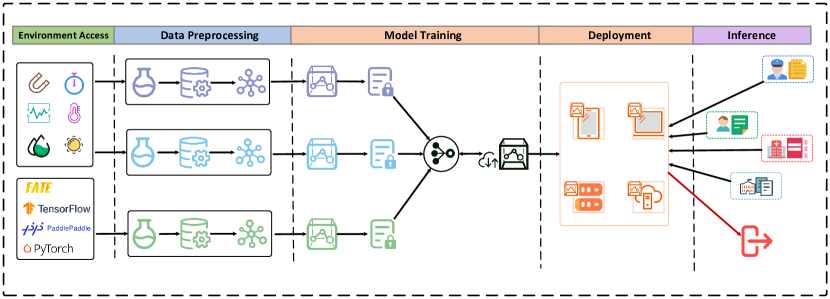
- Map threats and defenses to stages of the ML life cycle (environment access, data preprocessing, training, deployment, inference).
- Provide a taxonomy of defense mechanisms, including cryptographic (HE, FE, MPC) and non-cryptographic approaches, and discuss defense capabilities (trusted third party, training control, coordination, hardware).
- Relate VFL privacy to split learning and discuss implications for practical safeguarding of data privacy.
Experimental results
Research questions
- RQ1What are the distinct privacy threats in Vertical Federated Learning across the model life cycle?
- RQ2How do privacy risks in VFL differ from Horizontal FL, and what unique defense strategies are effective?
- RQ3What defense mechanisms (cryptographic and non-cryptographic) are proposed for protecting VFL privacy, and what are their requirements and trade-offs?
- RQ4What are the open challenges and future directions for safeguarding privacy in VFL?
Key findings
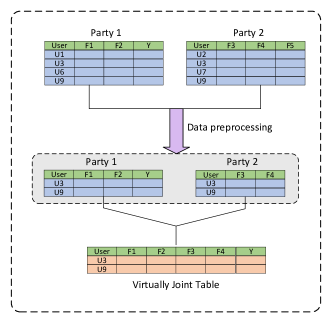
- VFL presents more intricate privacy concerns than HFL due to direct exchange of intermediate results and feature correlations across aligned samples.
- A lifecycle-based view reveals threat vectors during environment access, data preprocessing (including entity alignment), training, inference, and deployment, with corresponding countermeasures.
- Cryptographic defenses (e.g., homomorphic encryption, functional encryption, secure MPC) and non-cryptographic defenses are surveyed, with discussion of their capabilities and trade-offs (trusted third parties, training control, coordination, hardware).
- VFL architectures are categorized into Aggregate VFL and Split VFL, influencing how privacy risks and defenses are applied.
- Attacker models include insider adversaries (active, passive, colluding) and cover white-box, black-box, and gray-box scenarios, with strategies like gradient/inverse and surrogate model attacks.
- The survey provides a comprehensive taxonomy distinguishing VFL privacy threats from HFL and offers guidance for practitioners to protect privacy throughout the model life cycle.
Read this paper
Open the full text in the Nubint reader and ask about any passage as you read.
Read this paper on NubintThis review was generated by AI from the original paper. Please check the paper before citing it.