
[Paper Review] A Survey on Detection of LLMs-Generated Content
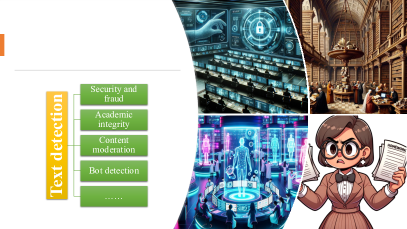
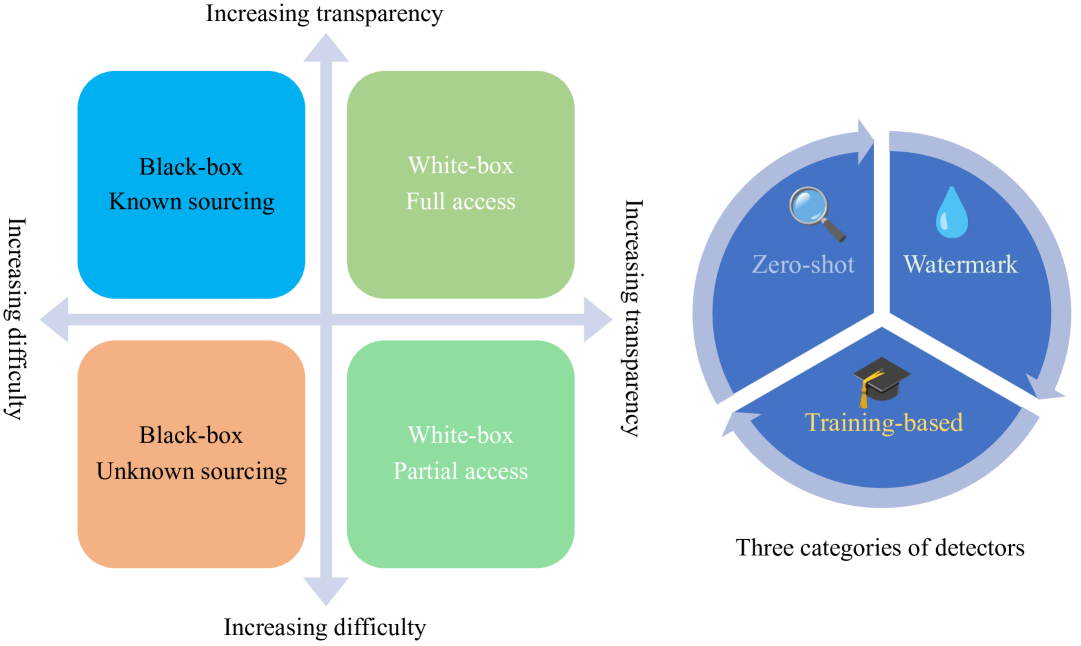
This survey provides a comprehensive analysis of detection methods for large language model (LLM)-generated content, categorizing techniques into training-based, zero-shot, and watermarking approaches. It identifies key challenges such as model robustness, bias, and generalization across evolving LLMs, and advocates for multi-faceted, adaptive detection systems to ensure reliability in real-world applications.
The burgeoning capabilities of advanced large language models (LLMs) such as ChatGPT have led to an increase in synthetic content generation with implications across a variety of sectors, including media, cybersecurity, public discourse, and education. As such, the ability to detect LLMs-generated content has become of paramount importance. We aim to provide a detailed overview of existing detection strategies and benchmarks, scrutinizing their differences and identifying key challenges and prospects in the field, advocating for more adaptable and robust models to enhance detection accuracy. We also posit the necessity for a multi-faceted approach to defend against various attacks to counter the rapidly advancing capabilities of LLMs. To the best of our knowledge, this work is the first comprehensive survey on the detection in the era of LLMs. We hope it will provide a broad understanding of the current landscape of LLMs-generated content detection, offering a guiding reference for researchers and practitioners striving to uphold the integrity of digital information in an era increasingly dominated by synthetic content. The relevant papers are summarized and will be consistently updated at https://github.com/Xianjun-Yang/Awesome_papers_on_LLMs_detection.git.
Motivation & Objective
- To provide a systematic overview of existing detection strategies for LLM-generated text and code across diverse applications.
- To identify critical challenges in detection, including model robustness, bias against non-native speakers, and poor generalization across LLM variants.
- To analyze adversarial attacks on detection systems and emphasize the need for resilient, multi-faceted defense mechanisms.
- To advocate for standardized evaluation, explainability, and transparency in detection tools to ensure fairness and reliability.
- To serve as a foundational reference for researchers and practitioners aiming to uphold digital information integrity in the era of synthetic content.
Proposed method
- Classifies detection methods by working mechanism and scope, including training-based, zero-shot, and watermarking techniques.
- Reviews benchmark datasets and evaluation metrics used in LLM detection research, emphasizing reproducibility and standardization.
- Analyzes model sourcing (e.g., GPT-who) that identifies the specific LLM origin of generated text using statistical signatures like Uniform Information Density (UID).
- Examines watermarking approaches as a proactive detection method, assessing their resilience under paraphrasing and context-length attacks.
- Investigates adversarial attacks on detectors, such as prompt engineering and paraphrasing, to test robustness and reliability.
- Evaluates generalization performance across unseen LLMs and data sources, highlighting limitations in zero-shot detection.
Experimental results
Research questions
- RQ1What are the dominant detection methodologies for LLM-generated content, and how do they differ in mechanism and performance?
- RQ2How do current detectors perform across diverse linguistic, stylistic, and domain-specific scenarios, particularly for non-English text and code?
- RQ3To what extent can detectors generalize to newly released or fine-tuned LLMs, such as updated versions of ChatGPT?
- RQ4What are the key vulnerabilities of existing detection systems to adversarial attacks, and how can they be mitigated?
- RQ5How can detection systems be made more equitable, transparent, and explainable to reduce bias and improve trust in real-world deployment?
Key findings
- Current detectors exhibit significant bias against non-native English speakers and perform poorly on non-English or shorter texts.
- Zero-shot detectors fail to generalize across different LLM generators, as shown by Pu et al. (2023), indicating a lack of robustness.
- Watermarking techniques show reliability under human paraphrasing and attacks at context lengths around 1000 tokens, according to Kirchenbauer et al. (2023b).
- Model sourcing methods like GPT-who achieve accurate attribution using UID-based features, enabling identification of specific LLMs and human authors.
- Performance degradation in detectors is observed over time as LLMs are updated, as demonstrated by Tu et al. (2023) with daily monitoring of ChatGPT responses.
- No existing detector is universally reliable, and all face challenges in handling evolving LLM capabilities, prompting the need for adaptive and multi-faceted detection strategies.
Read this paper
Open the full text in the Nubint reader and ask about any passage as you read.
Read this paper on NubintThis review was generated by AI from the original paper. Please check the paper before citing it.