
[논문 리뷰] A Unified Learning Model for Estimating Fiber Orientation Distribution Functions on Heterogeneous Multi-shell Diffusion-weighted MRI
이 논문은 이질적인 다중껍질 확산-weighted MRI에서 섬유 방향 분포 함수(fODFs)를 통합적이고 엔드 투 엔드로 추정하기 위한 단일 단계 구조의 구면 컨volution 신경망과 동적 헤드를 제안한다. q-space와 반경 방향 b-값 정보를 함께 모델링함으로써, 다양한 껍질 구성에서 fODF 정확도와 스캔-재스캔 일관성 면에서 다단계 학습 접근법을 능가하며, HCP 청소년 성인 데이터에서 최신 기술 수준의 성능을 달성한다.
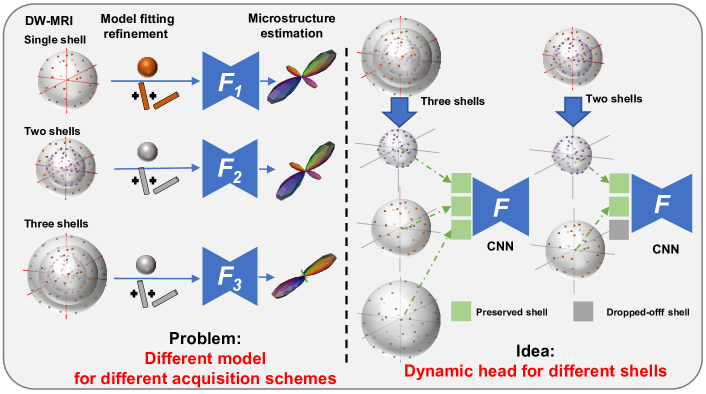
Diffusion-weighted (DW) MRI measures the direction and scale of the local diffusion process in every voxel through its spectrum in q-space, typically acquired in one or more shells. Recent developments in micro-structure imaging and multi-tissue decomposition have sparked renewed attention to the radial b-value dependence of the signal. Applications in tissue classification and micro-architecture estimation, therefore, require a signal representation that extends over the radial as well as angular domain. Multiple approaches have been proposed that can model the non-linear relationship between the DW-MRI signal and biological microstructure. In the past few years, many deep learning-based methods have been developed towards faster inference speed and higher inter-scan consistency compared with traditional model-based methods (e.g., multi-shell multi-tissue constrained spherical deconvolution). However, a multi-stage learning strategy is typically required since the learning process relies on various middle representations, such as simple harmonic oscillator reconstruction (SHORE) representation. In this work, we present a unified dynamic network with a single-stage spherical convolutional neural network, which allows efficient fiber orientation distribution function (fODF) estimation through heterogeneous multi-shell diffusion MRI sequences. We study the Human Connectome Project (HCP) young adults with test-retest scans. From the experimental results, the proposed single-stage method outperforms prior multi-stage approaches in repeated fODF estimation with shell dropoff and single-shell DW-MRI sequences.
연구 동기 및 목표
- 다중껍질 확산 MRI에서 중간 표현(예: SHORE)에 의존하는 다단계 딥러닝 파ip라인의 한계를 해결하기 위해.
- 재학습 없이도 임의의 b-값 조합을 처리할 수 있는 단일 통합 모델을 개발하기 위해.
- 이질적인 다중껍질 촬영에서 fODF 추정의 상호 스캔 일관성과 정확도를 향상시키기 위해.
- 다양한 껍질 구성에 맞게 네트워크 헤드를 동적으로 적응시켜 플러그 앤 플레이 방식으로 미세구조 특성 추정을 가능하게 하기 위해.
- fODF 예측 및 조직 부피 분율 추정에서 모델 기반(예: MSMT-CSD) 및 데이터 기반 기준보다 우월한 성능을 내기 위해.
제안 방법
- 다중껍질 DW-MRI 데이터에 대해 엔드 투 엔드로 훈련된 단일 단계의 구면 컨volution 신경망(SCNN)이 원시 q-space 신호를 직접 fODF 표현으로 매핑한다.
- 입력 껍질 구성에 따라 최종 완전 연결층을 자동으로 조정하는 동적 헤드 메커니즘이 도입되어 다양한 b-값 조합으로의 일반화를 가능하게 한다.
- 네트워크는 중간 표현(예: SHORE 또는 구면 조화 함수)을 피하고, 각도(구면) 및 반경(비-값) 신호 차원을 모두 활용한다.
- 모델은 조직 부피 분율 예측을 위해 평균 제곱오차(MSE) 손실을, fODF 유사도를 진값과 비교하기 위해 각도 상관 계수(ACC)를 사용하여 훈련된다.
- 재현성과 일반화 능력을 평가하기 위해 인간 연결도 프로젝트(HCP) 데이터와 테스트-재측정 스캔을 사용하여 아키텍처를 평가한다.
- 독립적인 모델 각각의 껍질 구성과 기준 딥러닝 및 모델 기반 방법(예: MSMT-CSD)과의 비교를 수행한다.
실험 결과
연구 질문
- RQ1재학습 없이도 다양한 다중껍질 확산 MRI 구성에 일반화할 수 있는 단일 딥러닝 모델이 가능한가?
- RQ2q-space와 반경 방향 b-값을 함께 모델링하는 엔드 투 엔드 학습이 다단계 접근법보다 fODF 추정 정확도를 향상시키는가?
- RQ3제안된 방법은 fODF 및 조직 부피 분율 추정에서 스캔-재측정 일관성 면에서 어떻게 성능을 내는가?
- RQ4동적 헤드 메커니즘이 다양한 b-값 조합에 맞게 네트워크를 효과적으로 적응시키며 높은 성능를 유지하는가?
- RQ5통합 모델이 fODF 예측 및 조직 분율 복원에서 모델 기반(MSMT-CSD) 및 데이터 기반 기준을 모두 능가하는가?
주요 결과
- 제안된 단일 단계 방법은 모든 껍질 구성에서 평균 각도 상관 계수(ACC) 0.824를 달성하여, 최고의 기준(0.815)과 MSMT-CSD 황금 표준을 능가하는 fODF 예측 성능을 보였다.
- 동적 헤드와 구면 컨볼루션을 갖춘 통합 모델은 전체 3껍질 구성(C1,2,3)에서 최고의 ACC 0.837을 기록하여, 별도로 훈련된 모델조차도 뛰어넘었다.
- 스캔-재측정 일관성은 크게 향상되었으며, 전체 다중껍질 데이터에서 통합 모델의 일관성 점수는 0.865로 MSMT-CSD 황금 표준(0.856)을 초월했다.
- 전체 다중껍질 케이스에서 조직 부피 분율 예측 MSE는 5.92×10⁻⁴로 모든 방법 중에서 가장 낮아, 뛰어난 미세구조 추정 능력을 보였다.
- 동적 헤드 설계 덕분에 단일 모델이 모든 껍질 구성으로 일반화할 수 있었으며, 재학습이나 구성별 별도 모델이 필요 없어졌다.
- 다단계 방법이 실패하는 상황에서도, 껍질 손실 시나리오에서조차 높은 정확도와 일관성을 유지하는 등 뛰어난 성능를 보였다.

더 나은 연구,지금 바로 시작하세요
논문 읽기부터 검토까지, 연구 시간을 획기적으로 줄여보세요.
카드 등록 없음 · 무료 플랜 제공
이 리뷰는 AI가 만들고, 인간 에디터가 검토했습니다.