
[Paper Review] A unified realization of electrical quantities from the quantum International System of Units
This paper presents a zero-field quantum current sensor (QCS) that realizes the ampere using a quantum anomalous Hall resistor and a programmable Josephson voltage standard integrated within a single cryostat, achieving a relative combined uncertainty of 3.91 × 10⁻⁶ A/A at 252 nA and validating accuracy via Ohm’s law comparison with a 1.46 × 10⁻⁶ A/A agreement near 83.9 nA.
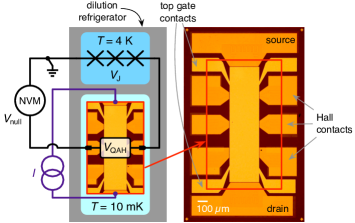
In the revised International System of Units (SI), the ohm and the volt are realized from the von Klitzing constant and the Josephson constant, and a practical realization of the ampere is possible by applying Ohm's law directly to the quantum Hall and Josephson effects. As a result, it is possible to create an instrument capable of realizing all three primary electrical units, but the development of such a system remains challenging. Here we report a unified realization of the volt, ohm, and ampere by integrating a quantum anomalous Hall resistor (QAHR) and a programmable Josephson voltage standard (PJVS) in a single cryostat. Our system has a quantum voltage output that ranges from 0.24 mV to 6.5 mV with combined relative uncertainties down to 3 $μ$V/V. The QAHR provides a realization of the ohm at zero magnetic field with uncertainties near 1 $μΩ$/$Ω$. We use the QAHR to convert a longitudinal current to a quantized Hall voltage and then directly compare that against the PJVS to realize the ampere. We determine currents in the range of 9.33 nA to 252 nA, and our lowest uncertainty is 4.3 $μ$A/A at 83.9 nA. For other current values, a systematic error that ranges from -10 $μ$A/A to -30 $μ$A/A is present due to the imperfect isolation of the PJVS microwave bias.
Motivation & Objective
- To enable a practical, traceable realization of the ampere in the 9.33 nA to 252 nA range, a critical gap in existing quantum standards.
- To overcome the limitations of traditional Ohm’s law-based current standards, which suffer from high uncertainty due to long calibration chains.
- To eliminate the need for external magnetic fields in quantum current measurement by using a quantum anomalous Hall (QAH) resistor with zero-field quantized Hall resistance.
- To integrate a programmable Josephson voltage standard (PJVS) and QAH resistor in a single cryostat, reducing system complexity and improving stability.
- To validate the QCS accuracy by comparing its measurements to a conventional Ohm’s law-based measurement, establishing traceability to fundamental constants.
Proposed method
- Directly couple a quantum anomalous Hall (QAH) resistor, which exhibits quantized Hall resistance (Ryx = h/e²) in zero magnetic field, to a programmable Josephson voltage standard (PJVS) within a single cryostat.
- Use the PJVS to generate a precisely known voltage across the QAH device, enabling direct current measurement via Ohm’s law: I = V / R.
- Implement a cryogenic current comparator (CCC) to measure the QAH device’s resistance with high precision by comparing it to a calibrated 100 Ω standard resistor.
- Employ a superconducting quantum interference device (SQUID) to detect null voltage differences in the CCC bridge, minimizing noise and drift.
- Apply overlapping Allan variance analysis to assess the stability of the null voltage measurements over time, identifying dominant noise sources such as 1/f noise and white noise.
- Use a custom interposer with a shunt capacitor to suppress differential-mode noise from the PJVS during direct-mode measurements, while maintaining superconducting coupling during QAH quantization.
Experimental results
Research questions
- RQ1Can a quantum current sensor be realized in zero magnetic field using a QAH resistor and a PJVS in a single cryostat?
- RQ2What is the achievable uncertainty of current measurement in the 9.33 nA to 252 nA range using this integrated quantum approach?
- RQ3How does the accuracy of the QCS compare to a conventional Ohm’s law-based measurement using secondary standards?
- RQ4What are the dominant sources of uncertainty in the measurement chain, and how can they be quantified and minimized?
- RQ5Can the stability of the null voltage measurement be characterized to ensure reliable and repeatable current readings over time?
Key findings
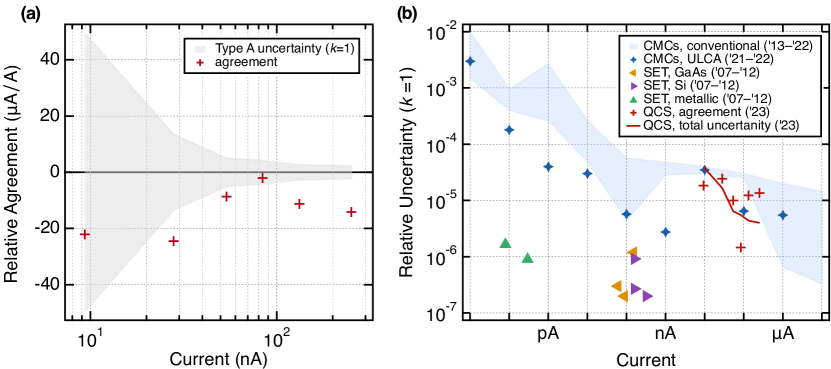
- The QCS achieves a relative combined uncertainty of 3.91 × 10⁻⁶ A/A at 252 nA, with a Type A uncertainty of 2.30 × 10⁻⁶ A/A, representing a significant improvement over traditional nA current standards.
- At the lowest current of 9.33 nA, the total relative uncertainty increases to 41.2 × 10⁻⁶ A/A, still demonstrating a viable path for quantum realization in the sub-nA range.
- The QCS shows best agreement (1.46 ± 4.28) × 10⁻⁶ A/A with a conventional Ohm’s law measurement at 83.9 nA, where the highest number of measurements were made.
- The uncertainty budget identifies the standard resistor (3 nΩ/Ω, k=1), CCC winding ratio error (a few parts in 10⁻¹⁰), and SQUID rectification noise as key contributors.
- Allan deviation analysis confirms measurement stability, with noise behavior consistent with white and 1/f noise, and the overlapping Allan variance method improves statistical confidence.
- The use of a custom interposer with a shunt capacitor effectively suppresses differential noise from the PJVS during direct measurements, enabling stable operation.
Read this paper
Open the full text in the Nubint reader and ask about any passage as you read.
Read this paper on NubintThis review was generated by AI from the original paper. Please check the paper before citing it.