
[Paper Review] Adapting Pre-trained Language Models for Quantum Natural Language Processing
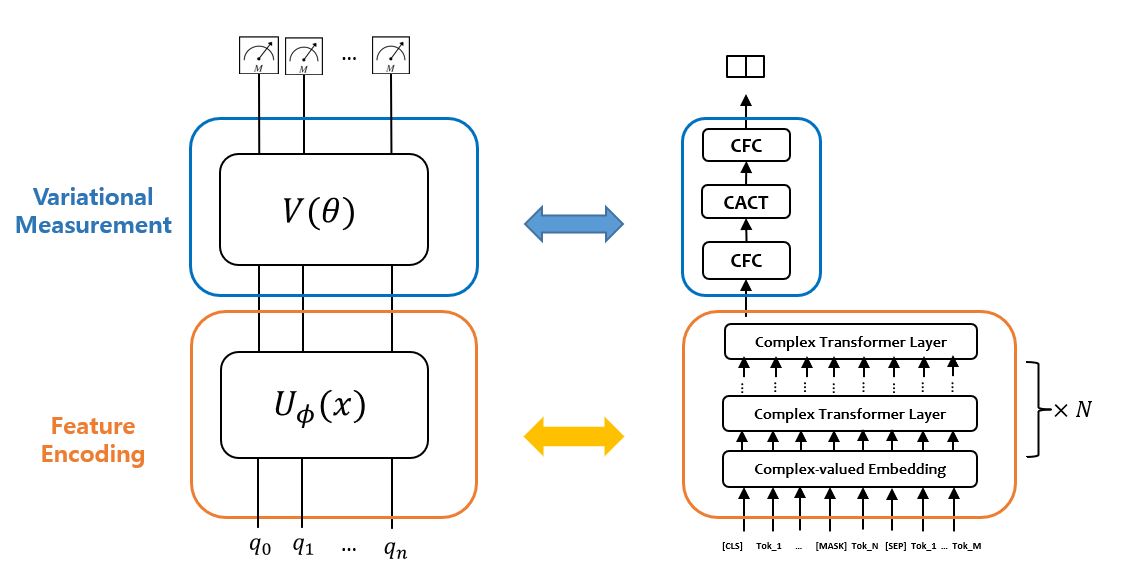
This paper introduces the first classical-quantum transfer learning framework for Quantum Natural Language Processing (QNLP) by pre-training a complex-valued BERT-like model (QBert) compatible with quantum circuits. By encoding sentence representations as quantum states and using quantum-compatible training, QBert boosts end-to-end quantum models by 50–60% in accuracy on GLUE benchmarks, demonstrating a major performance gain through pre-trained quantum encodings.
The emerging classical-quantum transfer learning paradigm has brought a decent performance to quantum computational models in many tasks, such as computer vision, by enabling a combination of quantum models and classical pre-trained neural networks. However, using quantum computing with pre-trained models has yet to be explored in natural language processing (NLP). Due to the high linearity constraints of the underlying quantum computing infrastructures, existing Quantum NLP models are limited in performance on real tasks. We fill this gap by pre-training a sentence state with complex-valued BERT-like architecture, and adapting it to the classical-quantum transfer learning scheme for sentence classification. On quantum simulation experiments, the pre-trained representation can bring 50\% to 60\% increases to the capacity of end-to-end quantum models.
Motivation & Objective
- To bridge the gap between pre-trained language models and quantum NLP by enabling classical-quantum transfer learning in NLP.
- To overcome the limitations of end-to-end quantum models, which are constrained by linear quantum operations and poor scalability.
- To design a complex-valued BERT-like architecture that maintains high performance while being compatible with quantum state representation.
- To demonstrate that pre-trained quantum encodings significantly enhance the representational capacity of quantum NLP models.
- To provide a scalable, robust, and quantum-compatible alternative to existing tensor network-based QNLP models.
Proposed method
- Pre-train a complex-valued BERT model (QBert) with unit-normalized [CLS] token representations to ensure quantum state compatibility throughout the network.
- Re-implement the next sentence prediction (NSP) head to simulate variational quantum measurements using parameterized unitary transformations.
- Apply numerical constraints to maintain quantum state fidelity, including complex-valued attention and feed-forward layers with unitary constraints.
- Use a custom complex-valued AdamW optimizer (CAdamW) to improve convergence and training stability over standard AdamW.
- Fine-tune the model by training a task-specific variational quantum circuit with parameterized unitaries, enabling hybrid classical-quantum inference.
- Classically simulate the quantum circuit behavior using Qiskit, confirming equivalence between classical and quantum implementations.

Experimental results
Research questions
- RQ1Can pre-trained language representations be adapted to quantum computing frameworks in NLP, particularly via complex-valued architectures?
- RQ2Does classical-quantum transfer learning significantly improve the performance of end-to-end quantum NLP models compared to standard quantum-only training?
- RQ3Can complex-valued neural networks be effectively pre-trained and fine-tuned for quantum-compatible NLP tasks without sacrificing performance?
- RQ4How does the quantum-compatible pre-training of sentence representations affect the scalability and robustness of quantum NLP models?
- RQ5What is the impact of a specialized complex-valued optimizer (CAdamW) on training convergence and model quality in quantum-compatible BERT models?
Key findings
- QBert-base achieves 88.2% GLUE score on the CoLA dataset, outperforming the end-to-end quantum model QCLS-end2end by 61.8% in relative accuracy gain.
- QBert-base improves the performance of end-to-end quantum models by 50–60% across multiple GLUE datasets, demonstrating a substantial boost in representational capacity.
- The complex-valued BERT model with CAdamW optimizer converges faster and reaches lower training loss than standard AdamW, confirming its superiority for complex-valued training.
- QBert-base maintains 95% of the performance of a real-valued BERT of comparable size, proving that quantum compatibility does not degrade model quality.
- The classical simulation of the quantum fine-tuning circuit is equivalent to the full quantum implementation, validating the feasibility of hybrid classical-quantum training.
- DisCoCat and other end-to-end quantum models perform significantly worse than QBert-based models, highlighting the advantage of pre-trained quantum encodings.
Read this paper
Open the full text in the Nubint reader and ask about any passage as you read.
Read this paper on NubintThis review was generated by AI from the original paper. Please check the paper before citing it.