
[Paper Review] Advancing High-Resolution Video-Language Representation with Large-Scale Video Transcriptions
This paper introduces HD-VILA, a high-resolution and diversified video-language pre-training model leveraging 371.5K hours of 720p videos and 100M video-sentence pairs from 15 YouTube categories. By using a hybrid Transformer to jointly encode high- and low-resolution frames and optimize multimodal embeddings end-to-end, HD-VILA achieves state-of-the-art performance, including a 40.4% relative R@1 gain on zero-shot text-to-video retrieval and 55.4% on high-resolution LSMDC.
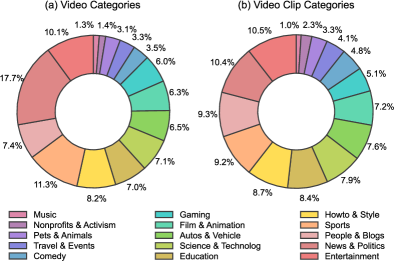
We study joint video and language (VL) pre-training to enable cross-modality learning and benefit plentiful downstream VL tasks. Existing works either extract low-quality video features or learn limited text embedding, while neglecting that high-resolution videos and diversified semantics can significantly improve cross-modality learning. In this paper, we propose a novel High-resolution and Diversified VIdeo-LAnguage pre-training model (HD-VILA) for many visual tasks. In particular, we collect a large dataset with two distinct properties: 1) the first high-resolution dataset including 371.5k hours of 720p videos, and 2) the most diversified dataset covering 15 popular YouTube categories. To enable VL pre-training, we jointly optimize the HD-VILA model by a hybrid Transformer that learns rich spatiotemporal features, and a multimodal Transformer that enforces interactions of the learned video features with diversified texts. Our pre-training model achieves new state-of-the-art results in 10 VL understanding tasks and 2 more novel text-to-visual generation tasks. For example, we outperform SOTA models with relative increases of 40.4% R@1 in zero-shot MSR-VTT text-to-video retrieval task and 55.4% in high-resolution dataset LSMDC. The learned VL embedding is also effective in generating visually pleasing and semantically relevant results in text-to-visual editing and super-resolution tasks.
Motivation & Objective
- To address the limitations of existing video-language pre-training models that rely on low-quality video features and limited text diversity.
- To enable more effective cross-modality learning by leveraging high-resolution (720p) videos and highly diverse, real-world YouTube content.
- To develop a unified framework that jointly optimizes spatiotemporal video representations and multimodal language-video embeddings in an end-to-end manner.
- To establish a new benchmark for high-resolution, large-scale, and diverse video-language understanding through a new dataset and model.
Proposed method
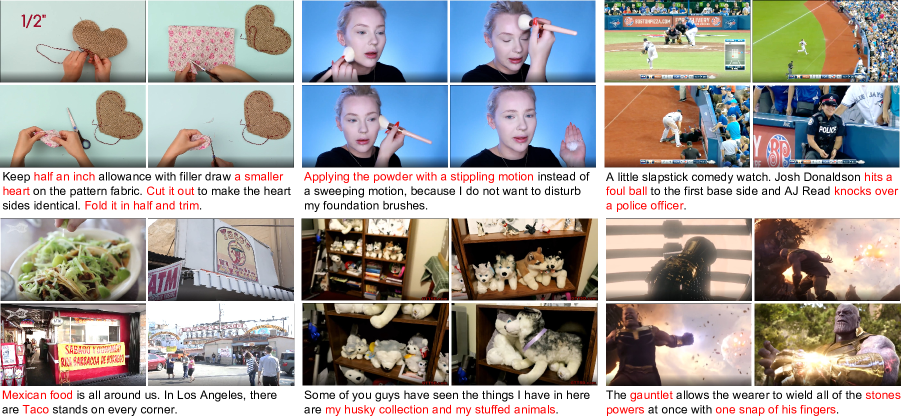
- The authors collect HD-VILA-100M, a large-scale dataset of 100M video-sentence pairs from 3.3 million 720p YouTube videos across 15 diverse categories.
- They use a hybrid image sequence strategy, sampling high-resolution (HR) frames randomly and low-resolution (LR) frames uniformly from surrounding temporal positions.
- A hybrid Transformer network encodes HR and LR frames separately and maps their features into a shared embedding space to preserve both spatial detail and temporal coherence.
- The model employs a multimodal Transformer to jointly optimize video and language representations in an end-to-end fashion, enabling rich cross-attention between modalities.
- The framework supports zero-shot transfer to downstream tasks such as text-to-video retrieval, video question answering, and text-to-visual generation.
- The dataset is released with video URLs and metadata under the Open Use of Data Agreement, with no raw data release due to copyright concerns.
Experimental results
Research questions
- RQ1Can high-resolution video inputs significantly improve video-language representation learning compared to lower-resolution baselines?
- RQ2Does increased semantic diversity in video content lead to better generalization and performance on downstream video-language tasks?
- RQ3Can end-to-end joint learning of spatiotemporal video features and multimodal embeddings outperform stage-wise or two-stream architectures?
- RQ4To what extent does a large-scale, diverse, and high-quality video-language dataset improve zero-shot and few-shot transfer performance?
- RQ5How effective is the proposed hybrid frame encoding strategy (HR + LR) in preserving both visual detail and temporal dynamics?
Key findings
- HD-VILA achieves a 40.4% relative improvement in R@1 on the zero-shot MSR-VTT text-to-video retrieval benchmark, surpassing prior SOTA models.
- On the high-resolution LSMDC dataset, HD-VILA achieves a 55.4% relative gain in retrieval performance, demonstrating strong generalization to high-quality video inputs.
- The model achieves state-of-the-art results across 10 video-language understanding tasks, including video question answering and captioning.
- The learned video-language embeddings enable high-quality text-to-visual editing and super-resolution, generating semantically relevant and visually plausible outputs.
- The HD-VILA-100M dataset, with 371.5K hours of 720p videos and 15 diverse categories, is the largest and highest-resolution video-language dataset to date.
- The model's performance gains are attributed to the combination of high-resolution input, diversified content, and end-to-end multimodal optimization.
Read this paper
Open the full text in the Nubint reader and ask about any passage as you read.
Read this paper on NubintThis review was generated by AI from the original paper. Please check the paper before citing it.