
[Paper Review] Adversarial Deep Structured Nets for Mass Segmentation from Mammograms
This paper proposes an end-to-end adversarial deep structured network combining fully convolutional networks (FCN) and conditional random fields (CRF) for mammographic mass segmentation. By integrating spatial priors, multi-scale FCN, and adversarial training to combat overfitting on small datasets, the method achieves state-of-the-art performance, with a 91.30% Dice score on the DDSM-BCRP dataset and 90.97% on INbreast.
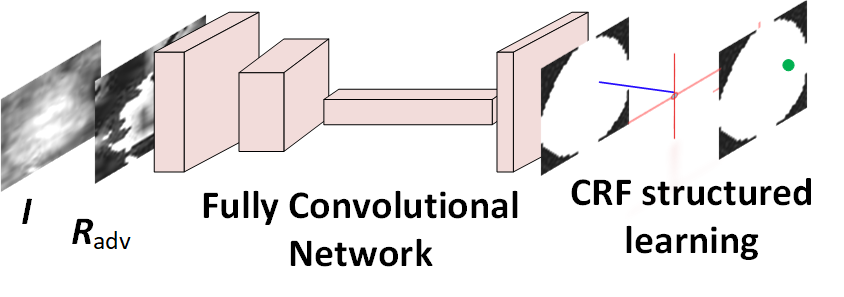
Mass segmentation provides effective morphological features which are important for mass diagnosis. In this work, we propose a novel end-to-end network for mammographic mass segmentation which employs a fully convolutional network (FCN) to model a potential function, followed by a CRF to perform structured learning. Because the mass distribution varies greatly with pixel position, the FCN is combined with a position priori. Further, we employ adversarial training to eliminate over-fitting due to the small sizes of mammogram datasets. Multi-scale FCN is employed to improve the segmentation performance. Experimental results on two public datasets, INbreast and DDSM-BCRP, demonstrate that our end-to-end network achieves better performance than state-of-the-art approaches. \footnote{https://github.com/wentaozhu/adversarial-deep-structural-networks.git}
Motivation & Objective
- Address the challenge of overfitting in mammographic mass segmentation due to limited training data.
- Improve segmentation accuracy by integrating spatial priors that reflect the positional distribution of masses in mammograms.
- Develop an end-to-end trainable framework that unifies FCN and CRF for joint optimization, avoiding multi-stage training.
- Enhance boundary detection and structural consistency in mass segmentation using structured CRF inference.
- Demonstrate superior performance on public datasets compared to existing state-of-the-art methods.
Proposed method
- Employ a fully convolutional network (FCN) with multi-scale convolutions to learn hierarchical features from mammograms.
- Integrate a position prior into the FCN to model the spatial distribution of mass regions, improving localization.
- Apply adversarial training by optimizing a generative adversarial network (GAN) framework to minimize pixel-wise labeling loss and reduce overfitting.
- Use a fully connected pairwise CRF with Potts model compatibility to enforce spatial consistency in predicted labels.
- Implement mean field approximation for efficient CRF inference, treating it as a recurrent neural network for differentiable optimization.
- Train the entire network end-to-end using backpropagation, jointly optimizing FCN, CRF, and adversarial components.
Experimental results
Research questions
- RQ1Can end-to-end training of an FCN-CRF network with adversarial regularization improve mass segmentation performance on small mammogram datasets?
- RQ2How does incorporating a spatial prior enhance the localization and accuracy of mass segmentation in mammograms?
- RQ3To what extent does adversarial training reduce overfitting and improve generalization in low-data regimes for medical image segmentation?
- RQ4Does multi-scale feature learning significantly improve segmentation quality, especially at lesion boundaries?
- RQ5How does the proposed adversarial FCN-CRF framework compare quantitatively to state-of-the-art methods on public mammographic segmentation benchmarks?
Key findings
- The proposed adversarial FCN-CRF model achieves a Dice score of 91.30% on the DDSM-BCRP dataset, outperforming the previous state-of-the-art method by 0.3%.
- On the INbreast dataset, the model reaches a Dice score of 90.97%, representing a 0.97% improvement over the baseline FCN.
- Adversarial training alone improves the Dice score by 0.4% on average across datasets, indicating effective regularization against overfitting.
- The integration of multi-scale FCN contributes the most to performance gains, with a 0.3% improvement over single-scale baselines.
- Trimap-based boundary accuracy analysis shows that adversarial training improves segmentation accuracy by 2–3% in regions near mass boundaries.
- McNemar’s Chi-Square Test confirms the model’s superiority over [6] with a p-value < 0.001, indicating statistical significance.
Read this paper
Open the full text in the Nubint reader and ask about any passage as you read.
Read this paper on NubintThis review was generated by AI from the original paper. Please check the paper before citing it.