
[Paper Review] AGMB-Transformer: Anatomy-Guided Multi-Branch Transformer Network for Automated Evaluation of Root Canal Therapy
This paper proposes AGMB-Transformer, a novel anatomy-guided multi-branch Transformer network that leverages landmark-based polynomial curve fitting for segmentation to extract anatomical features, which guide a progressive Transformer with Group Multi-Head Self-Attention to improve classification accuracy in automated root canal therapy evaluation. The method achieves 90.20% accuracy on a 245-image dataset, significantly outperforming baseline models.
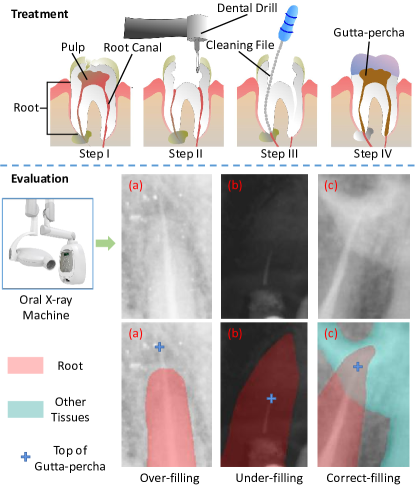
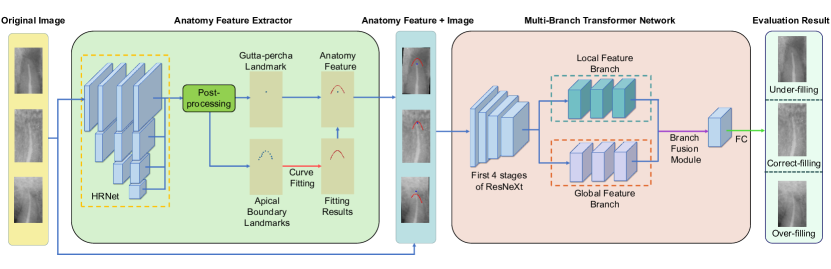
Accurate evaluation of the treatment result on X-ray images is a significant and challenging step in root canal therapy since the incorrect interpretation of the therapy results will hamper timely follow-up which is crucial to the patients' treatment outcome. Nowadays, the evaluation is performed in a manual manner, which is time-consuming, subjective, and error-prone. In this article, we aim to automate this process by leveraging the advances in computer vision and artificial intelligence, to provide an objective and accurate method for root canal therapy result assessment. A novel anatomy-guided multi-branch Transformer (AGMB-Transformer) network is proposed, which first extracts a set of anatomy features and then uses them to guide a multi-branch Transformer network for evaluation. Specifically, we design a polynomial curve fitting segmentation strategy with the help of landmark detection to extract the anatomy features. Moreover, a branch fusion module and a multi-branch structure including our progressive Transformer and Group Multi-Head Self-Attention (GMHSA) are designed to focus on both global and local features for an accurate diagnosis. To facilitate the research, we have collected a large-scale root canal therapy evaluation dataset with 245 root canal therapy X-ray images, and the experiment results show that our AGMB-Transformer can improve the diagnosis accuracy from 57.96% to 90.20% compared with the baseline network. The proposed AGMB-Transformer can achieve a highly accurate evaluation of root canal therapy. To our best knowledge, our work is the first to perform automatic root canal therapy evaluation and has important clinical value to reduce the workload of endodontists.
Motivation & Objective
- To address the limitations of manual, subjective, and time-consuming root canal therapy evaluation by endodontists.
- To develop an automated, objective, and accurate method for classifying root canal therapy outcomes using medical imaging and AI.
- To overcome challenges in X-ray image analysis, including unclear boundaries, poor image quality, and anatomical obstructions.
- To integrate anatomical priors into deep learning for improved diagnostic performance in dental imaging.
- To establish the first end-to-end automatic evaluation framework for root canal therapy using deep learning.
Proposed method
- A polynomial curve fitting segmentation strategy is used to extract anatomy features by fitting curves to detected landmarks on root canal X-ray images.
- The anatomy features are fused with input X-ray images and fed into a multi-branch Transformer architecture with a dedicated branch fusion module.
- A progressive Transformer mechanism models long-range global dependencies across the image, enhancing contextual understanding.
- Group Multi-Head Self-Attention (GMHSA) is introduced to efficiently capture local spatial patterns and improve feature representation.
- The network is trained end-to-end with cross-entropy loss for multi-class classification of therapy outcomes: under-filling, over-filling, or correct-filling.
- Hyperparameters such as the number of feature blocks (θ) and polynomial degree (δ) are optimized via ablation studies.
Experimental results
Research questions
- RQ1Can anatomy-guided features improve the accuracy of automated root canal therapy evaluation in X-ray images?
- RQ2How does a multi-branch Transformer architecture with progressive attention and GMHSA enhance classification performance compared to standard models?
- RQ3What is the optimal configuration of the branch fusion module and polynomial fitting degree for maximum diagnostic accuracy?
- RQ4Can the proposed method generalize to other medical imaging tasks beyond root canal therapy?
- RQ5To what extent does incorporating anatomical priors reduce reliance on high-quality image quality and reduce inter-observer variability?
Key findings
- The AGMB-Transformer achieves a classification accuracy of 90.20%, a significant improvement from the baseline model’s 57.96%.
- The optimal configuration uses θ = 64 (64 feature blocks) and δ = 2 (quadratic polynomial fitting), as shown by ablation studies.
- The model achieves an AUC of 95.63%, sensitivity of 91.39%, specificity of 95.09%, and F1-score of 90.48% on the root canal therapy dataset.
- When evaluated on the Plant Pathology 2020 dataset, AGMB-Transformer achieved 96.15% accuracy, outperforming ResNet50, ResNeXt50, GCNet50, and BoTNet50.
- The branch fusion module effectively combines features from multiple branches, enhancing both global and local feature learning.
- The method is the first to introduce anatomy-guided multi-branch Transformers for automated root canal therapy evaluation, demonstrating strong clinical potential.
Read this paper
Open the full text in the Nubint reader and ask about any passage as you read.
Read this paper on NubintThis review was generated by AI from the original paper. Please check the paper before citing it.