
[논문 리뷰] All-optical single-shot readout of a superconducting qubit
이 논문은 밀리켈빈 온도에서 삼중 공진 웨이브가드 모드 전기광학 변환기를 사용하여 초전도 트랜스몬 큐비트의 서큘레이터 없는, 전적으로 광학적인 단회 읽기 방법을 제시한다. 이 방법은 제이نز-커밍스 비선형성을 활용해 광신호의 동시에 마이크로파 하향-변조 및 상향-변조를 실현하며, 냉각된 마이크로파 전자기기나 차폐를 필요로 하지 않고 고정밀 양자-비파괴 측정을 가능하게 하여 열 부하가 최소화된 간단하고 확장 가능한 양자 프로세서 입출력을 실현한다.
The rapid development of superconducting quantum hardware is expected to run into significant I/O restrictions due to the need for large-scale error correction in a cryogenic environment. Classical data centers rely on fiber-optic interconnects to remove similar networking bottlenecks and to allow for reconfigurable, software-defined infrastructures. In the same spirit, ultra-cold electro-optic links have been proposed and used to generate qubit control signals, or to replace cryogenic readout electronics. So far, the latter suffered from either low efficiency, low bandwidth and the need for additional microwave drives, or breaking of Cooper pairs and qubit states. In this work we realize electro-optic microwave photonics at millikelvin temperatures to implement a radio-over-fiber qubit readout that does not require any active or passive cryogenic microwave equipment. We demonstrate all-optical single-shot-readout by means of the Jaynes-Cummings nonlinearity in a circulator-free readout scheme. Importantly, we do not observe any direct radiation impact on the qubit state as verified with high-fidelity quantum-non-demolition measurements despite the absence of shielding elements. This compatibility between superconducting circuits and telecom wavelength light is not only a prerequisite to establish modular quantum networks, it is also relevant for multiplexed readout of superconducting photon detectors and classical superconducting logic. Moreover, this experiment showcases the potential of electro-optic radiometry in harsh environments - an electronics-free sensing principle that extends into the THz regime with applications in radio astronomy, planetary missions and earth observation.
연구 동기 및 목표
- 코axial 케이블과 냉각된 마이크로파 구성요소의 증가로 인해 발생하는 대규모 초전도 양자 프로세서의 입출력 병목 현상을 해결하기 위해.
- 냉각된 마이크로파 전자기기를 활성 또는 수동적으로 대체하기 위해 단일 광섬유 기반 전기광학 수신기로 교체함으로써 큐비트 읽기에서의 필요성을 제거하기 위해.
- 통신 파장 대역의 빛이 차폐 없이도 초전도 큐비트와 공존할 수 있음을 입증하여, 조도가 악화되지 않음을 확인하기 위해.
- 오직 광학적 변조 및 복조, 혼합 검출만을 사용하여 단회 읽기 및 고정밀 양자-비파괴 측정을 실현하기 위해.
- 미래의 모듈러 양자 네트워크 및 초전도 큐비트의 통합 광학 제어를 위한 확장 가능하고 열 부하가 낮은 플랫폼을 제공하기 위해.
제안 방법
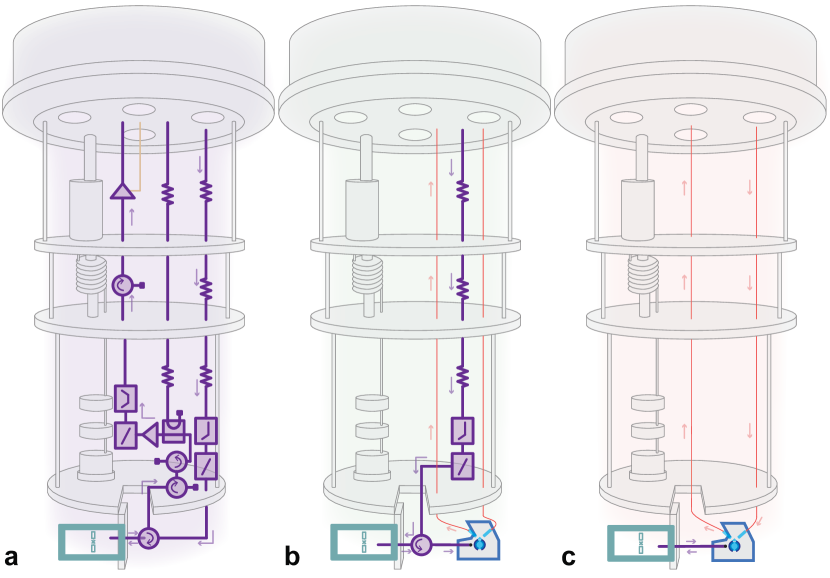
- 삼중 공진 웨이브가드 모드 전기광학 변환기를 사용하여 큐비트에서 온 마이크로파 신호를 동시에 광신호로 하향-변조하고, 혼합 검출을 위한 로컬 오실레이터를 상향-변조한다.
- 3D 초전도 공진자 양자 전기역학(cQED) 시스템을 활용하여 단거리 코axial 케이블을 통해 트랜스몬 큐비트를 전기광학 변환기와 결합함으로써 모든 냉각된 마이크로파 구성요소를 회피한다.
- 제이즈-커밍스 비선형성을 기반으로 한 서큘레이터 없는 읽기 방법을 구현하여 동시에 마이크로파-광학 변환과 광신호 복구를 실현한다.
- 실온에서 광학 혼합 검출을 통해 시간 영역에서 큐비트의 특성을 분석하며, 신호 처리를 전적으로 광영역에서 수행한다.
- 할당 정밀도와 양자 효율을 측정하여 마이크로파 및 광학 방식 간의 읽기 정밀도를 비교하고, 가우시안 히스토그램 피팅을 통해 탐지 효율을 추출한다.
- 고출력 광펄스(최대 100 mW)와 차폐 없음에도 불구하고 높은 정밀도의 양자-비파괴 측정을 통해 큐비트의 공명 및 비파괴 행동을 검증한다.
실험 결과
연구 질문
- RQ1냉각된 마이크로파 전자기기를 사용하지 않고 밀리켈빈 온도에서 서큘레이터 없는 전적으로 광학적인 단회 큐비트 읽기 방법을 구현할 수 있는가?
- RQ2차폐 없이도 통신 파장 대역의 고출력 광복사가 초전도 큐비트의 공명을 떨어뜨리는가?
- RQ3cQED 시스템에서 전기광학 변환을 기반으로 한 전적으로 광학적인 방법의 읽기 정밀도와 양자 효율은 얼마인가?
- RQ4신호 정밀도와 손실 예산 측면에서 전통적인 마이크로파 기반 읽기와 비교해 광학 방법의 성능은 어떠한가?
- RQ5광학 방법이 향후 고장내성 양자 프로세서에서 다중화된 읽기를 지원할 수 있는가?
주요 결과
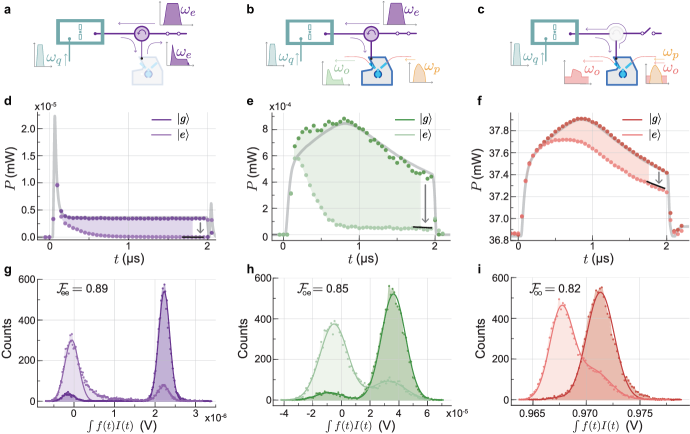
- 전적으로 광학적인 읽기 방법은 기존 마이크로파 읽기와 유사한 단회 할당 정밀도를 달성하였으며, 광학 방법의 측정 정밀도는 약 95%로 측정되었다.
- 차폐 없이 100 mW의 광펄스를 사용하더라도 큐비트의 공명 또는 상태 정밀도에 악영향을 주지 않아 초전도 회로와 통신 파장 빛 사이의 호환성이 확인되었다.
- 광학 읽기의 양자 탐지 효율은 η_det,opt ≈ 1.5 × 10⁻⁴로 측정되었으며, 이는 전기광학 변환 효율 η_eo = 0.3% 및 광손실과 일치한다.
- JPA 없이 마이크로파 기반 읽기의 탐지 효율은 η_det,mw ≈ 1.3 × 10⁻³로 측정되어, 전기광학 변환기의 반사 손실(9%) 등으로 인한 마이크로파 경로의 더 높은 손실을 시사한다.
- 시스템은 광결합 효율(η_o = 0.22)과 흡수된 펌프 파워로 인한 열 부하가 주요 제한 요소임을 입증하였으며, 이는 혼합 챔버 온도 상승과 고반복률에서 큐비트 공명의 열화를 유발한다.
- 향후 광결합 향상과 흡수 감소를 통해 이 플랫폼은 양자한계에 가까운 탐지 성능을 달성하고, 미래의 통합 광학 양자 프로세서에서 고대역폭, 고정밀도, 다중화된 읽기를 지원할 수 있을 것으로 제안된다.
더 나은 연구,지금 바로 시작하세요
논문 읽기부터 검토까지, 연구 시간을 획기적으로 줄여보세요.
카드 등록 없음 · 무료 플랜 제공
이 리뷰는 AI가 만들고, 인간 에디터가 검토했습니다.