
[Paper Review] An FRB Sent Me a DM: Constraining the Electron Column of the Milky Way Halo with Fast Radio Burst Dispersion Measures from CHIME/FRB
This study uses dispersion measures (DMs) from 83 CHIME/FRB fast radio bursts to constrain the electron column density in the Milky Way's ionized halo, finding a total contribution of 87.8–141 pc cm⁻³ for |b| ≥ 30°, with upper limits of 52–111 pc cm⁻³. The analysis accounts for survey selection effects and finds no significant evidence for a DM gap in the Galactic halo, supporting models with moderate electron density profiles.
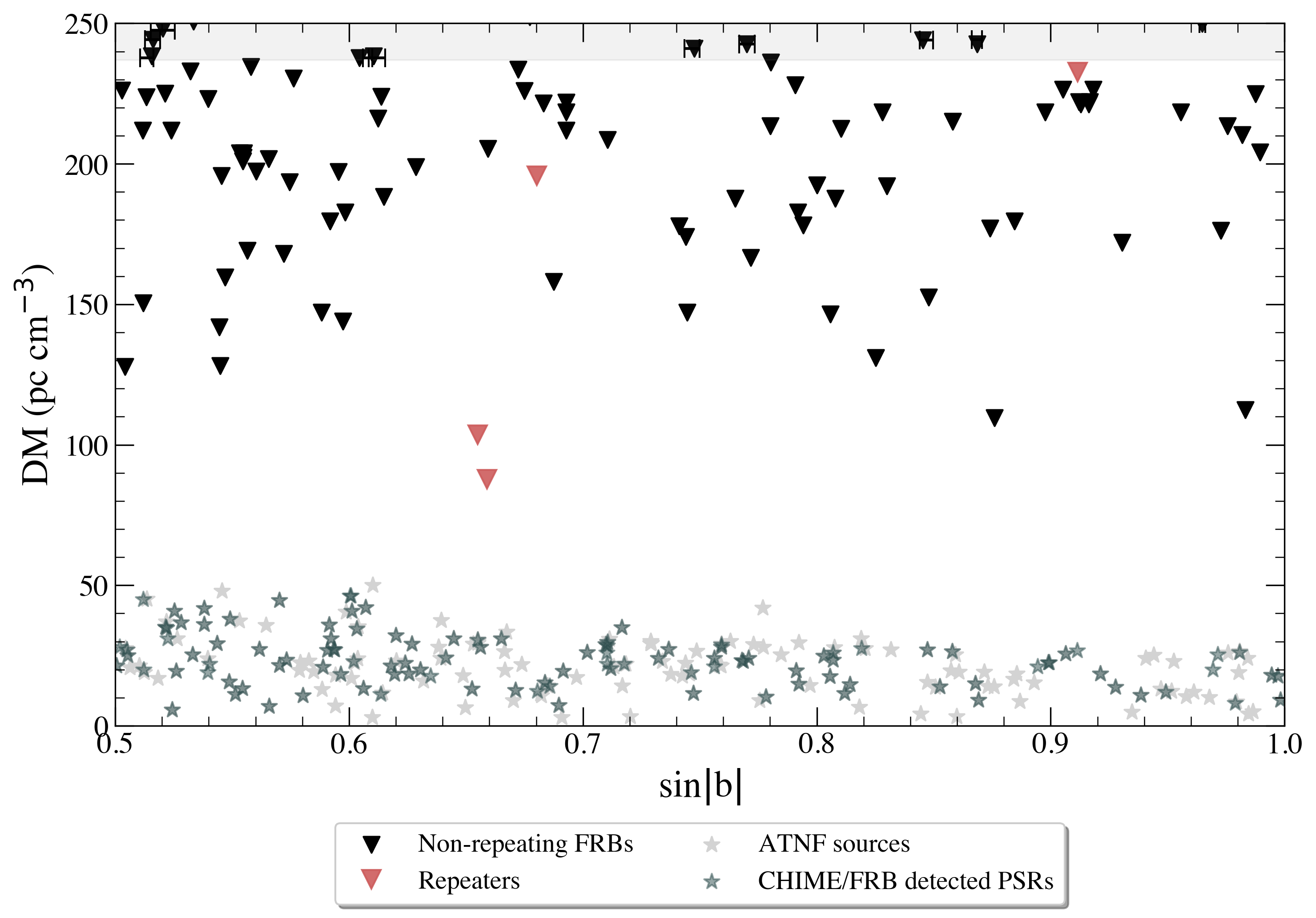
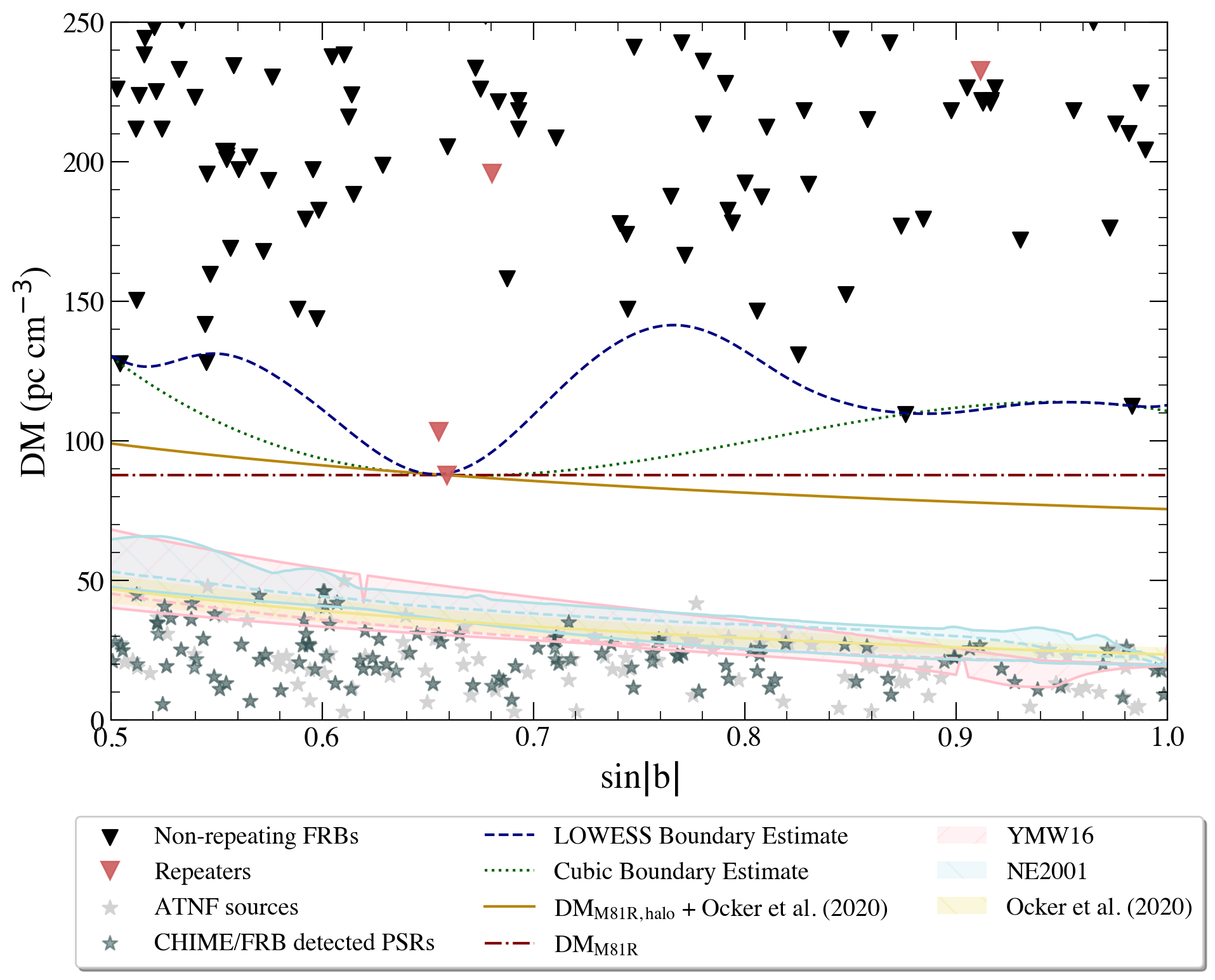
The CHIME/FRB project has detected hundreds of fast radio bursts (FRBs), providing an unparalleled population to probe statistically the foreground media that they illuminate. One such foreground medium is the ionized halo of the Milky Way (MW). We estimate the total Galactic electron column density from FRB dispersion measures (DMs) as a function of Galactic latitude using four different estimators, including ones that assume spherical symmetry of the ionized MW halo and ones that imply more latitudinal-variation in density. Our observation-based constraints of the total Galactic DM contribution for $|b|\geq 30^\circ$, depending on the Galactic latitude and selected model, span 87.8 - 141 pc cm^-3. This constraint implies upper limits on the MW halo DM contribution that range over 52-111 pc cm^-3. We discuss the viability of various gas density profiles for the MW halo that have been used to estimate the halo's contribution to DMs of extragalactic sources. Several models overestimate the DM contribution, especially when assuming higher halo gas masses (~ 3.5 x 10^12 solar masses). Some halo models predict a higher MW halo DM contribution than can be supported by our observations unless the effect of feedback is increased within them, highlighting the impact of feedback processes in galaxy formation.
Motivation & Objective
- To estimate the Milky Way halo's electron column density using dispersion measures (DMs) from fast radio bursts (FRBs) detected by CHIME/FRB.
- To assess the impact of survey selection effects and luminosity function biases on DM-based halo constraints.
- To test the viability of various ionized halo density profiles against observed FRB DM distributions.
- To determine whether a DM gap in the Galactic halo is supported by current data, accounting for detection efficiency and redshift-dependent fluence thresholds.
Proposed method
- Utilized 83 FRBs detected by the CHIME/FRB pipeline with known redshifts and DMs to estimate the Galactic halo contribution to total DM.
- Applied four different estimators: two assuming spherical symmetry of the halo and two allowing for latitudinal variation in electron density.
- Corrected for survey selection effects by modeling detection efficiency as a function of fluence and redshift, using Poisson statistics to assess likelihood of zero detections in low-redshift volume.
- Accounted for the non-uniform detection efficiency between two redshift volumes (z₁ ≈ 0.1, z₂ ≈ 0.3) using observed detection fractions (μ_v1 = 0.346, μ_v2 = 0.366) and a luminosity function with α = -1.0.
- Calculated the expected number of detections in volume 1 under the null hypothesis of no astrophysical DM gap, using the ratio of detection efficiencies and redshift scaling.
- Used Poisson probability P = exp(–N_det,v1) to compute the likelihood of observing zero FRBs in volume 1, yielding P = 0.24, indicating consistency with selection effects alone.
Experimental results
Research questions
- RQ1What is the total electron column density contributed by the Milky Way halo to FRB dispersion measures at Galactic latitudes |b| ≥ 30°?
- RQ2How do different assumptions about halo geometry (spherical vs. latitudinally varying) affect the inferred halo DM contribution?
- RQ3To what extent do survey selection effects and the FRB luminosity function bias the observed DM distribution and mask a potential DM gap?
- RQ4Are current models of the ionized halo's electron density profile consistent with the observed CHIME/FRB DM data?
- RQ5Is the observed lack of FRBs in a low-redshift volume (z₁ ≈ 0.1) statistically consistent with known detection biases, or does it suggest a physical gap in the DM distribution?
Key findings
- The total Galactic electron column density contribution to FRB DMs for |b| ≥ 30° is constrained to 87.8–141 pc cm⁻³, depending on the model and latitude.
- Upper limits on the halo DM contribution range from 52 to 111 pc cm⁻³, depending on the assumed electron density profile.
- The probability of detecting zero FRBs in the lower-redshift volume (z₁ ≈ 0.1) under the null hypothesis of no astrophysical DM gap is 24%, indicating consistency with selection effects and volume bias.
- The analysis shows that assuming FRBs are standard candles leads to a conservative overestimate of the likelihood of zero detections, implying that the true detection rate in volume 1 is likely higher than estimated.
- The observed DM distribution is consistent with existing halo models, but several commonly used profiles overestimate the halo contribution, suggesting a need for revised density profiles.
- The study finds no statistically significant evidence for a DM gap in the Milky Way halo, and the lack of detections in volume 1 is best explained by survey sensitivity and volume effects rather than a physical absence of FRBs.
Read this paper
Open the full text in the Nubint reader and ask about any passage as you read.
Read this paper on NubintThis review was generated by AI from the original paper. Please check the paper before citing it.