
[Paper Review] An Inexact Feasible Interior Point Method for Linear Optimization with High Adaptability to Quantum Computers
This paper proposes an Inexact Feasible Interior Point Method (IF-IPM) for Linear Optimization that generates inexact but feasible Newton steps via a novel Orthogonal Spaces System (OSS), enabling efficient integration with Quantum Linear System Algorithms (QLSAs). The method achieves $ ilde{/cal O}(n^{2.5}L ilde{ u}^2 ilde{ u}^5)$ time complexity, outperforming prior quantum IPMs and matching classical IPM complexity, while iterative refinement mitigates condition number growth and solver errors.
The use of quantum computing to accelerate complex optimization problems is a burgeoning research field. This paper applies Quantum Linear System Algorithms (QLSAs) to Newton systems within Interior Point Methods (IPMs) to take advantage of quantum speedup in solving Linear Optimization (LO) problems. Due to their inexact nature, QLSAs can be applied only to inexact variants of IPMs. Existing IPMs with inexact Newton directions are infeasible methods due to the inexact nature of their computations. This paper proposes an Inexact-Feasible IPM (IF-IPM) for LO problems, using a novel linear system to generate inexact but feasible steps. We show that this method has $\Ocal(\sqrt{n}L)$ iteration complexity, analogous to the best exact IPMs, where $n$ is the number of variables and $L$ is the binary length of the input data. Moreover, we examine how QLSAs can efficiently solve the proposed system in an iterative refinement (IR) scheme to find the exact solution without excessive calls to QLSAs. We show that the proposed IR-IF-IPM can also be helpful to mitigate the impact of the condition number when a classical iterative method, such as a Conjugate Gradient method or a quantum solver is used at iterations of IPMs. After applying the proposed IF-IPM to the self-dual embedding formulation, we investigate the proposed IF-IPM's efficiency using the QISKIT simulator of QLSA.
Motivation & Objective
- Develop a feasible IPM variant that remains feasible even with inexact Newton steps, overcoming limitations of existing inexact infeasible IPMs.
- Design a new linear system (Orthogonal Spaces System) that generates inexact but feasible search directions for IPMs.
- Enable efficient integration with Quantum Linear System Algorithms (QLSAs) by ensuring the Newton system is well-conditioned and amenable to iterative refinement.
- Achieve iteration complexity of $ ilde{/cal O}( ilde{ u}L)$, matching the best classical IPMs, while maintaining feasibility under inexact solves.
- Mitigate the impact of growing condition numbers and QLSA errors through an iterative refinement scheme in both quantum and classical settings.
Proposed method
- Propose the Orthogonal Spaces System (OSS) as a new Newton system that ensures inexact solutions remain feasible by projecting search directions into orthogonal subspaces.
- Formulate the OSS system as a symmetric, sparse linear system that preserves primal-dual feasibility even with inexact solutions.
- Integrate the OSS system into a feasible IPM framework, ensuring all iterates remain in the interior of the feasible region.
- Apply Quantum Linear System Algorithms (QLSAs) to solve the OSS system in a quantum-accelerated IPM, leveraging quantum speedup for linear system solves.
- Implement an iterative refinement (IR) scheme that reinitializes the QIPM with low-precision solutions to counteract condition number growth and QLSA errors.
- Combine the IF-IPM with classical iterative solvers (e.g., Conjugate Gradient) to enhance robustness and reduce dependence on high-precision quantum or classical solvers.
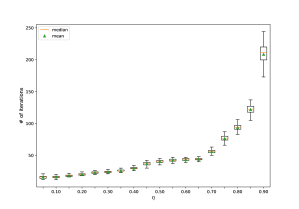
Experimental results
Research questions
- RQ1Can an inexact IPM be designed to maintain feasibility of iterates despite inexact Newton steps, unlike existing inexact infeasible IPMs?
- RQ2Does the proposed Orthogonal Spaces System (OSS) yield a Newton system with better conditioning than standard alternatives like the Normal Equation or Augmented systems?
- RQ3Can QLSAs be effectively used in a feasible IPM framework without compromising convergence or feasibility?
- RQ4Does iterative refinement significantly reduce the impact of growing condition numbers and QLSA errors in quantum-accelerated IPMs?
- RQ5What is the theoretical time complexity of the proposed IF-IPM when combined with QLSAs or classical iterative solvers, and how does it compare to existing quantum and classical IPMs?
Key findings
- The proposed IF-IPM achieves an iteration complexity of $ ilde{/cal O}( ilde{ u}L)$, matching the best-known classical IPMs, despite using inexact solutions.
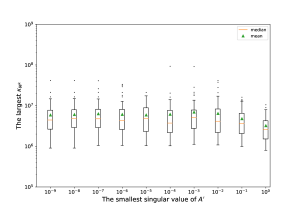
- The Orthogonal Spaces System (OSS) has a condition number that grows as $ ilde{ u}^{-1}$, slower than the $ ilde{ u}^{-1}$ rate of the Normal Equation and Augmented systems, making it more stable under inexact solves.
- Empirical results confirm that the OSS system maintains feasibility and exhibits better conditioning than the Normal Equation and Augmented systems across well-conditioned, ill-conditioned, and degenerate problems.
- Iterative refinement effectively mitigates the condition number growth of the Newton system, allowing the use of low-precision QLSAs or classical solvers without loss of convergence.
- The proposed IR-IF-QIPM achieves a time complexity of $ ilde{/cal O}_{n, ilde{ u}_Q, ilde{ u}, ilde{ u}^0,L}(n^{2.5}L ilde{ u}_Q^2 ilde{ u}^5)$, which is superior to the IR-II-QIPM and represents the best-known complexity among convergent quantum IPMs.
- The IR-IF-IPM with classical Conjugate Gradient solvers achieves $ ilde{/cal O}_{ ilde{ u}^0,L}(n^{2.5}L ilde{ u}_Q ilde{ u}^2)$ complexity, outperforming classical IPMs in terms of dependence on $n$ and condition number.
Read this paper
Open the full text in the Nubint reader and ask about any passage as you read.
Read this paper on NubintThis review was generated by AI from the original paper. Please check the paper before citing it.