
[Paper Review] An intelligent modular real-time vision-based system for environment perception
This paper proposes a modular, real-time vision-based system for driver assistance that integrates lane detection, object detection, semantic segmentation, and monocular depth estimation using optimized deep learning models. Fine-tuned on a custom dataset and BDD100K, the system achieves over 80% accuracy across all modules and runs in real time with a responsive GUI for driver alerts, offering a low-cost alternative to full self-driving systems.
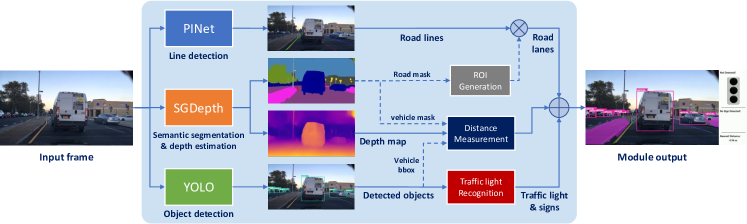
A significant portion of driving hazards is caused by human error and disregard for local driving regulations; Consequently, an intelligent assistance system can be beneficial. This paper proposes a novel vision-based modular package to ensure drivers' safety by perceiving the environment. Each module is designed based on accuracy and inference time to deliver real-time performance. As a result, the proposed system can be implemented on a wide range of vehicles with minimum hardware requirements. Our modular package comprises four main sections: lane detection, object detection, segmentation, and monocular depth estimation. Each section is accompanied by novel techniques to improve the accuracy of others along with the entire system. Furthermore, a GUI is developed to display perceived information to the driver. In addition to using public datasets, like BDD100K, we have also collected and annotated a local dataset that we utilize to fine-tune and evaluate our system. We show that the accuracy of our system is above 80% in all the sections. Our code and data are available at https://github.com/Pandas-Team/Autonomous-Vehicle-Environment-Perception
Motivation & Objective
- To reduce driving accidents caused by human error and traffic regulation violations by providing real-time environmental perception for drivers.
- To develop a lightweight, modular system that operates efficiently on low-cost hardware while maintaining high accuracy in diverse driving conditions.
- To integrate multiple perception tasks—lane detection, object detection, segmentation, and depth estimation—into a unified, real-time pipeline.
- To enhance model robustness in challenging scenarios such as poor lighting, occluded lanes, and missing road markings through dynamic ROI and fine-tuning.
- To provide actionable driver feedback via a GUI showing traffic sign status, distance to obstacles, and traffic light information.
Proposed method
- Uses PINet for lane detection, fine-tuned on a combination of BDD100K and a newly collected local dataset to improve performance in line-free or obscured scenarios.
- Employs YOLOv5 for real-time object detection of vehicles, pedestrians, and 15 distinct traffic signs, optimized for speed and mAP on the local dataset.
- Adopts SGDepth for joint semantic segmentation and monocular depth estimation, enabling accurate sidewalk boundary detection and distance measurement.
- Introduces a novel hierarchical method to compute precise distances to nearby vehicles using depth maps and segmentation outputs.
- Applies a dynamic region of interest (ROI) mechanism to stabilize PINet predictions under environmental turbulence and reduce false positives.
- Develops a real-time GUI to visualize detected objects, lane positions, traffic light status, and distance to obstacles for immediate driver feedback.
Experimental results
Research questions
- RQ1Can a modular, real-time vision system combining lane detection, object detection, segmentation, and depth estimation significantly improve driver safety with minimal hardware requirements?
- RQ2How does fine-tuning PINet on a custom dataset improve its performance in low-visibility or lineless road conditions compared to standard pre-trained models?
- RQ3To what extent does using a multi-task model like SGDepth enhance both segmentation and depth estimation accuracy compared to independent models?
- RQ4What is the trade-off between inference speed and accuracy when integrating multiple deep learning models into a single real-time pipeline?
- RQ5How effective is the proposed GUI in conveying critical environmental information to drivers in a timely and actionable manner?
Key findings
- The system achieves over 80% accuracy across all four modules—lane detection, object detection, segmentation, and depth estimation—on both the BDD100K and the custom local dataset.
- YOLOv5 outperforms other state-of-the-art object detectors on the local dataset, achieving 96.01% mAP and 90.9 FPS, making it optimal for real-time performance.
- PINet, after fine-tuning with the local dataset, demonstrates superior robustness in low-light and occluded scenarios compared to CondLaneNet and CLRNet, despite lower FPS.
- The dynamic ROI mechanism significantly improves PINet's stability and accuracy in turbulent conditions, reducing false positives in lane detection.
- The hierarchical distance calculation method based on SGDepth outputs enables precise, real-time estimation of distances to surrounding vehicles with high reliability.
- The overall system maintains real-time performance (FPS > 30) even with all modules active, with only rare frame drops observed, indicating strong practical feasibility.
Read this paper
Open the full text in the Nubint reader and ask about any passage as you read.
Read this paper on NubintThis review was generated by AI from the original paper. Please check the paper before citing it.