
[Paper Review] Analysing race and sex bias in brain age prediction
This study investigates race and sex bias in a ResNet-34 brain age prediction model trained on predominantly White and male subjects. Using Kruskal-Wallis and Conover-Iman post-hoc tests on UK Biobank data (n=42,786), it finds statistically significant performance differences—particularly higher absolute error in Black and male subjects—alongside detectable distribution shifts in model features across subgroups, highlighting risks of demographic bias in AI-driven neuroimaging biomarkers.
Brain age prediction from MRI has become a popular imaging biomarker associated with a wide range of neuropathologies. The datasets used for training, however, are often skewed and imbalanced regarding demographics, potentially making brain age prediction models susceptible to bias. We analyse the commonly used ResNet-34 model by conducting a comprehensive subgroup performance analysis and feature inspection. The model is trained on 1,215 T1-weighted MRI scans from Cam-CAN and IXI, and tested on UK Biobank (n=42,786), split into six racial and biological sex subgroups. With the objective of comparing the performance between subgroups, measured by the absolute prediction error, we use a Kruskal-Wallis test followed by two post-hoc Conover-Iman tests to inspect bias across race and biological sex. To examine biases in the generated features, we use PCA for dimensionality reduction and employ two-sample Kolmogorov-Smirnov tests to identify distribution shifts among subgroups. Our results reveal statistically significant differences in predictive performance between Black and White, Black and Asian, and male and female subjects. Seven out of twelve pairwise comparisons show statistically significant differences in the feature distributions. Our findings call for further analysis of brain age prediction models.
Motivation & Objective
- To investigate whether brain age prediction models trained on imbalanced datasets exhibit disparities in performance across racial and biological sex subgroups.
- To assess the impact of demographic imbalances in training data (e.g., underrepresentation of Black and male subjects) on model generalization and predictive accuracy.
- To examine whether learned features in the model encode demographic information, indicating potential bias propagation.
- To provide a statistical framework for subgroup performance comparison and feature distribution analysis in neuroimaging AI.
- To advocate for systematic bias evaluation in future brain age prediction models to ensure clinical fairness and validity.
Proposed method
- Trained a 3D ResNet-34 model on 1,215 T1-weighted MRI scans from Cam-CAN and IXI, using data augmentation including random flips, contrast changes, noise, and motion artifacts.
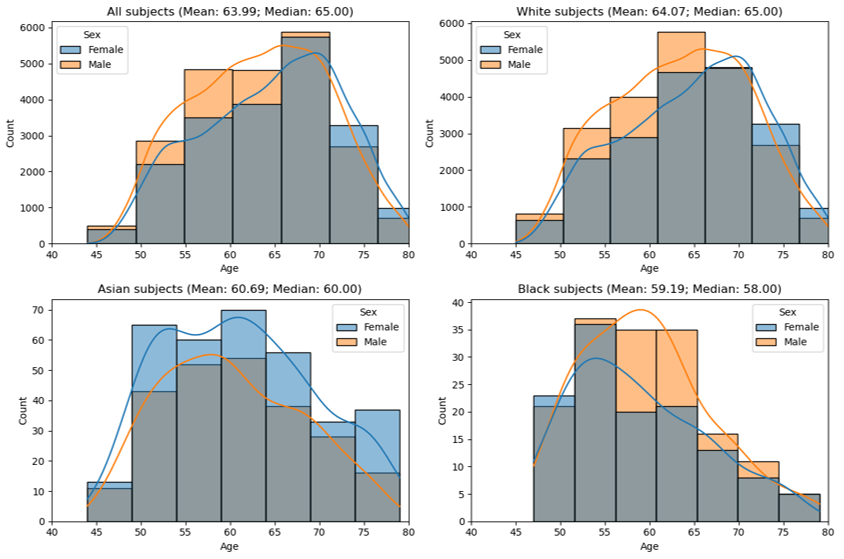
- Evaluated model performance on UK Biobank (n=42,786) using absolute prediction error as the primary metric, stratified into six subgroups by race and sex.
- Applied non-parametric Kruskal-Wallis tests to compare median absolute errors across subgroups, followed by Conover-Iman post-hoc tests with Benjamini-Yekutieli correction for multiple comparisons.
- Used PCA for dimensionality reduction on feature activations to identify high-level patterns in learned representations.
- Performed two-sample Kolmogorov-Smirnov tests to detect statistically significant distribution shifts in feature representations between subgroup pairs.
- Excluded 'Other' race and Chinese subgroups from analysis, merging Chinese into Asian; combined Cam-CAN and IXI data for training with pre-processing including skull stripping, registration to MNI space, and bias field correction.
Experimental results
Research questions
- RQ1Does the brain age prediction model exhibit statistically significant differences in absolute prediction error across racial and biological sex subgroups?
- RQ2Are there detectable distribution shifts in the model’s learned features between different racial and sex subgroups, indicating potential bias in representation learning?
- RQ3To what extent does demographic imbalance in the training data (e.g., underrepresentation of Black and male subjects) correlate with performance disparities in the test set?
- RQ4How do the model’s performance and feature distributions vary across subgroups when controlling for age range and data quality?
- RQ5Can statistical methods such as Kruskal-Wallis and Kolmogorov-Smirnov tests effectively detect bias in deep learning models for neuroimaging applications?
Key findings
- The model showed statistically significant differences in absolute prediction error between Black and White subjects (p < 0.0001), Black and Asian subjects (p = 0.0065), and male and female subjects (p < 0.0001).
- Seven out of twelve pairwise comparisons across race and sex subgroups revealed statistically significant differences in feature distribution (p < 0.05) via Kolmogorov-Smirnov tests on PCA components.
- The average absolute error was higher for Black and male subjects, indicating that these groups are systematically disadvantaged by the model.
- Feature representations in the model’s latent space showed detectable distribution shifts between subgroups, particularly in the first and second principal components, suggesting that demographic information is encoded in the features.
- The model’s performance was significantly worse for Black subjects compared to White and Asian subjects, with p-values of <0.0001 and 0.0065, respectively, in post-hoc tests.
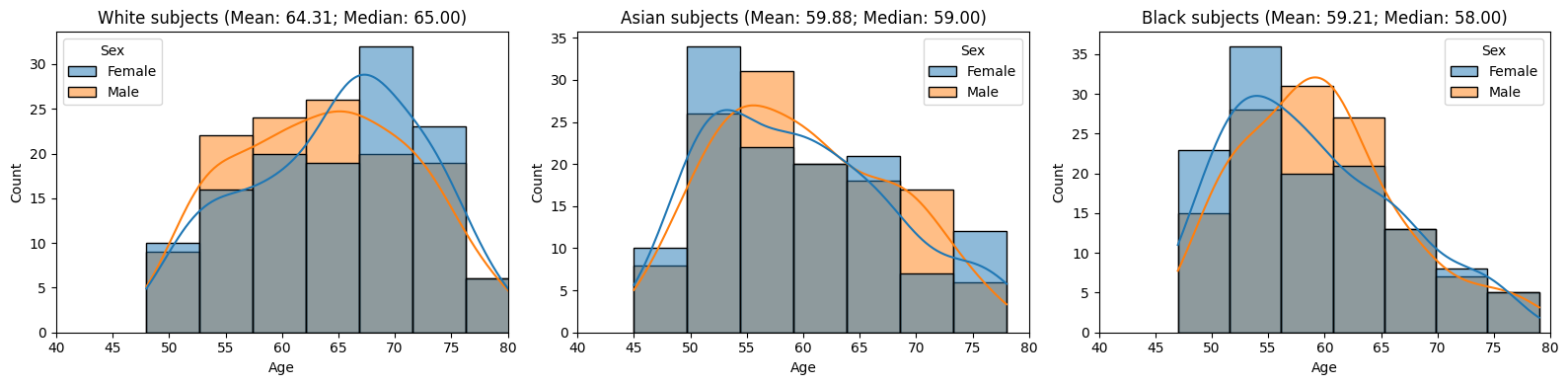
- Despite the model’s overall performance being affected by age range mismatch between training (18–88) and test (44–82) sets, subgroup comparisons remained meaningful due to similar age distributions within each subgroup.
Read this paper
Open the full text in the Nubint reader and ask about any passage as you read.
Read this paper on NubintThis review was generated by AI from the original paper. Please check the paper before citing it.