
[논문 리뷰] Analysis of learning a flow-based generative model from limited sample complexity
이 논문은 제한된 훈련 데이터로 고차원 가우시안 믹스처에서 학습하고 샘플링하기 위해 두 층의 디노이징 오토에코더(DAE)를 사용하는 플로우 기반 생성 모델에 대한 날카운 통합 분석을 제공한다. 모델이 스킵 연결 없이도 추정된 평균이 베이즈 최적 속도인 $\Theta_n(1/n)$로 진짜 믹스처 평균에 수렴함을 보이며, 평균과 분산 역학을 추적하는 폐쇄형 요약 통계량을 통해 생성 플로우를 특성화한다.
We study the problem of training a flow-based generative model, parametrized by a two-layer autoencoder, to sample from a high-dimensional Gaussian mixture. We provide a sharp end-to-end analysis of the problem. First, we provide a tight closed-form characterization of the learnt velocity field, when parametrized by a shallow denoising auto-encoder trained on a finite number $n$ of samples from the target distribution. Building on this analysis, we provide a sharp description of the corresponding generative flow, which pushes the base Gaussian density forward to an approximation of the target density. In particular, we provide closed-form formulae for the distance between the mean of the generated mixture and the mean of the target mixture, which we show decays as $Θ_n(\frac{1}{n})$. Finally, this rate is shown to be in fact Bayes-optimal.
연구 동기 및 목표
- 유한한 훈련 샘플에서 플로우 기반 생성 모델의 일반화 방식을 이해하는 데 있어 이론적 간극을 메우기 위해.
- 얕은 DAE를 통한 속도 장의 학습과 그에 따른 생성 플로우에 미치는 영향을 분석하기 위해.
- 유한한 수의 샘플로 훈련했을 때 생성된 밀도의 통계적 성질, 특히 평균과 분산을 특성화하기 위해.
- 유한한 샘플 복잡도 조건 하에서 평균 추정의 일반화 오차가 베이즈 최적 속도를 달성하는지 확인하기 위해.
- 제한된 데이터 조건에서 고차원 설정에서 생성 과정을 날카운 폐쇄형 특성화를 제공하기 위해.
제안 방법
- 모델은 두 층의 DAE와 하나의 은닉 유닛을 사용하여 확률적 보간 플로우의 속도 장을 매개변수화한다.
- 고차원 가우시안 믹스처에서의 $n$개 샘플을 사용하여 경험적 리스크 최소화 기반으로 속도 장을 훈련한다.
- 고차원 점근적 분석을 수행하여 각 시간 $t$에서 학습된 가중치 벡터 $\hat{\bm{w}}_t$에 대한 폐쇄형 표현을 유도한다.
- 기본 가우시안 분포를 통과하는 샘플의 플로우를 추적하기 위해 요약 통계량 $M_t$와 $Q^\eta_t$를 유도한다.
- 이 통계량의 역학이 폐쇄형 해를 가진 상수 미분 방정식 시스템을 따르며, 이는 평균 $\hat{\mu}$를 가진 특이 가우시안 믹스처에 해당함을 보여준다.
- 결과적으로 생성 모델의 평균 추정 오차를 분석하였으며, 이는 $\Theta_n(1/n)$ 속도로 감소함을 입증하였다.
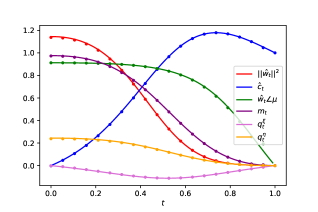
실험 결과
연구 질문
- RQ1고차원 가우시안 믹스처에서 유한한 수의 샘플로 훈련된 플로우 기반 생성 모델이 훈련 데이터를 암기하는가?
- RQ2유한한 샘플 복잡도 조건 하에서 얕은 DAE가 학습한 속도 장의 점근적 행동은 어떠한가?
- RQ3스킵 연결이 없는 DAE로 매개변수화된 생성 플로우가 평균과 분산 추정 측면에서 어떻게 행동하는가?
- RQ4추정된 믹스처 평균의 수렴 속도는 무엇이며, 이는 최적인가?
- RQ5평균 추정의 일반화 오차는 정확히 특성화될 수 있으며, 이는 베이즈 최적인가?
주요 결과
- 학습된 속도 장은 고차원 극한에서 시간에 종속되지 않는 벡터로 수렴하며, 이는 확률적 보간 스케줄에 영향을 받지 않는다.
- 생성 플로우는 요약 통계량 $M_t$와 $Q^\eta_t$로 특성화되며, 이는 폐쇄형 해를 가진 상수 미분 방정식 시스템에 따라 진화한다.
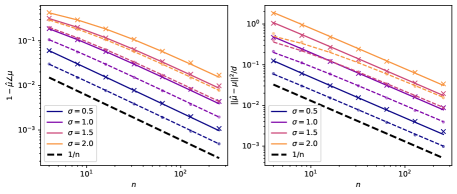
- 추정된 믹스처 평균 $\hat{\mu}$는 제곱 거리 기준으로 진짜 평균 $\mu$로 $\Theta_n(1/n)$ 속도로 수렴한다.
- 평균 추정 오차는 베이즈 최적 속도를 달성하며, 최소 평균 제곱 오차(MSE)는 $\frac{\lambda^2 + n\sigma^2}{(\lambda + n)^2}$이며, 이는 $\lambda = \sigma^2$에서 최소화된다.
- 최적의 평균 추정을 달성하긴 했지만, 모델은 진짜 분산을 복원하지 못하며, $\pm \hat{\mu}$에 델타 함수 성분을 가진 특이 가우시안 믹스처를 생성한다.
- 모델은 학습 과정을 암묵적으로 정규화하여 훈련 샘플의 암기를 방지하며, 이 암묵적 정규화가 최적의 평균 추정을 이끈다.
더 나은 연구,지금 바로 시작하세요
논문 읽기부터 검토까지, 연구 시간을 획기적으로 줄여보세요.
카드 등록 없음 · 무료 플랜 제공
이 리뷰는 AI가 만들고, 인간 에디터가 검토했습니다.