
[Paper Review] Ancillary files for "Full-colour double-virtual amplitudes for associated production of a Higgs boson with a bottom-quark pair at the LHC"
This paper presents the first analytic computation of full-colour double-virtual two-loop amplitudes for Higgs boson production in association with a bottom-quark pair at the LHC within the five-flavour scheme. Using finite-field reconstruction techniques, the authors derive exact helicity amplitudes, implement them in a public C++ library, and demonstrate numerical stability and efficiency for phenomenological applications in precision Higgs physics and BSM searches.
Ancillary files for the article "Full-colour double-virtual amplitudes for associated production of a Higgs boson with a bottom-quark pair at the LHC" by Simon Badger, Heribertus Bayu Hartanto, Rene Poncelet, Zihao Wu, Yang Zhang and Simone Zoia, available at https://arxiv.org/abs/2412.06519 and https://doi.org/10.1007/JHEP03(2025)066. See Appendix A of the article and the README file in anc_cpp.tar.gz for a description of the files.
Motivation & Objective
- To compute the complete set of two-loop double-virtual amplitudes for pp → b̄bH in the five-flavour scheme, including all colour structures.
- To enable high-precision phenomenological studies of the bottom-quark Yukawa coupling at the LHC by providing analytic amplitudes at NNLO QCD accuracy.
- To develop a numerically stable and efficient implementation of these amplitudes for use in Monte Carlo event generators and collider physics simulations.
- To support the extraction of the Higgs-boson coupling to bottom quarks and the search for new physics in the b̄bH final state.
Proposed method
- The computation is performed within the five-flavour scheme, treating the bottom quark as massless with finite Yukawa coupling.
- Finite-field reconstruction techniques are used to derive analytic expressions for the helicity amplitudes from numerical evaluations in finite fields.
- The amplitudes are decomposed into a basis of pentagon functions, transcendental constants, and square roots, with rational coefficients determined via polynomial reconstruction.
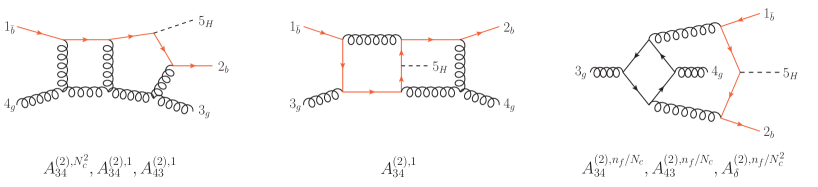
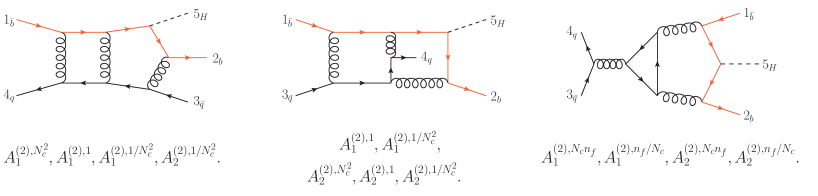
- The results are organized into ancillary files for different partonic channels (2g2bH, 2q2bH), loop orders, colour structures, helicity configurations, and powers of nf and Nc.
- A public C++ library is implemented for efficient and stable numerical evaluation of the bare amplitudes and hard functions.
- The framework includes tools for IR subtraction via Z operators and permutation rules for pentagon functions, enabling full automation in phenomenological applications.
Experimental results
Research questions
- RQ1What is the analytic structure of the full-colour double-virtual two-loop amplitudes for Higgs production in association with a bottom-quark pair in the five-flavour scheme?
- RQ2How can finite-field reconstruction techniques be effectively applied to compute multi-scale, multi-particle two-loop amplitudes with full colour and helicity dependence?
- RQ3What is the numerical stability and performance of the resulting analytic amplitudes when evaluated in realistic collider kinematics?
- RQ4How can the amplitudes be systematically organized and made publicly available for use in Monte Carlo simulations and precision Higgs physics?
- RQ5What is the role of the complete colour structure in the two-loop amplitudes for b̄bH production, and how does it affect the cross-section prediction?
Key findings
- The authors successfully compute the full-colour two-loop double-virtual amplitudes for pp → b̄bH in the five-flavour scheme, including all colour structures and helicity configurations.
- Analytic expressions for the helicity amplitudes are derived using finite-field reconstruction, ensuring exact rational coefficients and high numerical precision.
- The results are implemented in a public C++ library, enabling fast and stable numerical evaluations for phenomenological studies.
- The framework supports multiple partonic channels (2g2bH and 2q2bH), helicity configurations (pppp, pppm, ppmm), and includes tools for IR subtraction and function permutations.
- The implementation demonstrates robustness and efficiency, suitable for use in NNLO QCD predictions and future high-luminosity LHC analyses.
- The ancillary files provide a complete, modular, and reusable infrastructure for evaluating hard functions, poles, and finite remainders in a standardized format.
Read this paper
Open the full text in the Nubint reader and ask about any passage as you read.
Read this paper on NubintThis review was generated by AI from the original paper. Please check the paper before citing it.