
[Paper Review] Arbitrariness and Social Prediction: The Confounding Role of Variance in Fair Classification
This paper identifies variance in model predictions across different training runs as a major, overlooked source of arbitrariness in fair binary classification. It introduces self-consistency—a variance-based metric—to quantify arbitrariness, proposes a modified bagging ensemble that abstains from classifying low-self-consistency instances, and demonstrates through the largest such study to date that most benchmark datasets are already close-to-fair when accounting for this arbitrariness, calling into question the necessity of many existing fairness interventions.
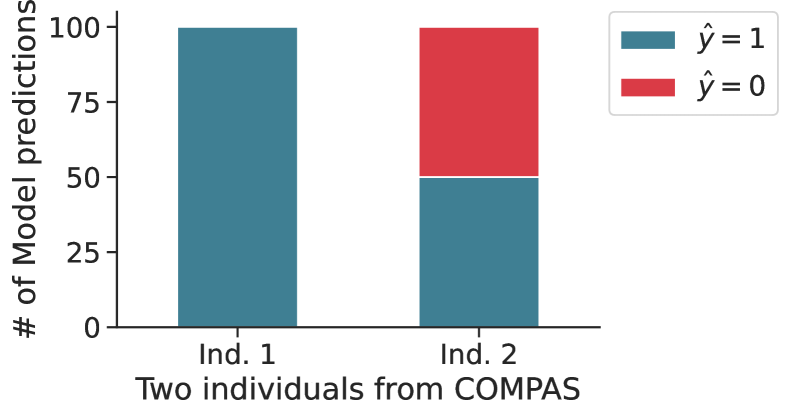
Variance in predictions across different trained models is a significant, under-explored source of error in fair binary classification. In practice, the variance on some data examples is so large that decisions can be effectively arbitrary. To investigate this problem, we take an experimental approach and make four overarching contributions: We: 1) Define a metric called self-consistency, derived from variance, which we use as a proxy for measuring and reducing arbitrariness; 2) Develop an ensembling algorithm that abstains from classification when a prediction would be arbitrary; 3) Conduct the largest to-date empirical study of the role of variance (vis-a-vis self-consistency and arbitrariness) in fair binary classification; and, 4) Release a toolkit that makes the US Home Mortgage Disclosure Act (HMDA) datasets easily usable for future research. Altogether, our experiments reveal shocking insights about the reliability of conclusions on benchmark datasets. Most fair binary classification benchmarks are close-to-fair when taking into account the amount of arbitrariness present in predictions -- before we even try to apply any fairness interventions. This finding calls into question the practical utility of common algorithmic fairness methods, and in turn suggests that we should reconsider how we choose to measure fairness in binary classification.
Motivation & Objective
- To investigate the role of prediction variance as a confounding factor in fair binary classification.
- To develop a practical metric—self-consistency—that quantifies arbitrariness in model predictions.
- To design an ensemble method that abstains from classifying instances with low self-consistency to reduce arbitrariness.
- To conduct the largest empirical study to date on variance in fair classification benchmarks.
- To release a toolkit for the US HMDA dataset to support future fairness research.
Proposed method
- Self-consistency is defined as 1 minus the variance of predictions across multiple bootstrapped models trained on different subsamples of the same data.
- An ensemble method is developed based on bagging, modified to abstain from classification when self-consistency falls below a threshold κ.
- The method improves both self-consistency and overall accuracy by avoiding high-variance predictions.
- The authors conduct extensive experiments on multiple fairness benchmarks using 100 bootstrapped models per individual to measure prediction variance and self-consistency.
- The HMDA dataset is packaged into a reusable, accessible toolkit for future fairness research.
- The study evaluates fairness metrics (e.g., equal opportunity, equalized odds) only after accounting for arbitrariness via self-consistency.
Experimental results
Research questions
- RQ1How much does prediction variance across different model runs contribute to arbitrariness in fair binary classification?
- RQ2To what extent does self-consistency serve as a reliable proxy for arbitrariness in model predictions?
- RQ3Can an ensemble method that abstains on low-self-consistency instances improve both reliability and fairness metrics?
- RQ4How does accounting for arbitrariness affect the perceived fairness of existing benchmark datasets?
- RQ5Are current fairness interventions necessary if baseline arbitrariness already masks or distorts fairness claims?
Key findings
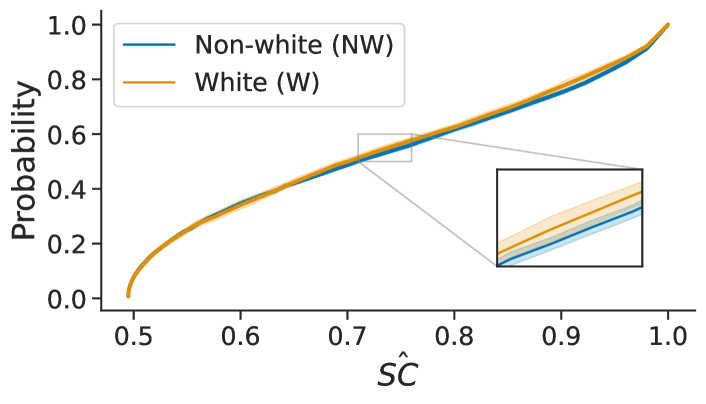
- Most fair binary classification benchmarks are already close-to-fair when variance and arbitrariness are accounted for, even before applying any fairness interventions.
- The study found that the level of arbitrariness in predictions is so high for some individuals that their classification outcomes are effectively random, undermining confidence in model decisions.
- The proposed ensemble method with abstention significantly improves self-consistency and overall accuracy by avoiding high-variance predictions.
- The authors observed that many prior claims of unfairness in benchmark datasets may be artifacts of unaccounted prediction variance rather than true group-level disparities.
- The release of the HMDA dataset toolkit enables future research to use large-scale, real-world data for fairness studies with improved reproducibility and scalability.
- The results challenge the practical utility of many algorithmic fairness methods, suggesting they may be empirically unnecessary when arbitrariness is properly measured.
Read this paper
Open the full text in the Nubint reader and ask about any passage as you read.
Read this paper on NubintThis review was generated by AI from the original paper. Please check the paper before citing it.