
[Paper Review] ARCH++: Animation-Ready Clothed Human Reconstruction Revisited
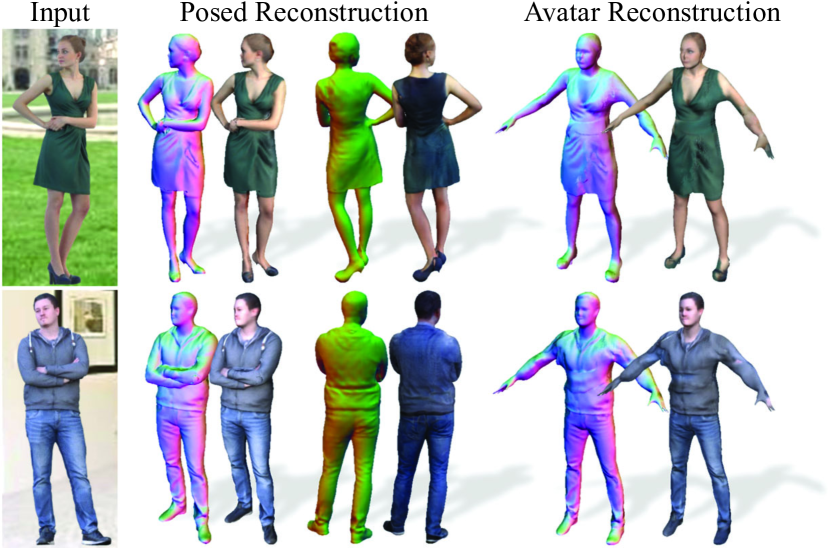
ARCH++ proposes an end-to-end, image-based method for reconstructing high-fidelity, animation-ready 3D clothed human avatars with improved geometry and texture consistency across all viewpoints. It introduces a learnable point-based geometry encoder, a co-supervision framework for joint occupancy prediction in posed and canonical spaces, and image-to-image translation for surface refinement, achieving state-of-the-art performance in realism and reconstruction quality on both synthetic and in-the-wild benchmarks.
We present ARCH++, an image-based method to reconstruct 3D avatars with arbitrary clothing styles. Our reconstructed avatars are animation-ready and highly realistic, in both the visible regions from input views and the unseen regions. While prior work shows great promise of reconstructing animatable clothed humans with various topologies, we observe that there exist fundamental limitations resulting in sub-optimal reconstruction quality. In this paper, we revisit the major steps of image-based avatar reconstruction and address the limitations with ARCH++. First, we introduce an end-to-end point based geometry encoder to better describe the semantics of the underlying 3D human body, in replacement of previous hand-crafted features. Second, in order to address the occupancy ambiguity caused by topological changes of clothed humans in the canonical pose, we propose a co-supervising framework with cross-space consistency to jointly estimate the occupancy in both the posed and canonical spaces. Last, we use image-to-image translation networks to further refine detailed geometry and texture on the reconstructed surface, which improves the fidelity and consistency across arbitrary viewpoints. In the experiments, we demonstrate improvements over the state of the art on both public benchmarks and user studies in reconstruction quality and realism.
Motivation & Objective
- To address the limitations of prior implicit function-based methods in reconstructing realistic, animatable clothed humans from single images.
- To overcome the trade-off between fidelity in the posed space and completeness in the canonical space during unposing.
- To improve reconstruction quality in occluded regions where texture and geometry are typically degraded.
- To enable end-to-end learning of 3D geometry and appearance priors without hand-crafted features or quantization errors.
- To achieve consistent, high-fidelity 360° photorealistic avatars suitable for AR/VR applications.
Proposed method
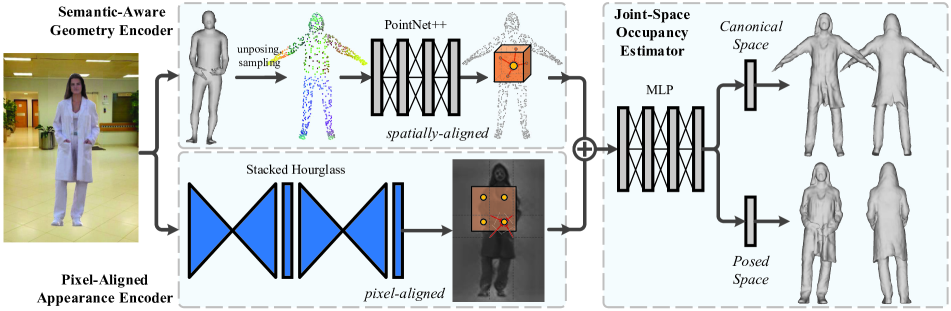
- Introduces an end-to-end point-based geometry encoder using PointNet++ to learn shape and pose priors directly from 3D point clouds, replacing hand-crafted RBF features.
- Proposes a co-supervision framework that jointly predicts occupancy in both posed and canonical spaces with cross-space consistency constraints to balance fidelity and completeness.
- Employs image-to-image translation networks to estimate surface normals and textures in image space, which are then used to refine the 3D mesh via a moulding-inpainting scheme.
- Uses pixel-aligned implicit functions to represent the 3D surface, with geometry and appearance encoded jointly for consistent reconstruction.
- Applies a differentiable warping scheme to transfer predictions from canonical to posed space while preserving detail and avoiding self-intersections.
- Leverages a parametric body model (SMPL) to transfer skinning weights, ensuring the final avatar is animation-ready.
Experimental results
Research questions
- RQ1How can we improve the representation of 3D human geometry in implicit function-based reconstruction to better capture shape and pose priors?
- RQ2What is the fundamental trade-off between reconstruction fidelity in the posed space and completeness in the canonical space, and how can it be resolved?
- RQ3Can image-based normal and texture refinement improve 3D surface quality in occluded regions and ensure view consistency?
- RQ4How does end-to-end learning of spatial features compare to hand-crafted or voxel-based encodings in terms of reconstruction accuracy and robustness?
- RQ5To what extent can co-supervision in multiple spaces enhance the realism and structural integrity of animatable clothed human avatars?
Key findings
- ARCH++ achieves state-of-the-art performance on public benchmarks, reducing mean reconstruction error to 0.031 in the posed space and 0.039 in the canonical space, outperforming prior methods.
- The learned point-based geometry encoder reduces error by 0.002 compared to hand-crafted RBF features and avoids quantization artifacts present in voxel-based alternatives.
- Co-supervision in both posed and canonical spaces eliminates mesh artifacts such as over-stretching and self-intersections, improving both fidelity and completeness.
- Image-space normal regression with moulding-inpainting refinement produces sharper surface details, especially on the back side, compared to object-space regression or image-space input baselines.
- User studies confirm that ARCH++ generates more realistic and consistent avatars across all viewpoints than prior methods.
- The method successfully reconstructs detailed clothing wrinkles and textures even in occluded regions, demonstrating robustness to complex topology changes.
Read this paper
Open the full text in the Nubint reader and ask about any passage as you read.
Read this paper on NubintThis review was generated by AI from the original paper. Please check the paper before citing it.