
[Paper Review] Are Large Language Model-based Evaluators the Solution to Scaling Up Multilingual Evaluation?
This paper investigates whether GPT-4 can serve as a scalable multilingual evaluator for LLM outputs, calibrating its judgments against 20,000 human annotations across eight languages and three tasks. It finds that GPT-4 exhibits a consistent bias toward higher scores—especially in low-resource and non-Latin script languages—highlighting the necessity of human-annotated calibration for reliable multilingual evaluation.
Large Language Models (LLMs) excel in various Natural Language Processing (NLP) tasks, yet their evaluation, particularly in languages beyond the top $20$, remains inadequate due to existing benchmarks and metrics limitations. Employing LLMs as evaluators to rank or score other models' outputs emerges as a viable solution, addressing the constraints tied to human annotators and established benchmarks. In this study, we explore the potential of LLM-based evaluators, specifically GPT-4 in enhancing multilingual evaluation by calibrating them against $20$K human judgments across three text-generation tasks, five metrics, and eight languages. Our analysis reveals a bias in GPT4-based evaluators towards higher scores, underscoring the necessity of calibration with native speaker judgments, especially in low-resource and non-Latin script languages, to ensure accurate evaluation of LLM performance across diverse languages.
Motivation & Objective
- To assess whether large language models like GPT-4 can effectively scale multilingual evaluation beyond English, reducing reliance on costly human annotators.
- To identify and quantify biases in LLM-based evaluators, particularly in low-resource and non-Latin script languages such as Chinese, Japanese, and Czech.
- To evaluate the effectiveness of various prompting strategies for improving LLM-based evaluation consistency across diverse languages and metrics.
- To establish a framework for calibrating LLM evaluators using human judgments, ensuring reliable and generalizable evaluation across tasks, languages, and evaluation dimensions.
- To provide best practices for future research, emphasizing caution in deploying LLM-based evaluators without human-annotated calibration in non-English settings.
Proposed method
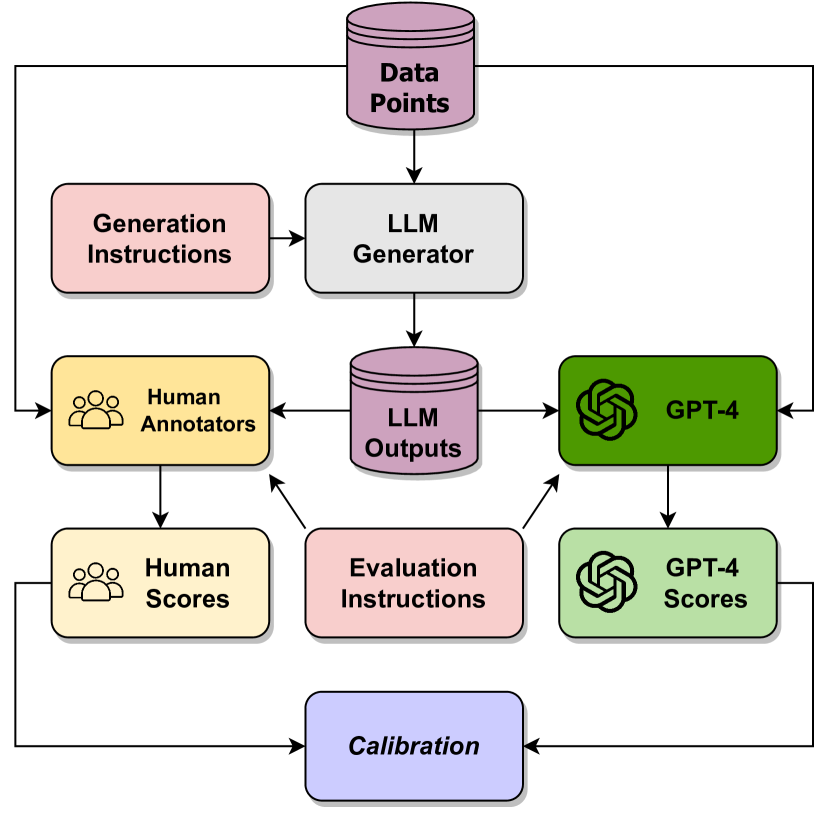
- Calibrated GPT-4’s judgments against 20,000 human-annotated scores across three text generation tasks (e.g., summarization, translation, dialogue) in eight languages.
- Used a multi-dimensional evaluation framework assessing linguistic acceptability, task accomplishment, safety, coherence, and fluency across diverse languages.
- Explored multiple prompting strategies: single-metric prompting vs. multi-metric prompting, few-shot examples, and detailed instruction sets.
- Measured agreement between LLM and human judgments using percentage agreement (PA) and correlation metrics (e.g., Spearman’s rho) to assess reliability.
- Evaluated the impact of model instruction clarity and persona design on judgment consistency, particularly in low-resource and morphologically complex languages.
- Proposed a calibration framework where LLM outputs are adjusted based on reference human judgments to reduce systematic bias.
Experimental results
Research questions
- RQ1Can GPT-4 serve as a reliable multilingual evaluator for LLM outputs across diverse languages, including low-resource and non-Latin script languages?
- RQ2To what extent do LLM-based evaluators like GPT-4 exhibit bias toward higher scores, and how does this bias vary across language families and resource levels?
- RQ3How do different prompting strategies (e.g., single-metric vs. multi-metric, few-shot examples) affect the consistency and accuracy of LLM-based evaluations?
- RQ4What is the impact of detailed instruction sets and evaluator personas on reducing bias in multilingual LLM evaluation?
- RQ5How effective is human-annotated calibration in aligning LLM judgments with human consensus, especially in linguistically complex or underrepresented languages?
Key findings
- GPT-4-based evaluators consistently assign higher scores than human annotators, particularly in non-Latin script languages like Chinese and Japanese, and low-resource languages like Czech.
- Percentage agreement (PA) between GPT-4 and human judgments was high overall, but this was driven by the model’s bias toward high scores rather than accurate alignment with human consensus.
- Evaluating one metric at a time produced more reliable results than evaluating multiple metrics in a single prompt, though at the cost of increased LLM inference calls.
- Providing few-shot examples or more detailed instructions did not significantly reduce the bias toward higher scores, indicating the issue is systemic to the model’s behavior.
- The bias was most pronounced in languages with rich morphology, complex writing systems, or limited training data exposure, suggesting LLMs struggle with linguistic diversity.
- The study concludes that LLM-based evaluators should not be deployed without calibration using native speaker judgments, especially in non-English and low-resource settings.

Read this paper
Open the full text in the Nubint reader and ask about any passage as you read.
Read this paper on NubintThis review was generated by AI from the original paper. Please check the paper before citing it.