
[Paper Review] Are Vision Transformers More Data Hungry Than Newborn Visual Systems?
This study challenges the assumption that Vision Transformers (ViTs) are more data-hungry than newborn visual systems by training ViTs on first-person visual data collected from newborn chicks in controlled-rearing experiments. Using self-supervised learning with temporal contrastive objectives on embodied data, ViTs achieved view-invariant object recognition performance equivalent to chicks, demonstrating that ViTs are not inherently more data-hungry when trained on biologically realistic, sparse visual experiences.
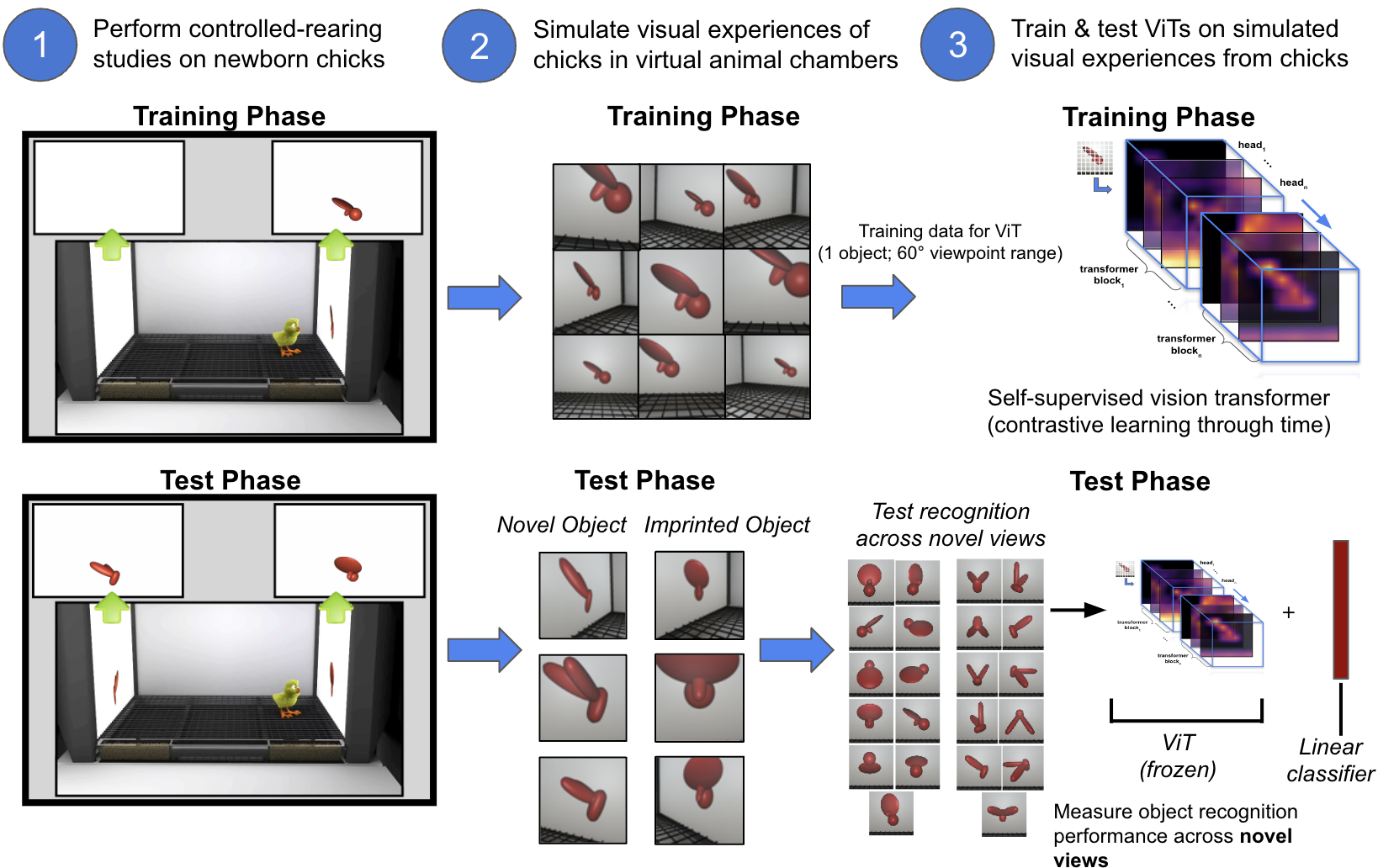
Vision transformers (ViTs) are top performing models on many computer vision benchmarks and can accurately predict human behavior on object recognition tasks. However, researchers question the value of using ViTs as models of biological learning because ViTs are thought to be more data hungry than brains, with ViTs requiring more training data to reach similar levels of performance. To test this assumption, we directly compared the learning abilities of ViTs and animals, by performing parallel controlled rearing experiments on ViTs and newborn chicks. We first raised chicks in impoverished visual environments containing a single object, then simulated the training data available in those environments by building virtual animal chambers in a video game engine. We recorded the first-person images acquired by agents moving through the virtual chambers and used those images to train self supervised ViTs that leverage time as a teaching signal, akin to biological visual systems. When ViTs were trained through the eyes of newborn chicks, the ViTs solved the same view invariant object recognition tasks as the chicks. Thus, ViTs were not more data hungry than newborn visual systems: both learned view invariant object representations in impoverished visual environments. The flexible and generic attention based learning mechanism in ViTs combined with the embodied data streams available to newborn animals appears sufficient to drive the development of animal-like object recognition.
Motivation & Objective
- To test whether Vision Transformers (ViTs) are more data-hungry than newborn visual systems, as commonly assumed.
- To directly compare learning performance between ViTs and newborn chicks under identical visual training conditions.
- To investigate whether self-supervised ViTs trained on first-person visual data from virtual animal chambers can achieve chick-level view-invariant object recognition.
- To evaluate whether the attention-based, sequence-learning mechanism in ViTs is sufficient to replicate core visual abilities seen in biological systems.
- To explore the sufficiency of generic learning mechanisms combined with embodied data for driving rapid, flexible visual learning.
Proposed method
- Conducted controlled-rearing experiments with newborn chicks in impoverished visual environments containing a single object, measuring their view-invariant object recognition performance.
- Built digital twins of the chick rearing chambers in Unity 3D to simulate the first-person visual experiences of the chicks.
- Recorded first-person image sequences from a virtual agent moving through the simulated chambers, capturing the visual data available to the chicks.
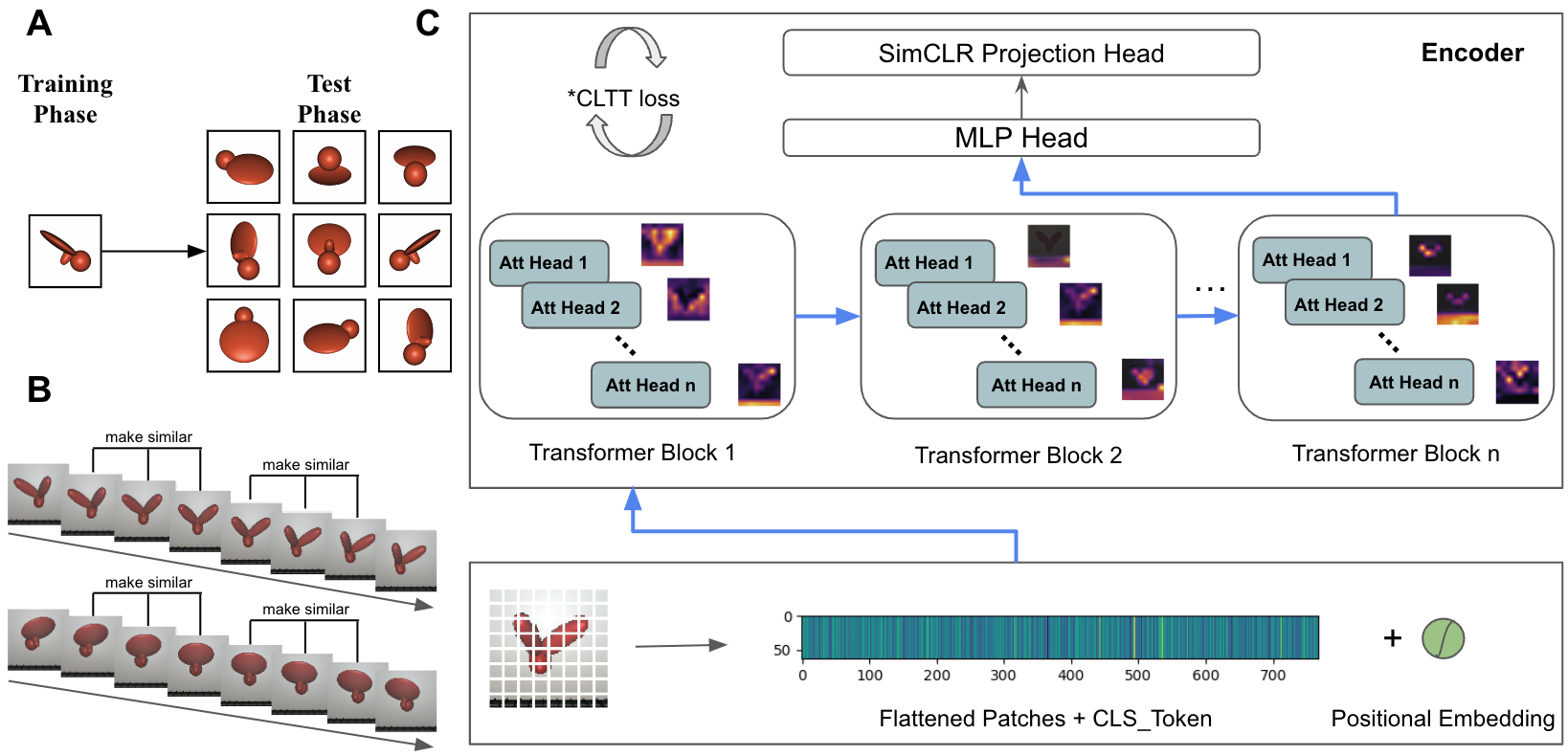
- Trained self-supervised Vision Transformers using contrastive learning over time, where successive views within a 300 ms window were made more similar in the embedding space.
- Froze the ViT backbone and attached a linear classifier to the penultimate layer for testing on the same stimuli used in chick experiments, using cross-validated evaluation.
- Used saliency heatmaps from the ViT's attention heads to analyze feature importance and attention patterns during inference.
Experimental results
Research questions
- RQ1Are Vision Transformers more data-hungry than newborn visual systems when trained on the same visual experiences?
- RQ2Can self-supervised ViTs trained on embodied, time-structured visual data achieve object recognition performance comparable to newborn chicks?
- RQ3Is a generic, attention-based learning mechanism sufficient to develop view-invariant object representations without prior inductive biases?
- RQ4Do the visual data streams available to newborn animals contain enough information to support rapid learning in artificial systems?
- RQ5Can digital twin experiments enable direct, fair comparisons between biological and artificial learning systems?
Key findings
- ViTs trained on first-person visual data from virtual chick rearing chambers achieved view-invariant object recognition performance equivalent to newborn chicks.
- The self-supervised ViT, using time as a teaching signal through contrastive learning, successfully learned object representations from minimal, impoverished visual input.
- Saliency heatmaps revealed that ViT attention heads focused on relevant object features, mirroring attention patterns observed in biological systems.
- The results challenge the assumption that ViTs require vastly more data than biological brains, showing both systems learn effectively from similar data distributions.
- The study demonstrates that a generic, attention-based learning mechanism combined with embodied data streams is sufficient to drive the development of animal-like object recognition.
- The findings support a 'single system' hypothesis in which a generic sequence-learning mechanism can give rise to domain-specific visual abilities through interaction with the environment.
Read this paper
Open the full text in the Nubint reader and ask about any passage as you read.
Read this paper on NubintThis review was generated by AI from the original paper. Please check the paper before citing it.