
[Paper Review] Assessment of the Reliablity of a Model's Decision by Generalizing Attribution to the Wavelet Domain
This paper introduces Wavelet Scale Attribution Method (WCAM), a novel technique that generalizes model attribution from the pixel domain to the wavelet space-scale domain, enabling simultaneous assessment of feature relevance and robustness to image corruptions. By analyzing saliency in both spatial and frequency (scale) components, WCAM reveals that models often rely on inconsistent scales across similar inputs, exposing vulnerabilities in decision-making even under data augmentation.
Neural networks have shown remarkable performance in computer vision, but their deployment in numerous scientific and technical fields is challenging due to their black-box nature. Scientists and practitioners need to evaluate the reliability of a decision, i.e., to know simultaneously if a model relies on the relevant features and whether these features are robust to image corruptions. Existing attribution methods aim to provide human-understandable explanations by highlighting important regions in the image domain, but fail to fully characterize a decision process's reliability. To bridge this gap, we introduce the Wavelet sCale Attribution Method (WCAM), a generalization of attribution from the pixel domain to the space-scale domain using wavelet transforms. Attribution in the wavelet domain reveals where and on what scales the model focuses, thus enabling us to assess whether a decision is reliable. Our code is accessible here: \url{https://github.com/gabrielkasmi/spectral-attribution}.
Motivation & Objective
- To address the limitations of existing attribution methods that only analyze relevance in the pixel domain, failing to assess robustness to distribution shifts.
- To bridge the gap between explainable AI and model robustness by introducing a space-scale attribution framework using wavelet transforms.
- To evaluate whether deep learning models rely on consistent, meaningful features across different inputs, especially under corruptions or distribution shifts.
- To provide practitioners with a tool to audit whether a model's decision is based on relevant, stable features across scales.
- To demonstrate that models exhibit scale inconsistency—focusing on different frequency components for similar images—revealing inherent vulnerabilities.
Proposed method
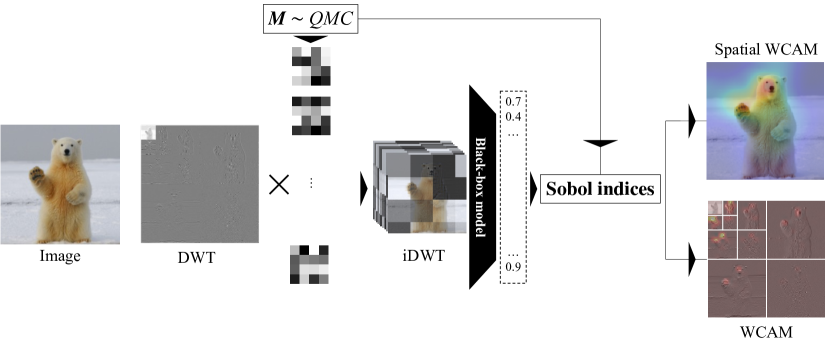
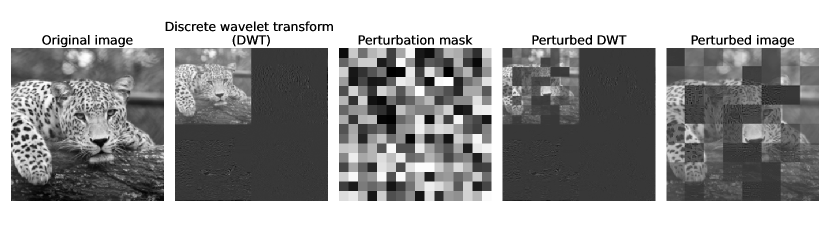
- The method applies a discrete wavelet transform (DWT) to input images, decomposing them into spatial and scale (frequency) components.
- Saliency maps are computed in the wavelet domain using Sobol indices to quantify the contribution of each wavelet coefficient to the model's prediction.
- The wavelet coefficient importance is ranked via Sobol indices, enabling reconstruction of minimal images using only the most influential coefficients.
- Scale consistency is evaluated by computing average Euclidean distances between scale embeddings of images within and across ImageNet classes.
- The approach enables reconstruction of 'minimal images'—images reconstructed from only the most important wavelet coefficients that still yield correct predictions.
- The method is applied to both CNNs and vision transformers, demonstrating generalizability across architectures.
Experimental results
Research questions
- RQ1Can attribution in the wavelet domain reveal whether a model's decision is based on relevant and stable features across different scales?
- RQ2To what extent do deep learning models rely on consistent scale components when classifying similar images?
- RQ3How does the wavelet domain attribution method compare to standard pixel-domain attribution in assessing model robustness?
- RQ4Can minimal images reconstructed from the most important wavelet coefficients preserve classification accuracy while reducing input complexity?
- RQ5Does data augmentation mitigate scale inconsistency in model decisions, as observed in the wavelet domain?
Key findings
- Models exhibit significant scale inconsistency: the average distance between scale embeddings of images from the same ImageNet class is not significantly different from that between random images, indicating no consistent scale usage.
- The average distance between scale embeddings within a class is substantially higher than the noise level attributable to sampling randomness, confirming that scale inconsistency is not due to random variation.
- Minimal images reconstructed from the most important wavelet coefficients can preserve correct classification, demonstrating that models often require only a small subset of scale components for accurate predictions.
- For some images, such as cats, fine details around the eyes are critical for prediction, while for others, like foxes, only coarse features are needed, highlighting variability in model requirements.
- The wavelet domain analysis reveals that models do not rely on background features, as these can be completely removed without affecting predictions, indicating robustness to irrelevant content.
- The phenomenon of scale inconsistency persists across both convolutional neural networks and vision transformers, suggesting it is rooted in optimization dynamics rather than architecture-specific behavior.
Read this paper
Open the full text in the Nubint reader and ask about any passage as you read.
Read this paper on NubintThis review was generated by AI from the original paper. Please check the paper before citing it.