
[Paper Review] Atacama Large Aperture Submillimeter Telescope (AtLAST) science: Gas and dust in nearby galaxies
A case study outlining how AtLAST, a proposed 50-m submillimeter telescope, will transform ISM and star formation studies in nearby galaxies, especially the LMC/SMC, via deep dust/gas mapping across wide sky areas and multiple tracers.
Understanding the physical processes that regulate star formation and galaxy evolution are major areas of activity in modern astrophysics. Nearby galaxies offer unique opportunities to inspect interstellar medium (ISM), star formation (SF), radiative, dynamic and magnetic physics in great detail from sub-galactic (kpc) scales to sub-cloud (sub-pc) scales, from quiescent galaxies to starbursts, and from field galaxies to overdensities. In this case study, we discuss the major breakthroughs in this area of research that will be enabled by the Atacama Large Aperture Submillimeter Telescope (AtLAST), a proposed 50-m single-dish submillimeter telescope. The new discovery space of AtLAST comes from its exceptional sensitivity, in particular to extended low surface brightness emission, a very large 2 degree field of view, and correspondingly high mapping efficiency. This paper focuses on four themes which will particularly benefit from AtLAST: 1) the LMC and SMC, 2) extragalactic magnetic fields, 3) the physics and chemistry of the interstellar medium, and 4) star formation and galaxy evolution. With ~1000-2000h surveys each, AtLAST could deliver deep dust continuum maps of the entire LMC and SMC fields at parsec-scale resolution, high-resolution maps of the magnetic field structure, gas density, temperature and composition of the dense and diffuse ISM in ~100 nearby galaxies, as well as the first large-scale blind CO survey in the nearby Universe, delivering molecular gas masses for up to 10^6 galaxies (3 orders of magnitude more than current samples). Through such observing campaigns, AtLAST will have a profound impact on our understanding of the baryon cycle and star formation across a wide range of environments.
Motivation & Objective
- Motivate and define a science case for AtLAST focused on gas and dust in nearby galaxies.
- Demonstrate how AtLAST will probe ISM physics, chemistry, magnetic fields, and star formation across diverse environments.
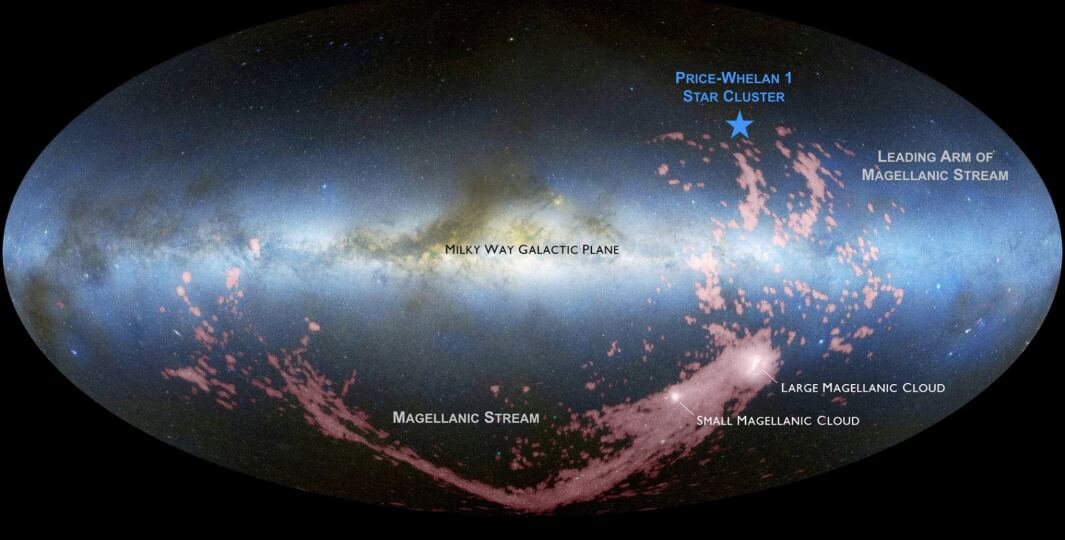
- Highlight LMC/SMC as key laboratories and quantify the observational requirements to achieve these goals.
- Illustrate potential survey strategies and the impact on understanding the baryon cycle in galaxies.
Proposed method
- Describe AtLAST capabilities: 50-m single-dish, exceptional sensitivity to extended emission, 2° field of view, and high mapping efficiency.
- Propose multi-band continuum and spectral line surveys from Band 3 to Band 10 to map dust and gas tracers.
- Outline concrete survey scenarios for the LMC/SMC with estimated on-source times (~2900 h total) and resolving power (Band 10 ~1.5–2″).
- Compare AtLAST capabilities to existing facilities (ALMA, APEX, Herschel) and discuss how AtLAST uniquely addresses CO-dark gas and diffuse ISM.
- Discuss target tracers including CO, [CI], [CII], and dust emission to characterize gas phases and dust properties.
- Present a framework for translating AtLAST data into constraints on gas mass, dust mass, metallicity effects, and star formation processes.
Experimental results
Research questions
- RQ1How does the diffuse and dense ISM in the LMC/SMC differ from Milky Way environments, and what does this imply for star formation?
- RQ2What is the extent and properties of CO-dark molecular gas in low-metallicity environments, and how can it be traced with [CI] and other lines?
- RQ3How do dust properties (temperature, emissivity, mass) vary with metallicity and environment in the LMC/SMC?
- RQ4What is the role of magnetic fields in shaping gas flows and star formation on Galactic to sub-kpc scales in nearby galaxies?
- RQ5What is the demographic of dust and molecular gas across a broad local galaxy population when surveyed comprehensively?
Key findings
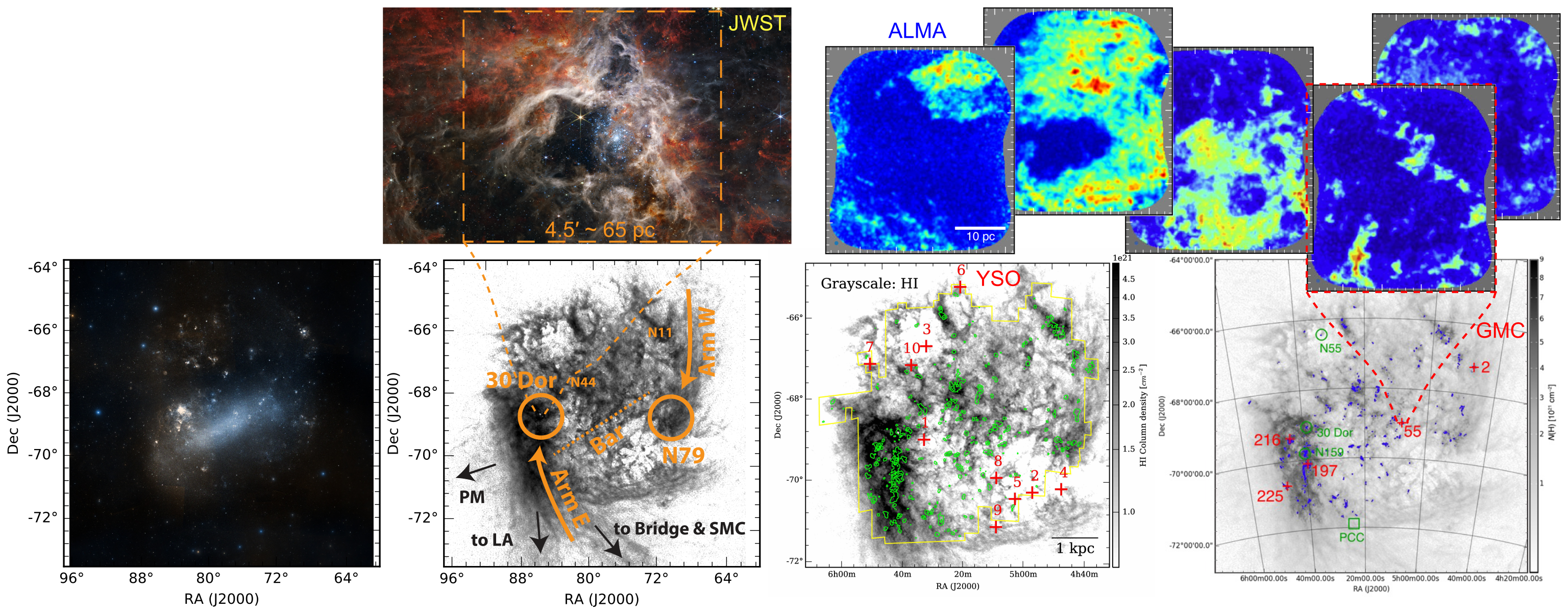
- CO-dark gas is significant in low-metallicity environments, with [CII] observations suggesting a large fraction of cold gas not traced by CO in the LMC.
- AtLAST can map the LMC/SMC in continuum across multiple bands with unprecedented sensitivity to diffuse emission and 10×–15× higher spatial resolution than Herschel, enabling sub-parsec scale studies over ∼100 deg² fields.
- A Large-Scale CO and [CI] survey with AtLAST will provide contiguous, high-sensitivity coverage rivaling or exceeding existing CO surveys in depth and resolution.
- Multi-band continuum data will allow disentangling dust from free-free emission and CMB/foreground confusion, improving dust mass and temperature estimates across environments.
- Line surveys (e.g., CO, [CI]) at higher frequencies will be feasible over significant areas, enabling detailed excitation and gas condition studies from cloud scales to galaxy scales.
- Survey strategies indicate substantial observing time (∼2900 hours for LMC/SMC continuum mapping) spread over years to enable comprehensive, multi-band coverage.
Read this paper
Open the full text in the Nubint reader and ask about any passage as you read.
Read this paper on NubintThis review was generated by AI from the original paper. Please check the paper before citing it.