
[Paper Review] ATLASGAL: 3-mm class I methanol masers in high-mass star formation regions
This study conducts a 3-mm spectral line survey of 408 ATLASGAL clumps using the IRAM 30m telescope to detect class I methanol masers at 84, 95, and 104.3 GHz. It identifies 54, 100, and 4 new maser detections respectively, revealing that 95 GHz masers are stronger than 84 GHz ones, and that masers correlate strongly with SiO shock tracers and clump properties like bolometric luminosity and H₂ column density, indicating their role as early-stage signposts of high-mass star formation shocks.
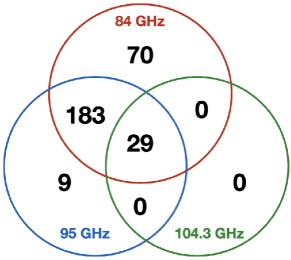
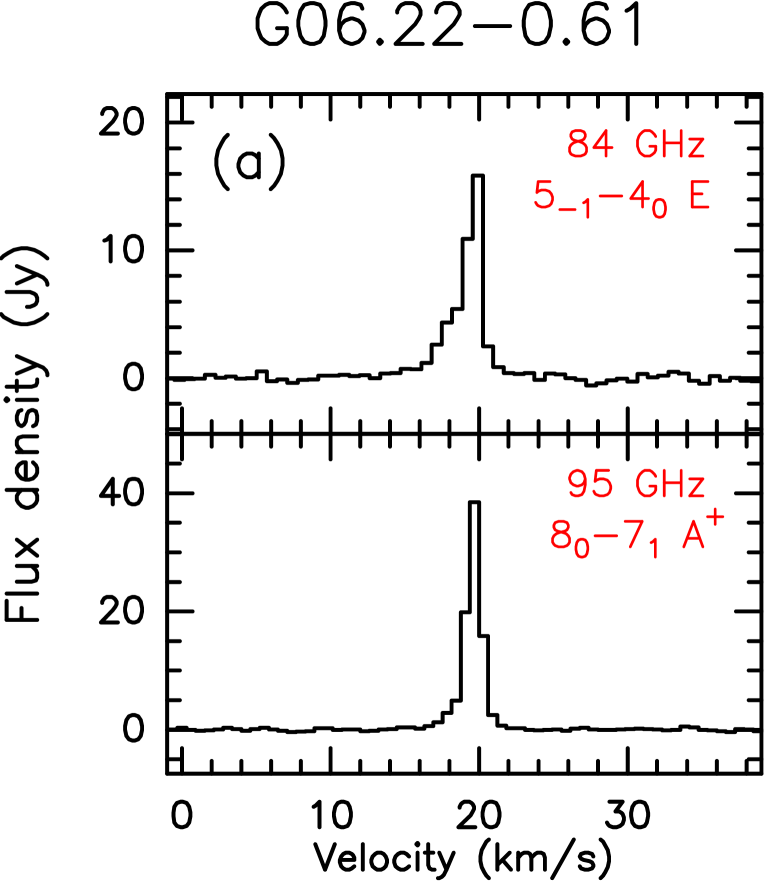
We analyzed the 3-mm wavelength spectral line survey of 408 ATLASGAL clumps observed with the IRAM 30m-telescope, focusing on the class I methanol masers with frequencies near 84, 95 and 104.3 GHz. We detect narrow, maser-like features towards 54, 100 and 4 sources in the maser lines near 84, 95 and 104.3 GHz, respectively. Among them, fifty 84 GHz masers, twenty nine 95 GHz masers and four rare 104.3 GHz masers are new discoveries. The new detections increase the number of known 104.3 GHz masers from 5 to 9. The 95 GHz class I methanol maser is generally stronger than the 84 GHz maser counterpart. We find 9 sources showing class I methanol masers but no SiO emission, indicating that class I methanol masers might be the only signpost of protostellar outflow activity in extremely embedded objects at the earliest evolutionary stage. Class I methanol masers that are associated with sources that show SiO line wings are more numerous and stronger than those without such wings. The total integrated intensity of class I methanol masers is well correlated with the integrated intensity and velocity coverage of the SiO (2--1) emission. The properties of class I methanol masers are positively correlated with the bolometric luminosity, clump mass, peak H$_2$ column density of their associated clumps but uncorrelated with the luminosity-to-mass ratio, dust temperature, and mean H$_2$ volume density. We suggest that the properties of class I masers are related to shocks traced by SiO. Based on our observations, we conclude that class I methanol masers at 84 and 95 GHz can trace a similar evolutionary stage as H$_2$O maser, and appear prior to 6.7 and 12.2 GHz methanol and OH masers. Despite their small number, the 104.3 GHz class I masers appear to trace a short and more evolved stage compared to the other class I masers. [abridged]
Motivation & Objective
- To detect new class I methanol masers at 84, 95, and 104.3 GHz in high-mass star formation regions.
- To investigate the statistical relationship between class I masers and shock tracers such as SiO emission.
- To compare maser properties with those of their host clumps across evolutionary stages.
- To constrain the physical conditions enabling simultaneous excitation of multiple class I masers.
- To determine the evolutionary stage traced by different class I maser transitions relative to other maser species.
Proposed method
- Conducted a 3-mm spectral line survey of 408 ATLASGAL clumps using the IRAM 30m telescope.
- Focused on identifying narrow, maser-like features in the 84, 95, and 104.3 GHz transitions of class I methanol masers.
- Correlated maser detections with SiO (2–1) emission, particularly line wings indicating shocks.
- Analyzed correlations between maser integrated intensity and clump properties: bolometric luminosity, mass, H₂ column density, dust temperature, and H₂ volume density.
- Used physical modeling to estimate kinetic temperature, para-H₂ density, and methanol column density in regions with multiple maser transitions.
- Applied statistical analysis to assess evolutionary stage associations based on luminosity-to-mass ratios and maser presence.
Experimental results
Research questions
- RQ1What is the detection rate of class I methanol masers at 84, 95, and 104.3 GHz in high-mass star-forming clumps?
- RQ2How do maser properties correlate with SiO emission features, particularly line wings indicative of shocks?
- RQ3Which clump properties (e.g., luminosity, mass, H₂ column density) are most strongly correlated with maser strength?
- RQ4Do 84 and 95 GHz class I masers trace the same evolutionary stage as H₂O masers, and how do they compare to 6.7/12.2 GHz methanol and OH masers?
- RQ5What physical conditions are required to simultaneously excite multiple class I maser transitions?
Key findings
- 54 new 84 GHz, 29 new 95 GHz, and 4 new 104.3 GHz class I methanol masers were detected, increasing the total known 104.3 GHz masers from 5 to 9.
- The 95 GHz class I maser is generally stronger than its 84 GHz counterpart, with relative velocities between maser and systemic velocity within ~5 km s⁻¹.
- Nine sources exhibit class I masers but no SiO emission, suggesting masers can be the sole signpost of protostellar outflow activity in the earliest embedded stages.
- Maser strength is positively correlated with SiO (2–1) integrated intensity and velocity coverage (FWZP), indicating a strong link to shock activity.
- Class I maser properties are positively correlated with bolometric luminosity, clump mass, and peak H₂ column density, but uncorrelated with luminosity-to-mass ratio, dust temperature, and mean H₂ volume density.
- The 104.3 GHz masers are only detected in H II region stages and require higher clump luminosity (>10⁴ L⊙), mass (>200 M⊙), and H₂ column density (>10²³ cm⁻²) than lower-frequency masers, indicating a more evolved stage.
Read this paper
Open the full text in the Nubint reader and ask about any passage as you read.
Read this paper on NubintThis review was generated by AI from the original paper. Please check the paper before citing it.