
[Paper Review] Audio-Linguistic Embeddings for Spoken Sentences
This paper proposes audio-linguistic sentence embeddings that jointly model acoustic and linguistic content in spoken sentences using a multitask encoder-decoder framework with a temporal convolutional network (TCN). The method outperforms phoneme and word-level embeddings on speech recognition and emotion recognition tasks, demonstrating superior modeling of long-term dependencies and high-level acoustic concepts without requiring external language models.
We propose spoken sentence embeddings which capture both acoustic and linguistic content. While existing works operate at the character, phoneme, or word level, our method learns long-term dependencies by modeling speech at the sentence level. Formulated as an audio-linguistic multitask learning problem, our encoder-decoder model simultaneously reconstructs acoustic and natural language features from audio. Our results show that spoken sentence embeddings outperform phoneme and word-level baselines on speech recognition and emotion recognition tasks. Ablation studies show that our embeddings can better model high-level acoustic concepts while retaining linguistic content. Overall, our work illustrates the viability of generic, multi-modal sentence embeddings for spoken language understanding.
Motivation & Objective
- To address the limitation of existing models that operate at character, phoneme, or word level, which fail to capture long-term dependencies in spoken language.
- To develop a unified, sentence-level embedding that captures both acoustic and linguistic content simultaneously.
- To eliminate the need for external language models in speech recognition by learning temporal structure directly in the embedding.
- To evaluate the generalization and robustness of sentence-level embeddings across diverse speech tasks such as ASR and emotion recognition.
- To explore the viability of multi-modal, generic sentence embeddings for spoken language understanding.
Proposed method
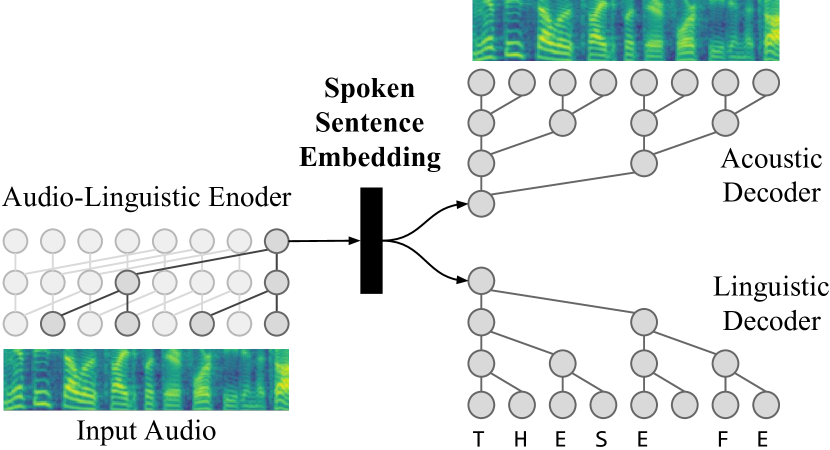
- Uses a temporal convolutional network (TCN) with dilated and causal convolutions to model long-range temporal dependencies in speech sequences.
- Employs a multitask learning framework where the model jointly reconstructs acoustic features (e.g., spectrograms) and linguistic features (e.g., word embeddings) from the same audio input.
- Applies a deep averaging network (DAN) to aggregate intermediate representations into a fixed-size sentence embedding vector.
- Trains the encoder-decoder model end-to-end using a shared loss objective that combines acoustic and linguistic reconstruction losses.
- Fixes the encoder weights after pre-training on LibriSpeech and fine-tunes only the decoder heads for downstream tasks on TIMIT and RAVDESS.
- Utilizes a causal convolutional architecture to ensure autoregressive behavior, enabling context-aware modeling without future information.
Experimental results
Research questions
- RQ1Can a single sentence-level embedding effectively model both acoustic and linguistic content in spoken language?
- RQ2Does learning sentence embeddings jointly via multitask learning improve performance on downstream tasks like speech recognition and emotion classification?
- RQ3How does the performance of sentence-level embeddings compare to phoneme- and word-level baselines in modeling long-term dependencies?
- RQ4To what extent can the learned embeddings generalize to unseen datasets and tasks, such as emotion recognition on RAVDESS?
- RQ5How does sequence length affect the quality and robustness of sentence embeddings in speech recognition?
Key findings
- Spoken sentence embeddings significantly outperform phoneme-level and word-level embeddings on automatic speech recognition, achieving lower word error rates than baselines.
- On the RAVDESS emotion recognition task, the sentence embeddings achieved strong performance without any fine-tuning on emotion data, indicating robust generalization.
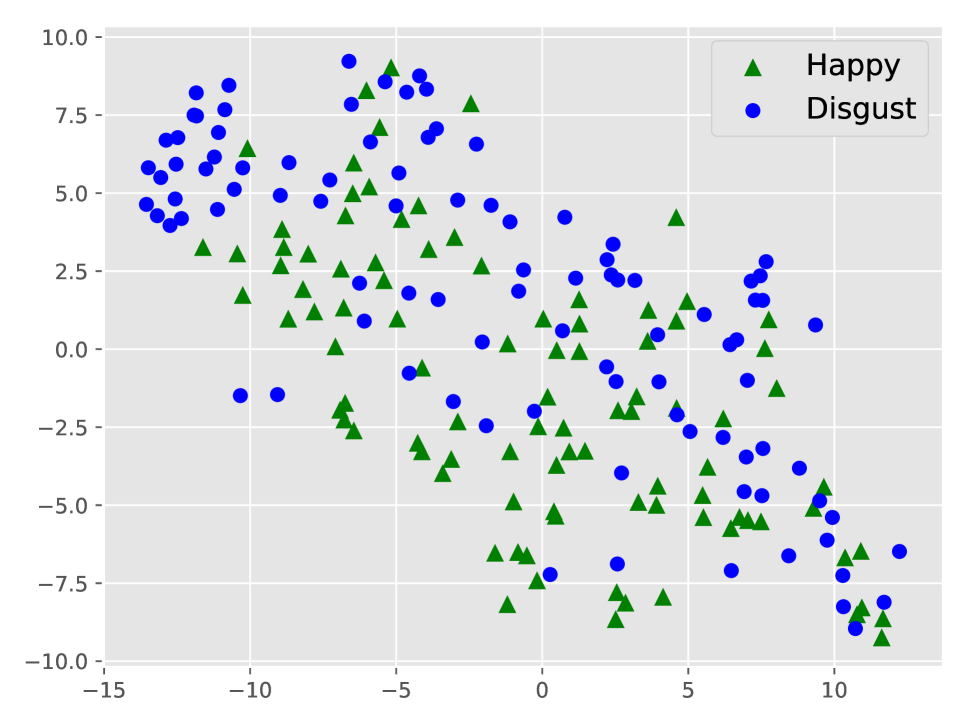
- Ablation studies show that the model clusters different emotions in the embedding space even though it was not trained on emotion recognition, suggesting it captures high-level acoustic concepts.
- The performance of all embeddings degrades with increasing sentence length, but the proposed method is more robust than simpler baselines, indicating better handling of long-context modeling.
- The uniform average baseline performed nearly as well as the more complex deep averaging network (DAN), suggesting that the bottleneck lies in the input representation rather than the aggregation method.
- The model’s ability to reconstruct both acoustic and linguistic features simultaneously confirms that the learned embeddings preserve rich, multi-modal information.
Read this paper
Open the full text in the Nubint reader and ask about any passage as you read.
Read this paper on NubintThis review was generated by AI from the original paper. Please check the paper before citing it.