
[Paper Review] Automated, LLM enabled extraction of synthesis details for reticular materials from scientific literature
The paper presents a Knowledge Extraction Pipeline (KEP) that uses prompt-engineered, in-context learning with open-source LLMs to automatically extract synthesis protocols for reticular materials from PDFs, without fine-tuning, and compares five LLM families across paragraph classification and information extraction tasks.
Automated knowledge extraction from scientific literature can potentially accelerate materials discovery. We have investigated an approach for extracting synthesis protocols for reticular materials from scientific literature using large language models (LLMs). To that end, we introduce a Knowledge Extraction Pipeline (KEP) that automatizes LLM-assisted paragraph classification and information extraction. By applying prompt engineering with in-context learning (ICL) to a set of open-source LLMs, we demonstrate that LLMs can retrieve chemical information from PDF documents, without the need for fine-tuning or training and at a reduced risk of hallucination. By comparing the performance of five open-source families of LLMs in both paragraph classification and information extraction tasks, we observe excellent model performance even if only few example paragraphs are included in the ICL prompts. The results show the potential of the KEP approach for reducing human annotations and data curation efforts in automated scientific knowledge extraction.
Motivation & Objective
- Motivate rapid construction of a synthesis protocol database for reticular materials (MOFs, ZIFs, COFs, zeolites) from literature.
- Develop a domain-independent KEP that does not require model fine-tuning or training.
- Demonstrate that prompt engineering with in-context learning (ICL) can retrieve chemical synthesis details from PDFs with reduced hallucination risk.
- Assess performance across multiple open-source LLM families in both paragraph classification and information extraction.
- Highlight how example selection in prompts influences model success and reduces annotation effort.
Proposed method
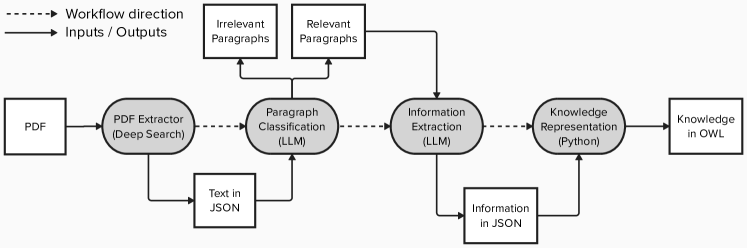
- Introduce a four-module Knowledge Extraction Pipeline (KEP): PDF extractor, Paragraph classification, Information extraction, and Knowledge representation.
- Use DS4SD to convert PDFs (including image PDFs via OCR) into JSON-like document elements.
- Apply prompt-engineered ICL with few-shot examples to classify paragraphs as synthesis-related or not (S vs I).
- Apply prompt-driven JSON annotation to extract synthesis details (product, conditions, reactants, solvents) and map them into a structured knowledge representation.
- Conduct an Example selection phase to choose the best prompt exemplars for each model and task to maximize performance.
Experimental results
Research questions
- RQ1Can open-source LLMs (without fine-tuning) achieve high-accuracy paragraph classification and information extraction for reticular-material synthesis from PDFs?
- RQ2How does the choice of prompt exemplars affect model performance across different LLM families?
- RQ3Which LLMs and prompt strategies best support automated knowledge extraction of synthesis protocols from scientific literature?
Key findings
- Five LLM families (Flan, Granite, LLaMA, Mistral, Mixtral) achieved high performance without task-specific fine-tuning.
- In paragraph classification, most models reached F1 scores above 0.84 with the best prompts; several reached 0.98 (e.g., llama-3-70b-instruct, mistral-large).
- In information extraction, top models achieved accuracies up to 0.96 (e.g., llama-3-1 405b-instruct) using as few as two example paragraphs in prompts.
- The results show that prompt-example selection significantly impacts performance and that larger models do not always guarantee superior results.
- The proposed KEP can reduce SME annotation and data curation while enabling automated extraction of synthesis protocols from unstructured PDFs.
Read this paper
Open the full text in the Nubint reader and ask about any passage as you read.
Read this paper on NubintThis review was generated by AI from the original paper. Please check the paper before citing it.