
[Paper Review] Back to the Formula -- LHC Edition
This paper introduces symbolic regression using PySR to extract human-readable analytic formulas for optimal LHC observables from simulated matrix-element data, achieving performance comparable to neural networks. It successfully recovers known CP-violating observables in WBF Higgs production and demonstrates that simple formulas like $p_{T,1}p_{T,2}\sin(\Delta\phi)$ match neural network performance even with detector effects.
While neural networks offer an attractive way to numerically encode functions, actual formulas remain the language of theoretical particle physics. We show how symbolic regression trained on matrix-element information provides, for instance, optimal LHC observables in an easily interpretable form. We introduce the method using the effect of a dimension-6 coefficient on associated ZH production. We then validate it for the known case of CP-violation in weak-boson-fusion Higgs production, including detector effects.
Motivation & Objective
- To bridge the gap between black-box machine learning and interpretable theoretical physics by extracting analytic formulas from LHC simulation data.
- To address the lack of interpretability in neural network-based optimal observables used in LHC analyses.
- To validate symbolic regression as a viable alternative to neural networks for constructing optimal observables in Higgs and weak-boson-fusion processes.
- To demonstrate that symbolic regression can recover known theoretical expressions for CP-violating Wilson coefficients in WBF Higgs production.
- To assess the performance of derived formulas against numerically trained neural networks (Sally) under realistic detector effects and varying Wilson coefficient values.
Proposed method
- Leverages MadMiner to extract matrix-element information from simulated LHC events for specific processes (ZH and WBF Higgs production).
- Applies symbolic regression via PySR to learn closed-form analytic expressions for optimal observables (scores) from high-dimensional phase space data.
- Modifies the standard PySR algorithm to better handle the functional complexity of LHC observables, especially for large Wilson coefficients.
- Uses the likelihood ratio as the score function, derived from fully differential cross sections, to train symbolic models.
- Validates results by comparing symbolic formulas to numerically trained neural networks (Sally) using MSE and score-weighted MSE metrics.
- Incorporates detector effects and jet radiation by training on realistic event-level simulations, not just parton-level matrix elements.
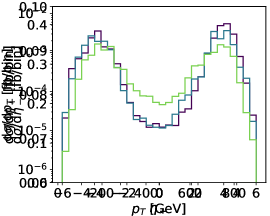
Experimental results
Research questions
- RQ1Can symbolic regression recover known analytic forms for optimal observables in CP-violating WBF Higgs production, such as $p_{T,1}p_{T,2}\sin(\Delta\phi)$?
- RQ2How does the performance of symbolic regression-derived formulas compare to numerically trained neural networks (Sally) in terms of MSE and statistical significance?
- RQ3Can symbolic regression produce interpretable, compact formulas for optimal observables even when Wilson coefficients are large and non-perturbative effects emerge?
- RQ4To what extent can detector effects and jet radiation be incorporated into symbolic regression without degrading performance?
- RQ5Does the symbolic formula approach maintain sensitivity in exclusion limits compared to the full neural network framework?
Key findings
- The symbolic regression approach successfully recovers the known analytic form $p_{T,1}p_{T,2}\sin(\Delta\phi)$ for the CP-violating Wilson coefficient $f_{W\widetilde{W}}$ in WBF Higgs production, matching theoretical expectations.
- For small Wilson coefficients, PySR-derived formulas achieve near-identical performance to the numerically trained Sally neural network, with MSE differences below 1% in most cases.
- Even for large Wilson coefficients ($f_B = 10/\text{TeV}^2$), symbolic regression produces rational functions that maintain high fidelity to the true score, though with increased complexity.
- The inclusion of detector effects does not significantly degrade performance, and the symbolic formulas remain robust under realistic simulation conditions.
- Score-weighted MSE analysis shows that the correlation between performance and event score is flat for the best symbolic formulas, indicating consistent performance across phase space.
- The study demonstrates that simple, interpretable formulas can replace complex neural networks in LHC analyses without loss of sensitivity, enabling transparent and theory-guided inference.
Read this paper
Open the full text in the Nubint reader and ask about any passage as you read.
Read this paper on NubintThis review was generated by AI from the original paper. Please check the paper before citing it.