
[논문 리뷰] Bar formation and evolution in the cosmological context: Inputs from the Auriga simulations
The paper analyzes barred galaxies in the Auriga cosmological zoom-in simulations to characterize bar formation, growth, and evolution across cosmic time, and relates bar properties to global galaxy/halo parameters.
Galactic bars drive the internal evolution of spiral galaxies, while their formation is tightly coupled to the properties of their host galaxy and dark matter halo. To explore what drives bar formation in the cosmological context and how these structures evolve throughout cosmic history, we use the Auriga suite of magneto-hydrodynamical cosmological zoom-in simulations. We find that bars are robust and long-lived structures, and we recover a decreasing bar fraction with increasing redshift which plateaus around $\sim20\%$ at $z\sim3$. We find that bars which form at low and intermediate redshifts grow longer with time, while bars that form at high redshifts are born `saturated' in length, likely due to their merger-induced formation pathway. This leads to a larger bar-to-disc size ratio at high redshifts as compared to the local Universe. We subsequently examine the multi-dimensional parameter space thought to drive bar formation. We find that barred galaxies tend to have lower Toomre $Q$ values at the time of their formation, while we do not find a difference in the gas fraction of barred and unbarred populations when controlling for stellar mass. Barred galaxies tend to be more baryon-dominated at all redshifts, assembling their stellar mass earlier, while galaxies that are baryon-dominated but that do not host a bar, have a higher ex-situ bulge fraction. We explore the implications of the baryon-dominance of barred galaxies on the Tully-Fisher relation, finding an offset from the unbarred relation; confirming this in observations would serve as additional evidence for dark matter, as this behaviour is not readily explained in modified gravity scenarios.
연구 동기 및 목표
- Investigate how bar formation depends on cosmological context and host galaxy properties in Auriga simulations.
- Quantify bar properties (strength, length) and their evolution from high redshift to the present.
- Assess how bar formation correlates with baryon dominance, disc stability, and mass assembly histories.
- Explore implications for the Tully-Fisher relation and bars at high redshift within a cosmological framework.
제안 방법
- Use the Auriga magneto-hydrodynamical cosmological zoom-in simulations spanning halo masses from 0.5 to 2 x 10^12 Msun.
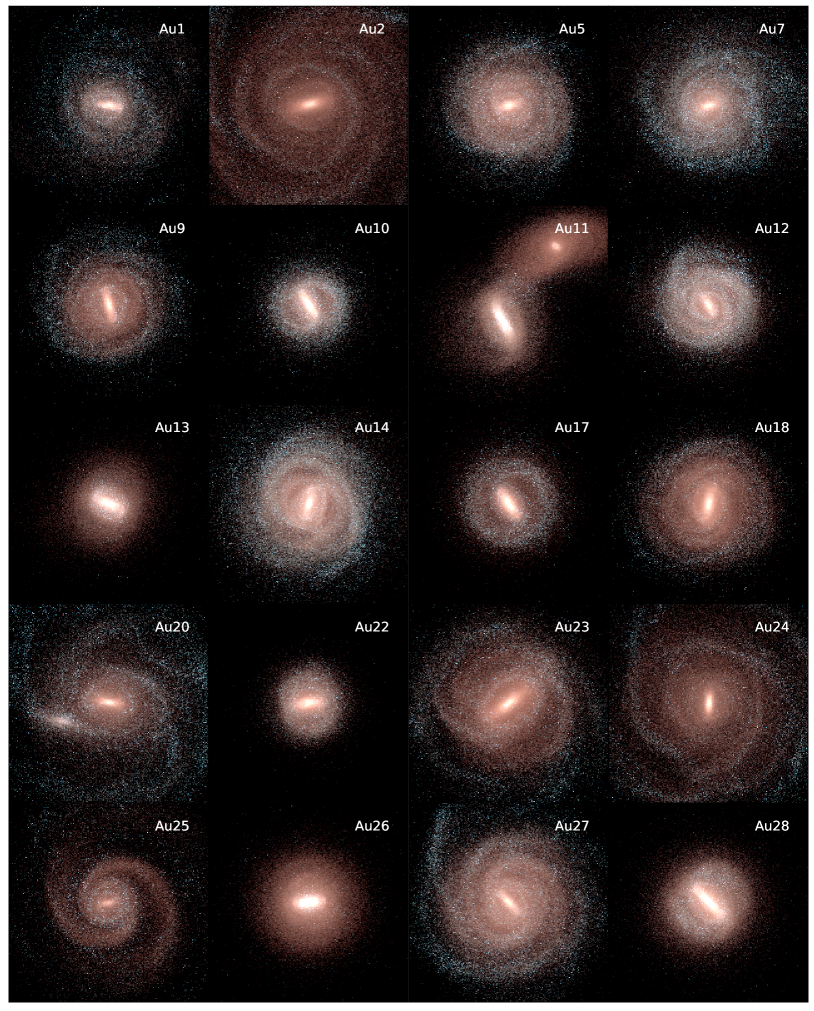
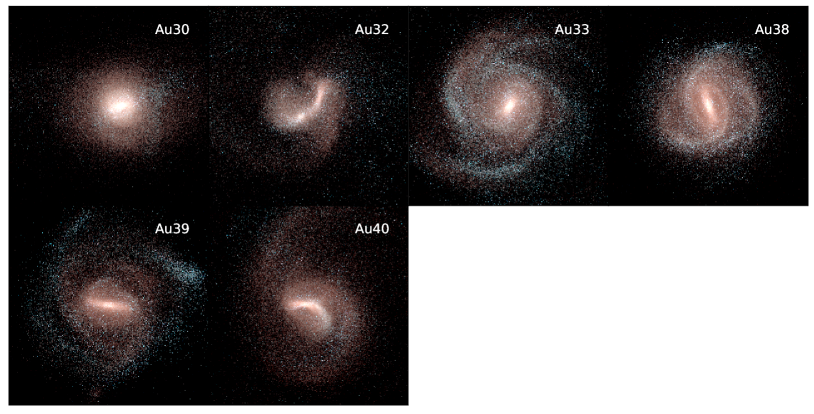
- Identify barred galaxies at z=0 via the bar strength A2 (A2 >= 0.25) computed from the m=2 Fourier mode of the stellar surface density.
- Compute bar formation time t_bf as the first lookback time when A2 exceeds 0.25 and remains above it.
- Measure bar length R_bar as the radius where A2 drops to 70% of its maximum within ~0–10 kpc.
- Define disc size R_d as the radius where stellar surface density falls below 1 Msun/pc^2.
- Assess baryon-dominance time t_gal,bd as when stars contribute >=80% of mass within 5 kpc.
실험 결과
연구 질문
- RQ1What is the bar fraction in Auriga galaxies as a function of redshift and stellar mass?
- RQ2How do bar strength, length, and formation time relate to host galaxy properties (baryon dominance, disc size, stellar mass) across cosmic time?
- RQ3Do barred and unbarred galaxies differ in gas fraction when controlling for stellar mass, and how does this affect bar formation?
- RQ4What are the implications of bar formation for the Tully-Fisher relation in a cosmological context, especially at high redshift?
주요 결과
- Bars are robust and long-lived in Auriga galaxies, with a decreasing bar fraction toward higher redshift, plateauing around ~20% at z~3.
- Bars forming at low/intermediate redshifts grow longer over time, while early-formed bars are born long and change little in length.
- Barred galaxies tend to be more baryon-dominated at all redshifts, and bar formation correlates with earlier baryon dominance onset.
- There is a mild correlation between bar strength at z=0 and bar age, and a correlation between bar formation time and inner stellar-to-dark matter ratio, but no strong dependence on present-day stellar mass.
더 나은 연구,지금 바로 시작하세요
연구 설계부터 논문 작성까지, 연구 시간을 획기적으로 줄여보세요.
카드 등록 없음 · 무료 플랜 제공
이 리뷰는 AI가 만들고, 인간 에디터가 검토했습니다.