
[Paper Review] Bayesian analysis of a Unified Dark Matter model with transition: can it alleviate the $H_{0}$ tension?
This paper investigates a Unified Dark Matter (UDM) model with a fast transition to alleviate the Hubble tension, using Bayesian inference with SNIa (Pantheon), CMB priors (Planck), and SH0ES-based $M$-prior. The model slightly reduces the $H_0$ tension by ~1.5σ, but AIC/BIC criteria strongly favor $Λ$CDM, indicating no significant improvement over the standard model despite satisfying key theoretical requirements for tension relief.
We consider cosmological models in which Dark Matter (DM) and Dark Energy (DE) are described by a single component, dubbed Unified Dark Matter (UDM) models, in which the DE-like part can have an equation state $<-1$ at late times without violating the null energy condition. In this paper, we investigate whether this feature can relieve the Hubble tension. We perform a Bayesian analysis of the model using SNIa data from Pantheon, the CMB distance prior from Planck, and the prior on the absolute magnitude $M$ of SNIa from SH0ES. Using the prior, the data suggests a smooth transition taking place at redshifts $z_{ m t} \simeq 2.85$, which provides a value $H_0=69.64\pm 0.88$ for the Hubble constant, slightly alleviating the tension by $\sim 1.5 σ$. Without it, we obtain $H_0 = 67.6^{+1.3}_{-0.82}$ and a transition happening at $z_t=1.36$. We also discuss the importance of using the prior on $M$ for constraining this model.
Motivation & Objective
- To assess whether a Unified Dark Matter (UDM) model with a fast transition can alleviate the $H_0$ tension.
- To perform a Bayesian analysis of the UDM model using cosmological data including SNIa (Pantheon), CMB distance priors (Planck), and the SH0ES prior on the absolute magnitude $M$ of type Ia supernovae.
- To evaluate the impact of the $M$-prior on constraining the UDM model parameters and on the resulting $H_0$ value.
- To compare the UDM model's fit to data against the standard $Λ$CDM model using information criteria (AIC/BIC).
- To determine whether the UDM model's ability to cross $w < -1$ while preserving the null energy condition provides a viable resolution to the $H_0$ tension.
Proposed method
- Employing the CLASS Boltzmann solver and MontePython for Bayesian parameter estimation to analyze the UDM model with a transition parameterized by $\beta$ and $a_t$.
- Using a pressure profile from Bertacca et al. (2011) that allows for a smooth or fast transition from matter-like to dark energy-like behavior depending on $\beta$ and $a_t$.
- Applying a prior on the absolute magnitude $M$ of SNIa from the SH0ES collaboration to break degeneracies and improve constraints on $H_0$ and UDM parameters.
- Fixing CMB-related distance priors (e.g., $R$, $l_A$) from Planck to isolate the effect of the UDM model on $H_0$ and $M$.
- Calculating the Akaike (AIC) and Bayesian (BIC) information criteria to compare model performance between UDM and $Λ$CDM.
- Assessing the model's consistency with Pantheon SNIa data by comparing theoretical magnitude differences with observed values.
Experimental results
Research questions
- RQ1Can a Unified Dark Matter model with a fast transition reduce the $H_0$ tension compared to $Λ$CDM?
- RQ2How does the inclusion of the SH0ES prior on $M$ affect the constraints on the UDM model parameters and the inferred $H_0$?
- RQ3Does the UDM model's ability to cross $w < -1$ while satisfying the null energy condition provide a viable mechanism to alleviate the $H_0$ tension?
- RQ4To what extent does the UDM model improve the fit to cosmological data compared to $Λ$CDM, as measured by information criteria?
- RQ5Is the observed reduction in $H_0$ tension due to a genuine increase in $H_0$ or due to increased parameter uncertainties from correlations with $H_0$?
Key findings
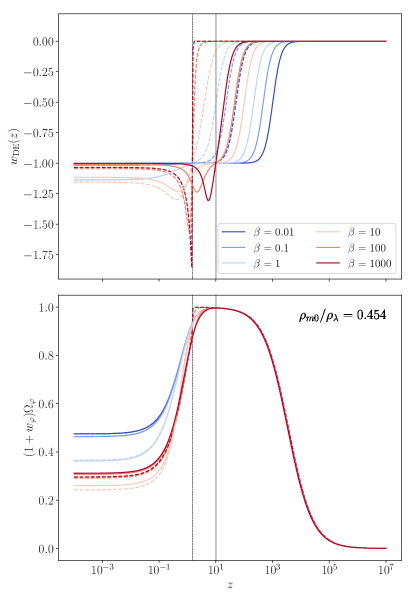
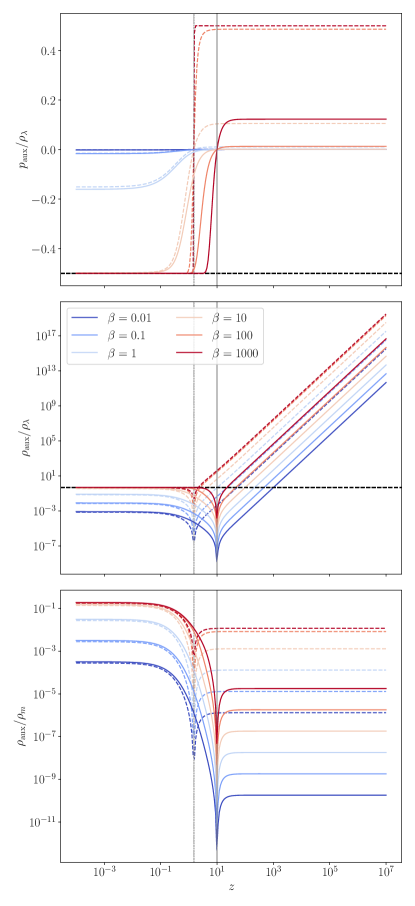
- The data favors a smooth transition in the UDM model, with $\beta(a^3 - a_t^3) < 1$, indicating that the transition is not fast but gradual.
- The posterior on the transition redshift is $z_t \simeq 2.85$ when the $M$-prior is included, suggesting a transition at relatively high redshift.
- The model yields $H_0 = 69.64 \pm 0.88 \, \text{km} \, \text{s}^{-1} \, \text{Mpc}^{-1}$, which reduces the $H_0$ tension by approximately $1.5\sigma$ compared to the $Λ$CDM value.
- The reduction in tension is primarily due to increased uncertainties from parameter correlations with $H_0$, not a significant shift in the central value of $H_0$.
- The AIC and BIC criteria strongly favor $Λ$CDM over the UDM model, with $\Delta$AIC = 0.8 and $\Delta$BIC = 10.8 when the $M$-prior is used, indicating empirical preference for the standard model.
- The UDM model is inconsistent with Pantheon SNIa data for $\beta = 10$, the case with the most promising tension reduction, indicating a tension with observations despite theoretical appeal.
Read this paper
Open the full text in the Nubint reader and ask about any passage as you read.
Read this paper on NubintThis review was generated by AI from the original paper. Please check the paper before citing it.