
[Paper Review] Benchmarking Distribution Shift in Tabular Data with TableShift
This paper introduces TableShift, a benchmark for evaluating robustness to distribution shift in tabular machine learning, comprising 15 diverse binary classification tasks across domains like healthcare, finance, and public policy. It reveals a strong linear correlation between in-distribution and out-of-distribution accuracy, a persistent shift gap linked to label distribution shifts, and trade-offs between domain robustness and in-domain performance across models.
Robustness to distribution shift has become a growing concern for text and image models as they transition from research subjects to deployment in the real world. However, high-quality benchmarks for distribution shift in tabular machine learning tasks are still lacking despite the widespread real-world use of tabular data and differences in the models used for tabular data in comparison to text and images. As a consequence, the robustness of tabular models to distribution shift is poorly understood. To address this issue, we introduce TableShift, a distribution shift benchmark for tabular data. TableShift contains 15 binary classification tasks in total, each with an associated shift, and includes a diverse set of data sources, prediction targets, and distribution shifts. The benchmark covers domains including finance, education, public policy, healthcare, and civic participation, and is accessible using only a few lines of Python code via the TableShift API. We conduct a large-scale study comparing several state-of-the-art tabular data models alongside robust learning and domain generalization methods on the benchmark tasks. Our study demonstrates (1) a linear trend between in-distribution (ID) and out-of-distribution (OOD) accuracy; (2) domain robustness methods can reduce shift gaps but at the cost of reduced ID accuracy; (3) a strong relationship between shift gap (difference between ID and OOD performance) and shifts in the label distribution. The benchmark data, Python package, model implementations, and more information about TableShift are available at https://github.com/mlfoundations/tableshift and https://tableshift.org .
Motivation & Objective
- To address the lack of high-quality, accessible benchmarks for distribution shift in tabular machine learning, which is critical given the widespread use of tabular data in real-world applications.
- To investigate how state-of-the-art tabular models perform under distribution shift, particularly in comparison to robust learning and domain generalization methods.
- To understand the relationship between in-distribution (ID) accuracy, out-of-distribution (OOD) accuracy, and shifts in label distributions across diverse tabular datasets.
- To provide a standardized, accessible framework via a Python API and preprocessed datasets to enable reproducible and scalable research on distribution shift in tabular data.
Proposed method
- The benchmark consists of 15 binary classification tasks drawn from real-world tabular datasets across domains including healthcare, finance, education, public policy, and civic participation.
- Each task includes a defined distribution shift (e.g., temporal, domain, or label shift), with data split into in-domain (ID) and out-of-domain (OOD) sets to evaluate robustness.
- The TableShift API enables programmatic access to raw datasets, with standardized preprocessing pipelines, feature encoding, and support for common ML frameworks (e.g., scikit-learn, PyTorch).
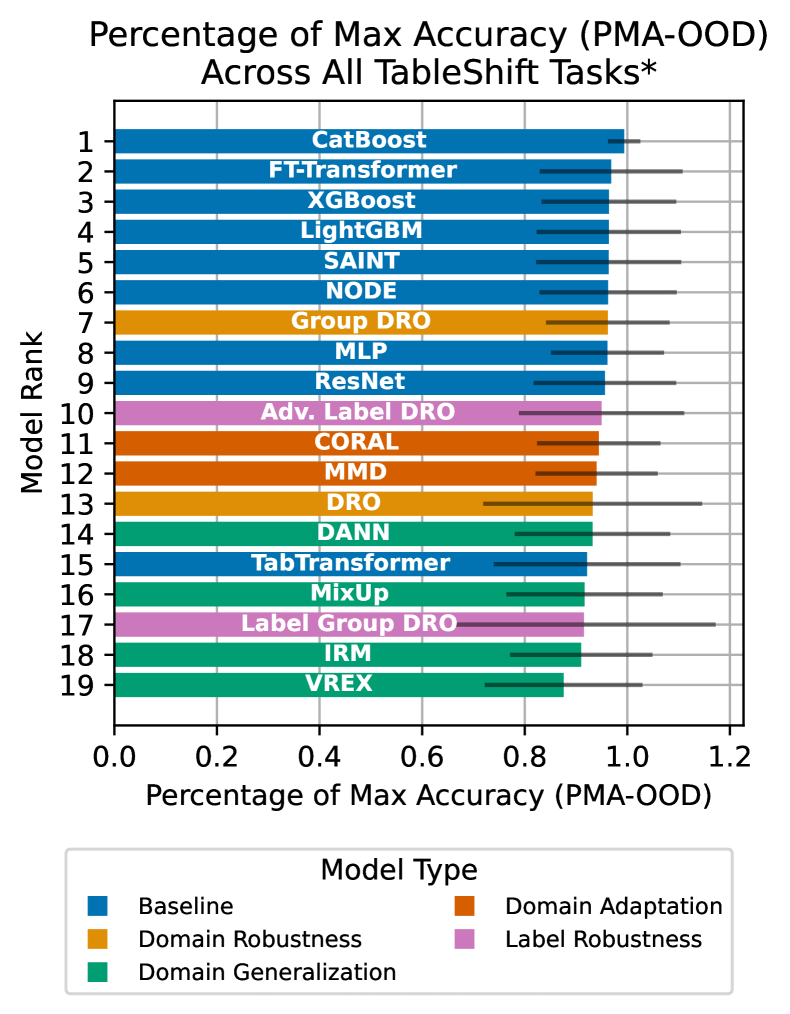
- A large-scale empirical study evaluates 19 model types, including tree-based models (XGBoost, LightGBM, CatBoost), neural networks (MLP, ResNet, TabTransformer, FT-Transformer), and robust learning methods (DRO, Group DRO, DANN, IRM, VReX, CORAL, MixUp).
- Hyperparameter tuning is performed using comprehensive grids, with a focus on ensuring fair comparison across methods by including full or extended hyperparameter ranges from original works.
- Performance is measured via ID and OOD accuracy, with statistical analysis to assess correlations between shift gaps and label distribution shifts.
Experimental results
Research questions
- RQ1Is there a consistent relationship between in-distribution (ID) and out-of-distribution (OOD) performance across diverse tabular tasks and models?
- RQ2To what extent do domain robustness methods (e.g., DRO, IRM, VReX) reduce the shift gap, and what is the trade-off with in-domain accuracy?
- RQ3How does the magnitude of label distribution shift correlate with the shift gap (difference between ID and OOD accuracy) across tasks?
- RQ4Do label shift robustness methods (e.g., Adversarial Label DRO) effectively mitigate performance degradation under label distribution shifts in tabular data?
- RQ5Can a shared, accessible benchmark improve reproducibility and comparability in future research on distribution shift in tabular machine learning?
Key findings
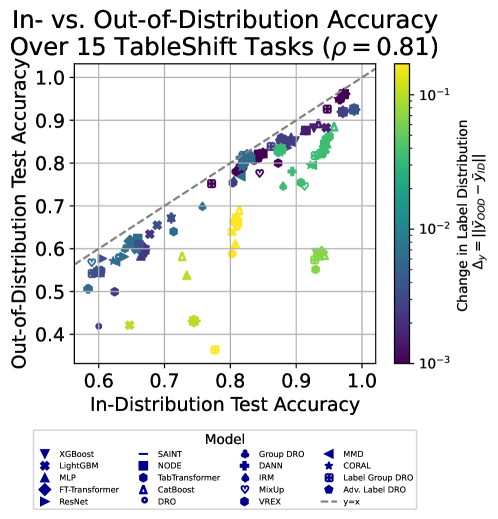
- A strong linear trend exists between in-distribution (ID) and out-of-distribution (OOD) accuracy across all 15 TableShift tasks and 19 model types, with a correlation coefficient of ρ = 0.81.
- The shift gap (difference between ID and OOD accuracy) is highly predictable and explained by 99% of the variance in OOD accuracy when considering both ID accuracy and label distribution shift (R² = 0.993).
- Domain robustness methods reduce the shift gap but consistently lead to a decrease in in-distribution accuracy, indicating a performance trade-off.
- No single model consistently outperforms baseline methods (e.g., XGBoost, LightGBM) across all tasks, indicating no clear winner in robustness under distribution shift.
- Label shift robustness methods, including Adversarial Label DRO, do not ameliorate the shift gap caused by label distribution shifts, suggesting limitations in current approaches for this type of shift.
- The benchmark reveals that shifts in label distribution are a primary driver of OOD performance degradation, underscoring the need for better modeling of label shift in tabular data.
Read this paper
Open the full text in the Nubint reader and ask about any passage as you read.
Read this paper on NubintThis review was generated by AI from the original paper. Please check the paper before citing it.