
[Paper Review] Beneath the Tip of the Iceberg: Current Challenges and New Directions in Sentiment Analysis Research
This paper challenges the misconception that sentiment analysis has reached saturation, arguing instead that the field is underexplored in critical areas like sarcasm detection, aspect-level sentiment analysis, multimodal understanding, and bias mitigation. It advocates for moving beyond simple classification to achieve deeper sentiment understanding through advanced NLP techniques and ethical AI practices.
Sentiment analysis as a field has come a long way since it was first introduced as a task nearly 20 years ago. It has widespread commercial applications in various domains like marketing, risk management, market research, and politics, to name a few. Given its saturation in specific subtasks -- such as sentiment polarity classification -- and datasets, there is an underlying perception that this field has reached its maturity. In this article, we discuss this perception by pointing out the shortcomings and under-explored, yet key aspects of this field that are necessary to attain true sentiment understanding. We analyze the significant leaps responsible for its current relevance. Further, we attempt to chart a possible course for this field that covers many overlooked and unanswered questions.
Motivation & Objective
- To challenge the widespread belief that sentiment analysis has reached maturity due to high performance on standard benchmarks.
- To highlight under-explored subtasks such as aspect-based sentiment analysis, sarcasm detection, and sentiment-aware dialogue generation.
- To address the issue of bias in sentiment analysis models, particularly gender bias in contextualized embeddings like BERT.
- To advocate for a shift from shallow text classification to deeper sentiment understanding through advanced NLP and multimodal approaches.
- To promote ethical research practices by identifying and mitigating bias in training data and model architectures.
Proposed method
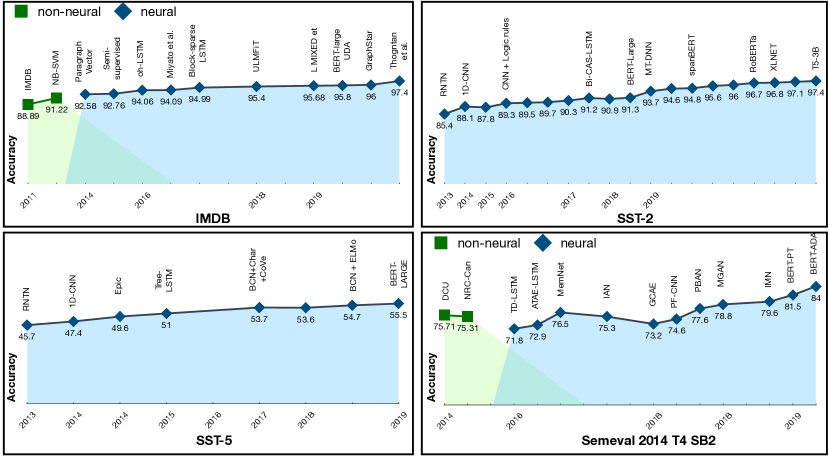
- Analyzes performance trends on major benchmark datasets (IMDB, SST-2, SST-5, SemEval) to demonstrate saturation in sentiment polarity classification.
- Reviews state-of-the-art transformer-based models (e.g., BERT, RoBERTa) and their limitations in achieving true sentiment understanding despite high accuracy.
- Proposes de-biasing techniques such as word substitution to generate counterfactual training instances and regularize model predictions.
- Introduces the concept of masking bias-indicating terms during training, though acknowledges the risk of semantic disruption.
- Reviews existing bias detection and mitigation methods, particularly for contextualized embeddings like BERT and ELMo.
- Calls for conscious research choices to include underrepresented languages and marginalized topics to ensure equity in NLP research.
Experimental results
Research questions
- RQ1Why is the perception of sentiment analysis saturation misleading despite high performance on standard benchmarks?
- RQ2What are the key under-explored subtasks in sentiment analysis that require deeper research attention?
- RQ3How can bias in sentiment analysis models—especially gender bias in contextualized word embeddings—be detected and mitigated?
- RQ4To what extent do modern transformer-based models achieve true sentiment understanding beyond surface-level classification?
- RQ5What ethical considerations should guide future sentiment analysis research, particularly regarding language diversity and representation?
Key findings
- Performance on standard sentiment classification benchmarks like IMDB and SST-2 has reached near-perfect scores, indicating saturation in simple polarity classification tasks.
- Despite high accuracy, state-of-the-art models like BERT and RoBERTa lack interpretability and fail to capture deeper sentiment dimensions such as motives, causes, and reasoning.
- Sarcasm and irony remain significant challenges due to their figurative and context-dependent nature, with few robust detection methods available.
- Gender bias in sentiment models is prevalent, especially in static embeddings, but remains under-investigated in contextualized models like BERT.
- De-biasing techniques such as counterfactual data augmentation and embedding space regularization show promise but are underdeveloped compared to bias detection.
- The NLP community’s overreliance on English corpora limits progress in multilingual and low-resource sentiment analysis, creating a research equity gap.

Read this paper
Open the full text in the Nubint reader and ask about any passage as you read.
Read this paper on NubintThis review was generated by AI from the original paper. Please check the paper before citing it.